Following up from my recent post, “VeddEr”, which had a few hidden meanings, aka “easter eggs”, I thought it would be fun to share an article that illustrates some hidden bits in more notable artworks.
I scoured the interwebs for a few hours and compiled a list of famous paintings that have cleverly inserted easter eggs which go beyond mere subjective interpretations. For example, there’s a lot of blah blah out there about the Mona Lisa, that her enigmatic smile has sparked countless interpretations, with some suggesting it conceals secrets or represents the duality of human nature. Barf! Who cares about that outside of a Philosophy class. I want stuff that’s hidden and hard to find, cleverly inserted to entertain or make a point. To that end, I give you the first unofficial list of notable paintings with clever easter eggs.
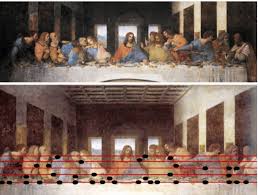
- The Last Supper by Leonardo da Vinci: In 2007, an Italian musician claimed to have found musical notes in the painting, creating 40-second musical composition. The notes are seen in the overlay in the photo below, whereby the notes are made up of the bread rolls and hands (both round things) of the attendees. Da Vinci was a musician himself, so there’s some further plausibility to this easter egg.
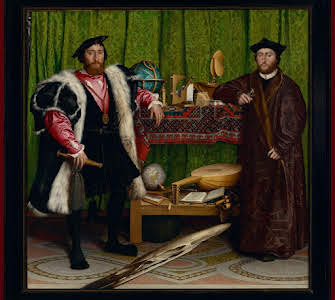
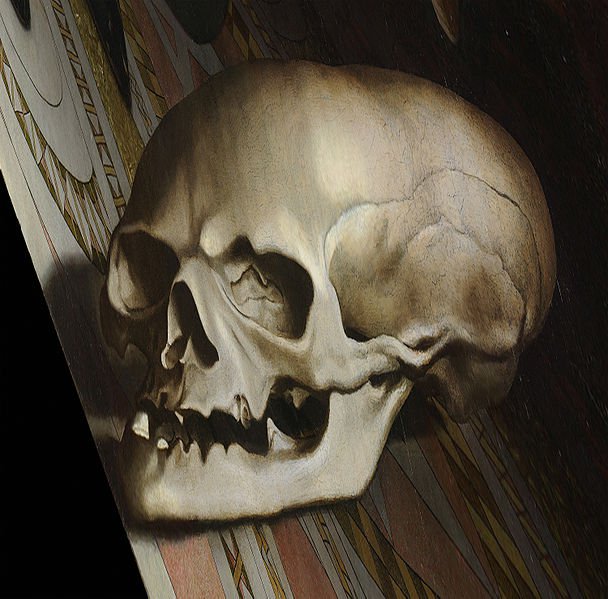
- The Ambassadors by Hans Holbein the Younger: A seemingly ordinary portrait reveals an anamorphic skull when viewed from a certain angle, perhaps symbolizing the inevitability of death… or just a sick sense of humor in an age when laughs were at a premium for many. From Tim Schneider, “The center-bottom of the work harbors what at first appears to be an abstract smear of black and yellowish-gray. When viewed at an oblique angle from the right side of the painting, the skewed shape “corrects” to reveal an imposing skull—possibly Holbein’s reminder that death lies in wait even when it can be temporarily hidden by youth, earthly riches, and influence.” Or maybe he just had a sick sense of humor or played too much D&D!
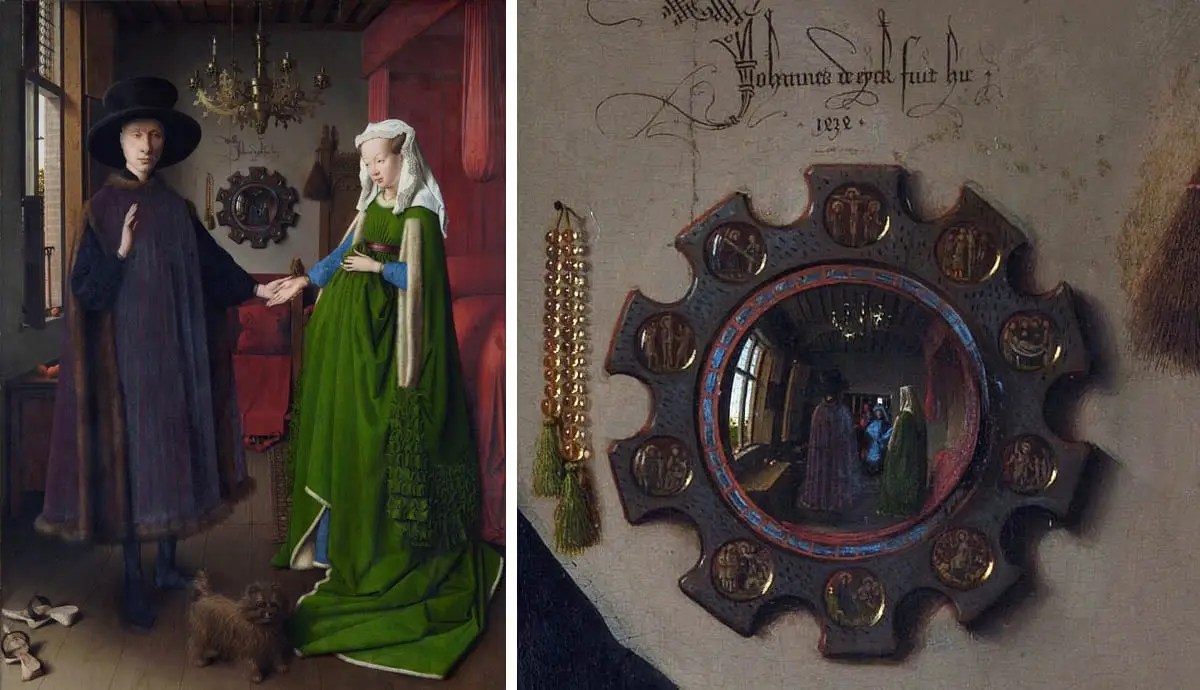
- The Arnolfini Portrait by Jan van Eyck: Look closely at the mirror in the background, and you’ll spot the reflection of the artist himself, adding a layer of self-awareness to this iconic piece. Not to mention it’s one hell of a detail to bake into the painting, especially when you consider the rudimentary materials of the day.
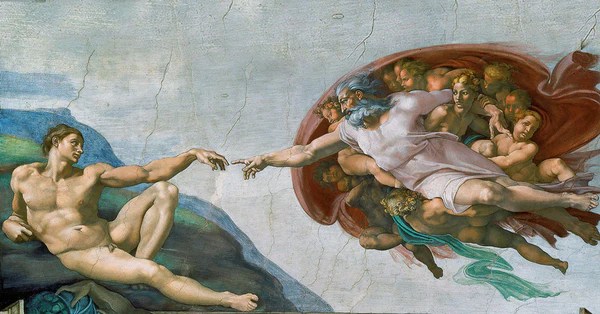
- The Creation of Adam by Michelangelo: Michelangelo was also an anatomist, apparently dissecting corpses to use as a basis for creating anatomical sketches. Point is he knew his anatomy, so in this piece in the Sistine Chapel, hidden within the robes of the figure of God and his gaggle of friends, one can see the shape is actually that of a brain, including the brain stem. That’s not an accident people! Some say this was his his way of poking at the church’s lack of respect for science.
- Portrait of Bill Clinton by Nelson Shanks: In 2006, former U.S President Bill Clinton unveiled a portrait painted by John Nelson Shanks. The former President is depicted standing beside a mantel in the Oval Office. There doesn’t seem to be much out of whack here, but the artist admitted that he used a clever easter egg to hint at the infamous Lewinsky affair. According to Shanks – the actual artist – he subtly incorporated a shadow of a dress into the painting, assuredly the infamous blue dress of Monica Lewinsky that was the ultimate smoking gun.

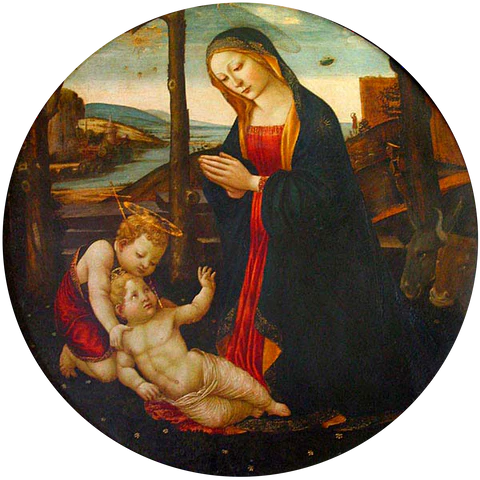
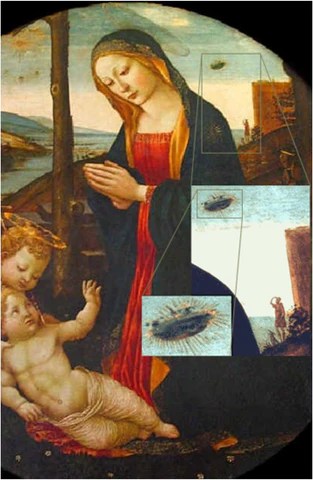
- The Madonna with Saint Giovannino by Domenico Ghirlandaio: This is perhaps my favorite because it incorporates UFOs way back in the day. Italian Renaissance painter Domenico Ghirlandaio painted The Madonna with Saint Giovannino in the 15th century, it incorporated a hidden gem from another world perhaps. The work portrays the Madonna with Jesus, a relatively unassuming piece typical of that time. However, upon closer inspection, it clearly has a UFO in the background! The UFO can be seen near Mary’s left shoulder, and while it looks less than aerodynamic, it has a lot of intentional details, and furthermore there is a guy on the ledge below it clearly staring at it, holding his hand up to shield the bright sun. So cool!
 Art Bern