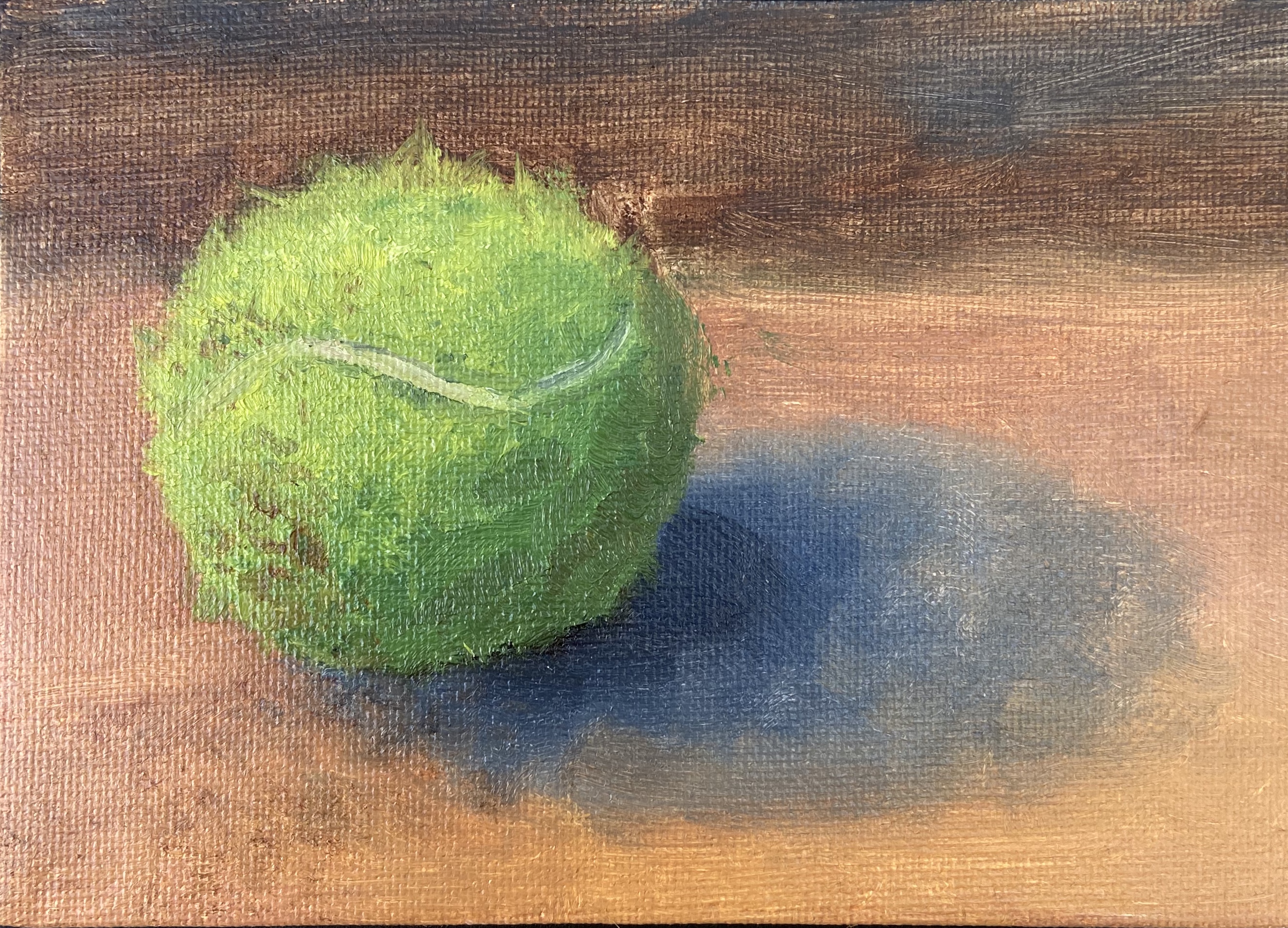
Ball! Ball! Ball! Ball!

Oil on Paper | 6” x 8”

If you’ve been reading my blog for the past year, you’ll recall the familiar look of this battered tennis ball in the Ball! Ball! Ball! composition. This was done on paper, while the original was on canvass board. I definitely prefer the teeth of the canvass board because it allows for a more textured look, lending to more realism in terms of teasing out the hairs of a well used tennis ball. 

Ball! Ball! Ball! Ball!

The palette was simple, but I never got the clay court orange just right. I’ll have to experiment before doing it again on a larger scale. The green of the ball itself is a base of Permanent Green Light, straight out of the tube, with variations of Cadmium Yellow Light and a touch of red. The shadow side of the ball is more traditional green from Ultramarine Blue and Cadmium Yellow Deep. 

Lastly, a comment on fine details. This ball doesn’t look like a tennis ball until the final white seam is added. It’s amazing how a very simple object such as this ball doesn’t come into focus until the one identifying element has been added. Without the seam, they’re all just yellow green fuzzy balls. 

Ball! Ball! Ball!

Oil on canvass panel, 6″x4″
My dogs are a big part of my life, which means I live to serve their needs, in large part because I love them and, well, they don’t have thumbs. My oldest dog, Zip, is a 7 year old Aussie Catahoula rescue mutt from Austin Pets Alive!. Her world revolves around two things – food and “ball”. To that end, I serve as her chef and throwing machine.
The lifespan of a Zip tennis ball is a couple weeks. She chews on them while bringing the ball back for another throw, as if they’ve offended her and need to be destroyed. It’s the epitome of a love hate relationship.
This piece is a tennis ball after 1 throwing session. The fuzz and color have been adequately altered, making what had been a boring, new green smooth tennis ball into something with depth and intrigue. Thank you Zip!
I like to do these small dog toy pieces on a canvass board to help with texture. In this piece, it was very helpful with the need to pull out strands of tennis ball fuzz because the rough surface helped scatter the stringy look in a random pattern, thus making it look more natural. The hardest part was getting the dirt just right, which took some experimentation with Burnt Sienna, Raw Umber, and various puddles of orange.
Finally, I was pleasantly surprised how effective the white line of the tennis ball added realism. It was also important to put a small hint of shadow along the edge of the white line to give just enough depth on the surface of all that green fuzz.
Tennis Ball - Oil Panel 2