KERBEY LANE CENTRAL | 9 x 12” | Oil on canvas board
KERBEY LANE CENTRAL is a nod to the iconic venue that hosted my most recent solo show. I had the privilege to hang 30+ pieces at Kerbey Lane on Kerbey Lane, which has been a destination for diner lovers across the country for decades. In fact, when I first moved to Austin more than 30 years ago, I lived on Kerbey Lane just 3 blocks down from the restaurant. Many a hangover was remedied by their coffee, pancakes and queso.
Back in the day, the Kerbey Lane sign was a 3D coffee cup – today it’s still a cofffee cup but just flat and a little less intriguing. I’m not sure what happened to the original sign, but I found an old photo as a reference to recreate it as the focal point in this piece.
I used a palette knife to do the sign, adding texture and more detail, whereas the rest of the painting is brushwork. For those of you who haven’t had the fortune to visit this location, it’s inside an old house, actually two houses that are connected. The other businesses along this street are also converted homes, so that’s why the backdrop looks like a neighborhood… cuz it is.
For the compositional geeks out there, I used the angles of the metal sign post, the walkway, and the roof lines to direct the viewer to the focal point. While the slightly aerial viewing angle is clearly not something you’d get standing in front of the restaurant, it was infinitely more interesting than anything I managed to come up with at street level.
Thanks again Kerbey Lane for hosting me and my wide ranging artistic subjects! I look forward to another show in the near future.
What makes something iconic? “Widely recognized and well-established” is the Merriam-Webster technical definition. For me, it’s something that is instantly recognizable and evokes a sense of place, which means that one person’s “iconic” is another person’s “what the…?”
As an artist, creating an artwork based on an iconic place can be a tall order, something that the voice in your head quips “you better get this right”. There’s also a category of artists, the ones with more ego than talent or sense, who consider many subjects beneath them and not worth the flex of their brush. For these nimrods, the most egregious waste of their precious time is painting something iconic, cataloging the entirety of these subjects as passé, predictable and pedestrian.
What the aforementioned dolts don’t seem to understand is that most people gravitate to artwork that’s relatable, and there’s no better way to make something relatable than to make it recognizable! When it comes to leveraging the power of an iconic subject for a painting, I think its important to “get it right”, whatever that really means, but also put it in a setting or context that grabs the viewer’s attention. One way to pull this off is to present the icon in the evening, known as a “nocturne” in fancy art vernacular, whereby the setting is atypical yet still recognizable.
ONE NIGHT ONLY is, hopefully, instantly recognizable by any resident, past or present, of Austin, Texas. The Paramount Theater, and arguably to a lesser degree, the State Theater, epitomize the Old Guard that is downtown Austin. The Austin skyline has transformed over the past 15 years at an insane pace, but it’s hard to wax nostalgia over skyscrapers, in large part because, in my humble opinion, none are iconic, with two possible exceptions. First is the State Capitol, the original skyscraper of Austin, which held the crown of the tallest building in Austin for more than 70 years! Second, the Frost Tower Building (full disclosure, it’ one of, if not my wife’s favorite downtown building), which while it held the crown for a meager 4 years (2004 – 2008), was such a beautiful piece of architecture, residents readily recognized it in pictures and movies… by name! In other words, it was iconic.
Finally, there are a few technical details you might find of interest, and perhaps elicit some additional joy from the painting. Or not.
First, there was a lot of simplification, which was driven by equal parts fear and intent. As chance would have it, the very basic, loose structure of the dark buildings in the background turned out to be a happy accident. Initially, these were a simple dark value block-in that were necessary to contrast the very bright elements of the signs. I never bothered to go back and refine this area, frankly forgot about it, and then realized it did a fantastic job of directing viewers to the focal points. The second bit of artistic license was the exclusion of pretty much all of the Paramount building details. This is the fear factor, whereby I didn’t want to tank the composition with the distraction of what would have certainly been mediocre windows and brick detail. The cast shadows on the roof paired with the glowing orange wall is meant to anchor the right side of the work, which would have been difficult to do with architectural details.
As you can tell from the progression gallery below, the lettering of the signs was done by hand, no stencil and it evolved quite a bit over painting sessions. I practiced the lettering on separate paper canvas, experimenting with different brush shapes and sizes, as well as variations in paint load.
Regarding the Paramount marquis, the ultimate focal point of the work, it has virtually no paint! I washed the underpainting off of that area early on, and like the simplified background buildings, I never went back to it until the very end, and that was only to add “ONE NIGHT ONLY” lettering.
Lastly, note the lack of people on the street. This was intentional, but I struggled with the decision. I like adding people to urban scenes like this, in large part because they add interest, motion, and a sense of place. However, without them, the scene has that feel of a theater that has a full house and nobody is lingering outside. Hopefully that intent translates to you, too.
ONE NIGHT ONLY will be making its public debut this week at my solo show at Kerbey Lane Cafe (Westlake), “Paintings and Pancakes”. Come by and check out the 25+ pieces of artwork while enjoying the sweet nectar of pancakes and syrup!
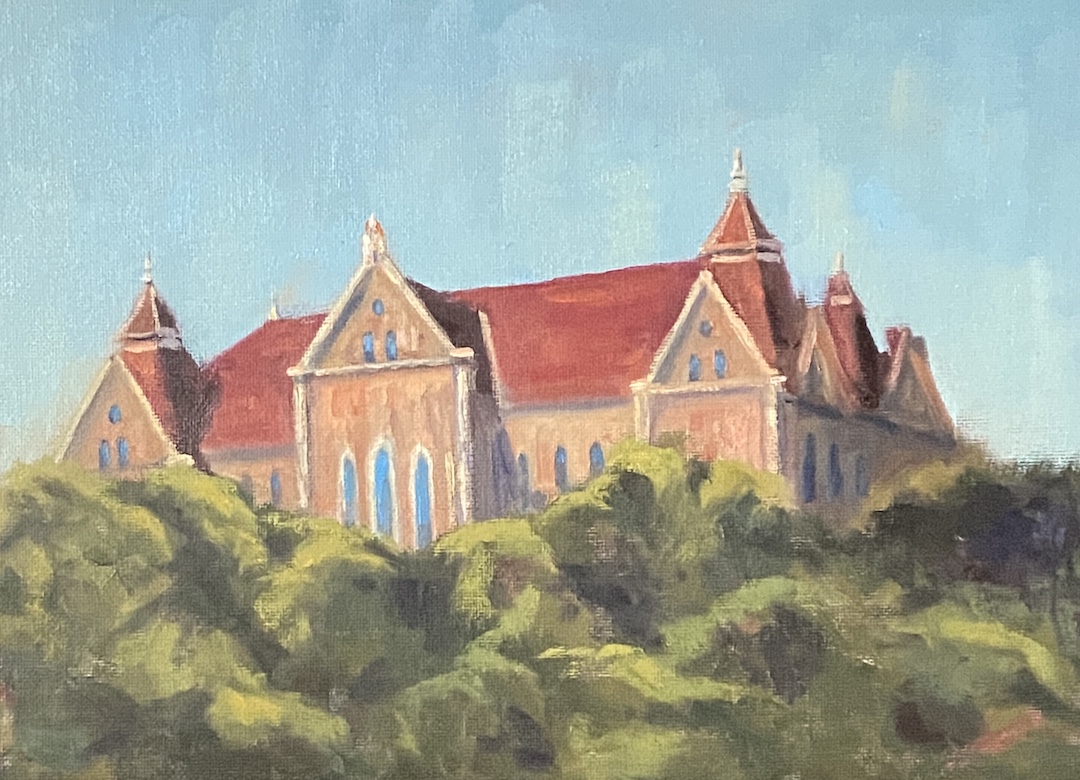
OLD MAIN – TEXAS STATE | 9 x 12” | Oil on Canvas Board
I’m a fan of wandering university campuses, both in the US and abroad, in large part because they’re often home to intriguing architecture, beautiful grounds, and chock full of history. Some do it better than others. For example, the University of Texas is by many measures a great school, but let’s be honest, people don’t go there for campus aesthetics. Alternatively, wander onto the stunning grounds of the University of Colorado and you may never leave.
However, there are also a long list of wonderful colleges and universities – no, I don’t know the difference -hidden between neighborhoods and history, more notable for their pride than their size, and arguably constitute the backbone of “usable” degrees. While I’ve never spent a day as a student at Texas State University, I can say with assurity that the San Marcos campus has enough beautiful open space and intriguing buildings to make for a nice afternoon wander.
In this piece I wanted to capture the university using an iconic building… say hello to OLD MAIN at Texas State. I assume this is one of, if not the site of the original building on campus, which is a beautiful piece of architecture. I used a reference photo from the University website, but it was pretty flat in terms of lighting, yet the perspective of the composition was excellent. I opted to “wing it” with the lighting, incorporating strong sunlight that lit up the facade and cast dark shadows downstream.
Ideally this piece finds a home with a Texas State alumni, but failing that it would be well suited for a fan of architecture. I’ve been pushing my painting style to be more impressionistic, but I had to tamp that back a little with OLD MAIN so as to include the necessary details of this beautiful building.
OLD MAIN will be added to the “Something for Everyone” show at Kerbey Lane Cafe in San Marcos. Drop by for a beer, some pancakes and art!
More European inspiration, this time from a little city called Cuenca, Spain, which is located about 100 miles east of Madrid. Cuenca is magnificent and thankfully not on the itinerary of the selfie-taking, speaker phone talking, culturally ignorant hordes. This city is in the mountains, founded by the Moors (like most everything in central Spain), and best known for their hanging houses, called “casas colgadas”. In my view, they’re the original “room with a view” architecture, and it’s frankly amazing they’re still clinging to the cliffs.
We were visiting in late May and did a lot of strolling as we explored the old town. This particular scene is from the Plaza Mayor, looking north towards the Cathedral of Santa Maria and San Julian of Cuenca. Even during this morning hour, there was a lot of activity and the city had a sense of energy and vitality, which I’ve tried to capture with this piece.
Initially, the intent was to do a quick study in preparation for a larger piece. While I still intend to do a larger, more composed painting, I kept getting sucked into the details of CUENCA. There are two focal points – I know, I know, that’s not how the rules work – but I’ve developed the opinion that multi-focal point perspective in a composition can work really well. In this case, focal point 1 is the Cathedral, which anchors the background as it captures the morning light before the rest of the buildings. Focal point 2 is the guy in the foreground walking right at you, also touched by the light, contrasted by the shaded patio immediately behind.
Lastly, there are various bits of sky blue incorporated through the piece. It’s an experiment to see if it gives the viewer the sense of having a relatively blue sky overhead, adding to the depth of the painting. Not sure if it works because I was actually in Cuenca to take this photo, therefore I always have that sense of a sky overhead when I think about this scene.
If you haven’t been to Cuenca, Spain… go! The setting, sights, food and people are wonderful.
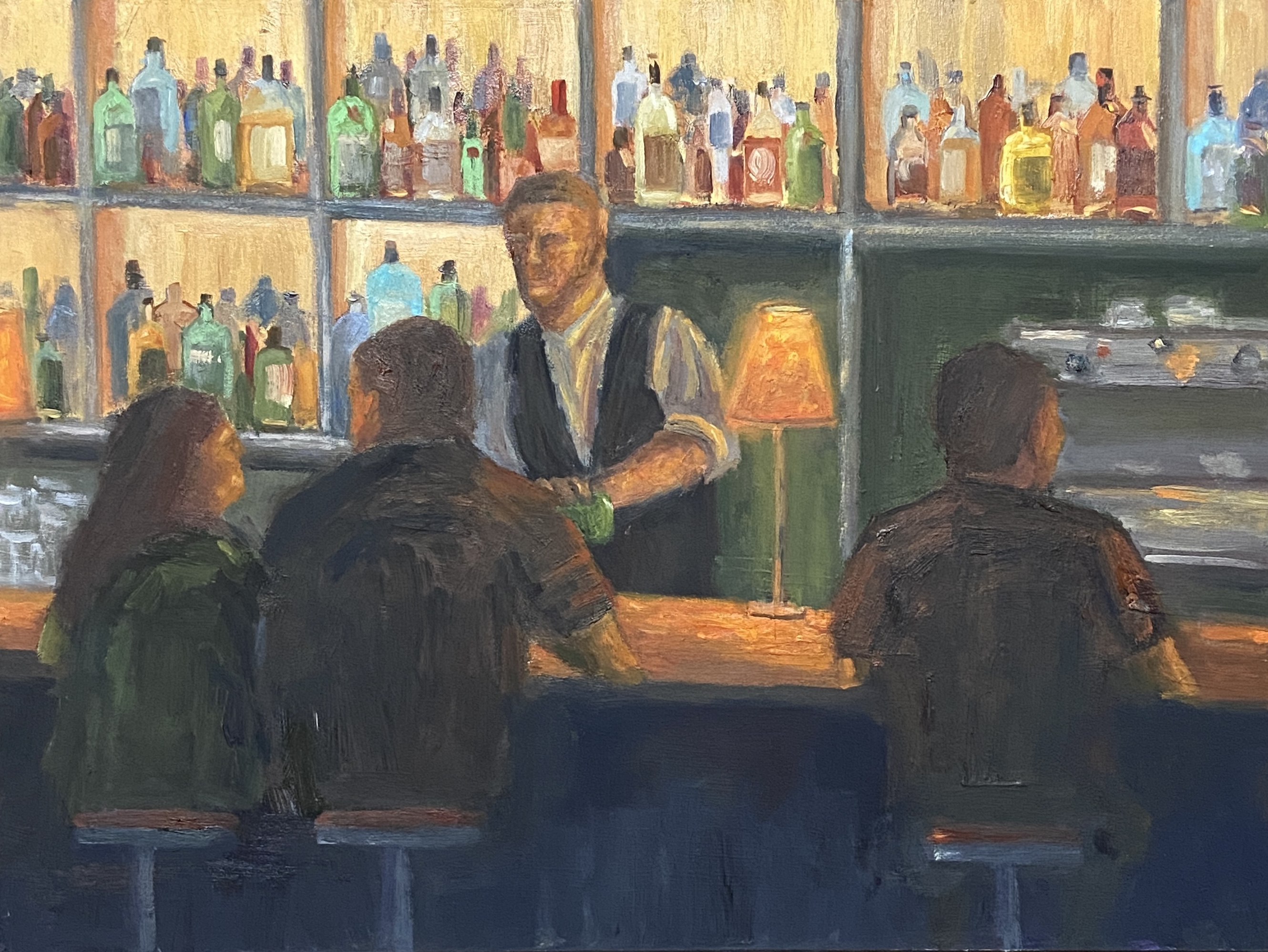
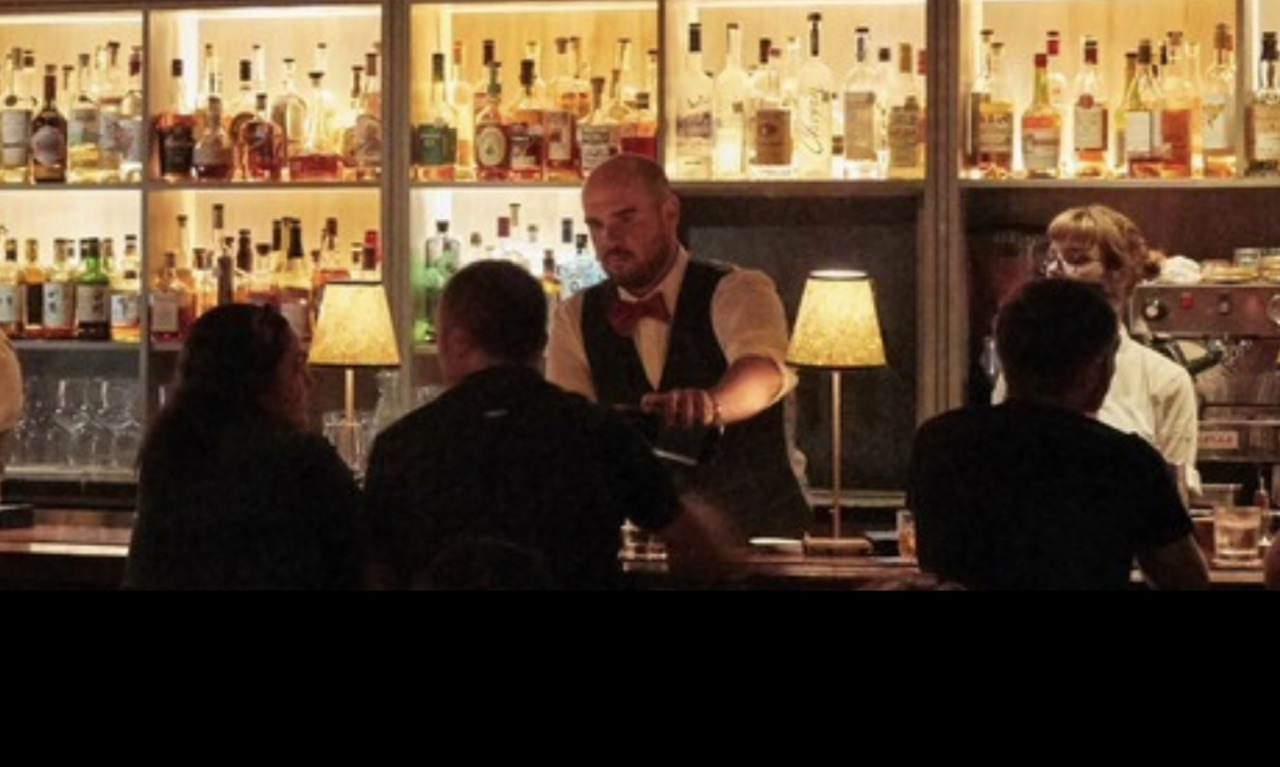
Oftentimes I use my own photos as inspiration for my paintings, but I also use pics from people I don’t know. This is something I believe most painters do, typically for a couple of possible reasons. First, I paint, I’m no photographer, so my photos are, well, not very good. Some things even an iPhone can’t fix. So I might use my own photo as the main reference, but find other options online of the same area to enhance the view. The other main reason for using a reference shot from someone else, be it an individual, magazine, etc., is because it’s something or some place I’ve never seen or been to personally. It’s this latter reason that applies to this new piece, LAMP GLOW.
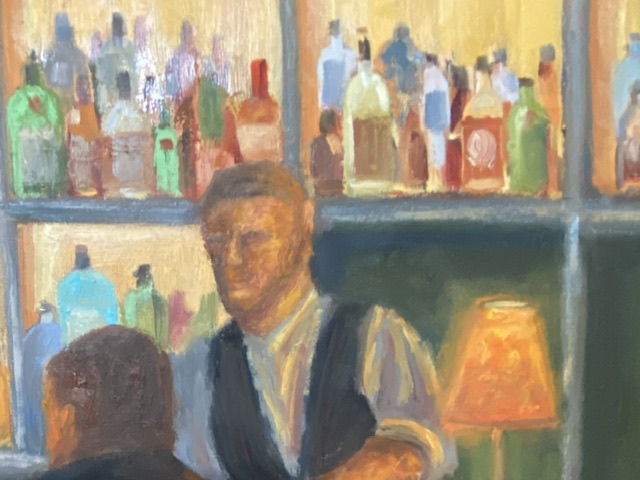
I spent a lot of time on the canvas with this one, which was expected given my lack of experience painting people in detail. In fact, I must have wiped the face of the bartender no less than 6 times, and reshaped the bar patrons many times as well. Ultimately, I’m happy with the result and I learned a lot in terms of technique and what NOT to do.
Lamp Glow Detail
The focal point of LAMP GLOW is the glow from the lamp on the bar, not the lamp itself. Because the glow is a soft light with a mid-range value, it was a little tricky to make it work. Usually, the focal point of a composition is highlighted by things such as high contrast values or sharp edges. Lacking these options I pushed the saturation and ensured the soft, orange light bathed the primary elements in the painting, which (hopefully) makes the glowing lamp a clear focal point given it emanates throughout the scene.
In terms of design decisions, I’m not sure I took the right approach regarding the liquor bottles in the background. While they turned out nicely, I think they’re ultimately a distraction and might be more effective if they were softer and less saturated. Oh, and painting 67 individual bottles is a wee bit tedious.