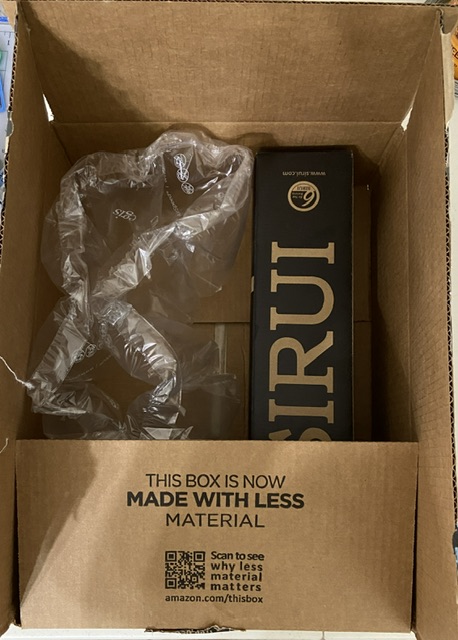
I ordered a new tripod for my New Wave u.go plein air pochade box from Amazon this week. More on the tripod in a minute, but first I had to share the shipping fail, which made me laugh. Do you see it in the image below? Note Amazon marketing hard at work touting their environmental credentials, extolling their green leadership with “This box is now made with less material”, all the while shipping a 3”x3”x18” product in a box that’s easily 4x larger than necessary. Seriously, Amazon? FAIL!
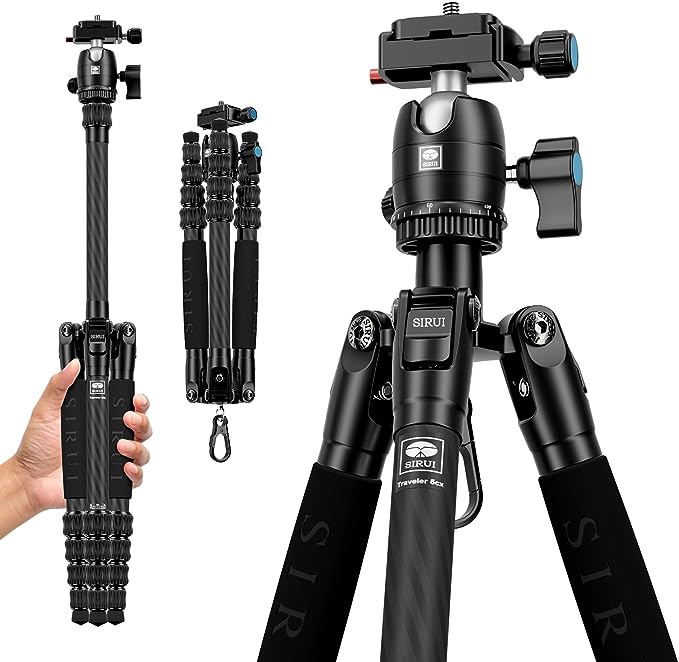
Despite the dim witted packaging, the Sirui tripod looks good and could prove to be a major update to my plein air setup. Sirui has a wide range of tripods, but I needed something that was sturdy, portable and lightweight, so I went with the Sirui Carbon Fiber Travel Tripod. I have yet to use it in the field, but the setup in the studio was surprisingly quick and easy. The horizontal and vertical swivel heads are liquid smooth and easy to lock, the legs invert to fold up around the neck of the tripod so it compacts to 13”, and there’s an actual clip for hanging a weight bag (or backpack) in the center for further stability. This isn’t advertised as a painter’s tripod, but it should be!
Stay tuned for an update on the Sirui field test later this week!
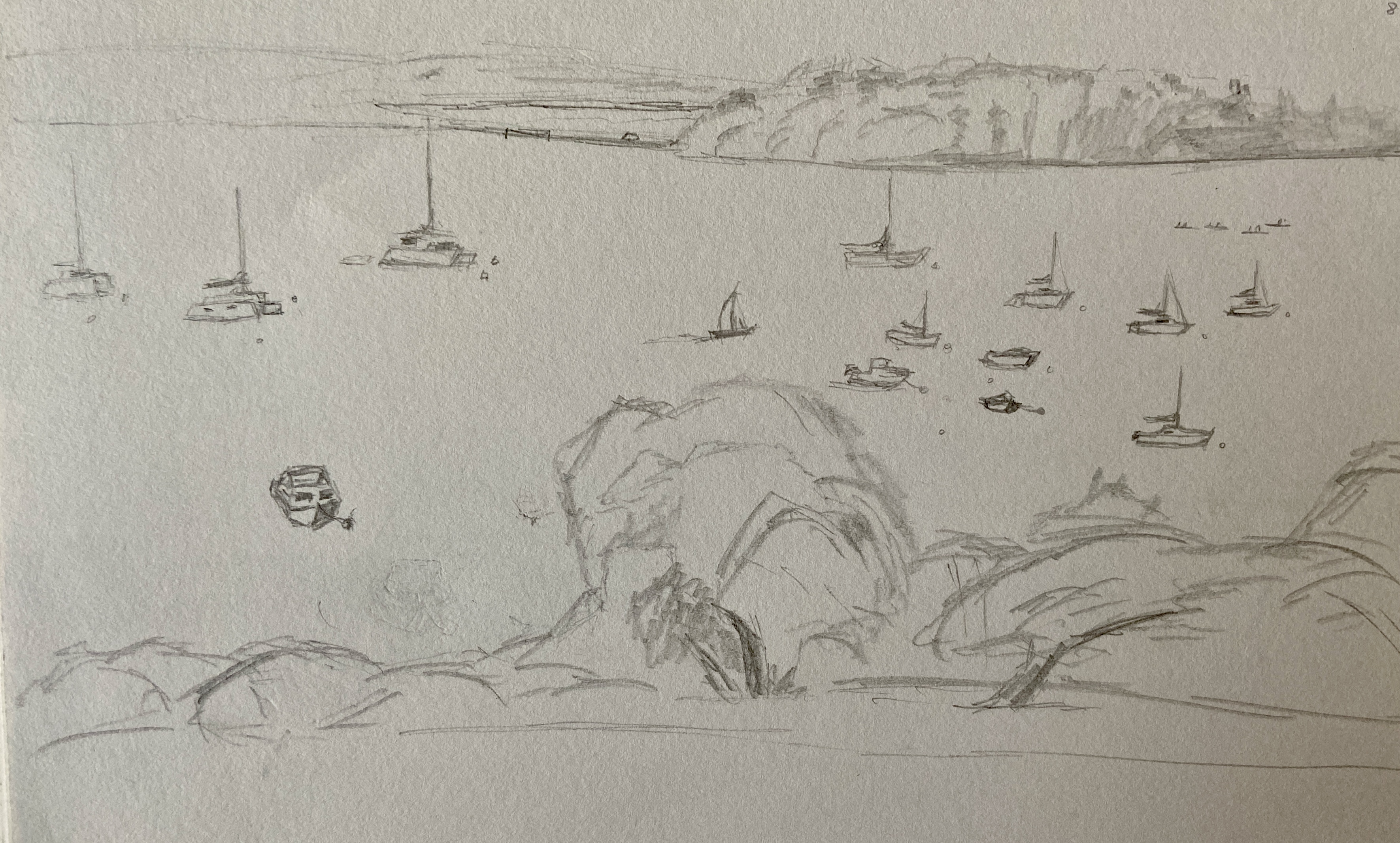
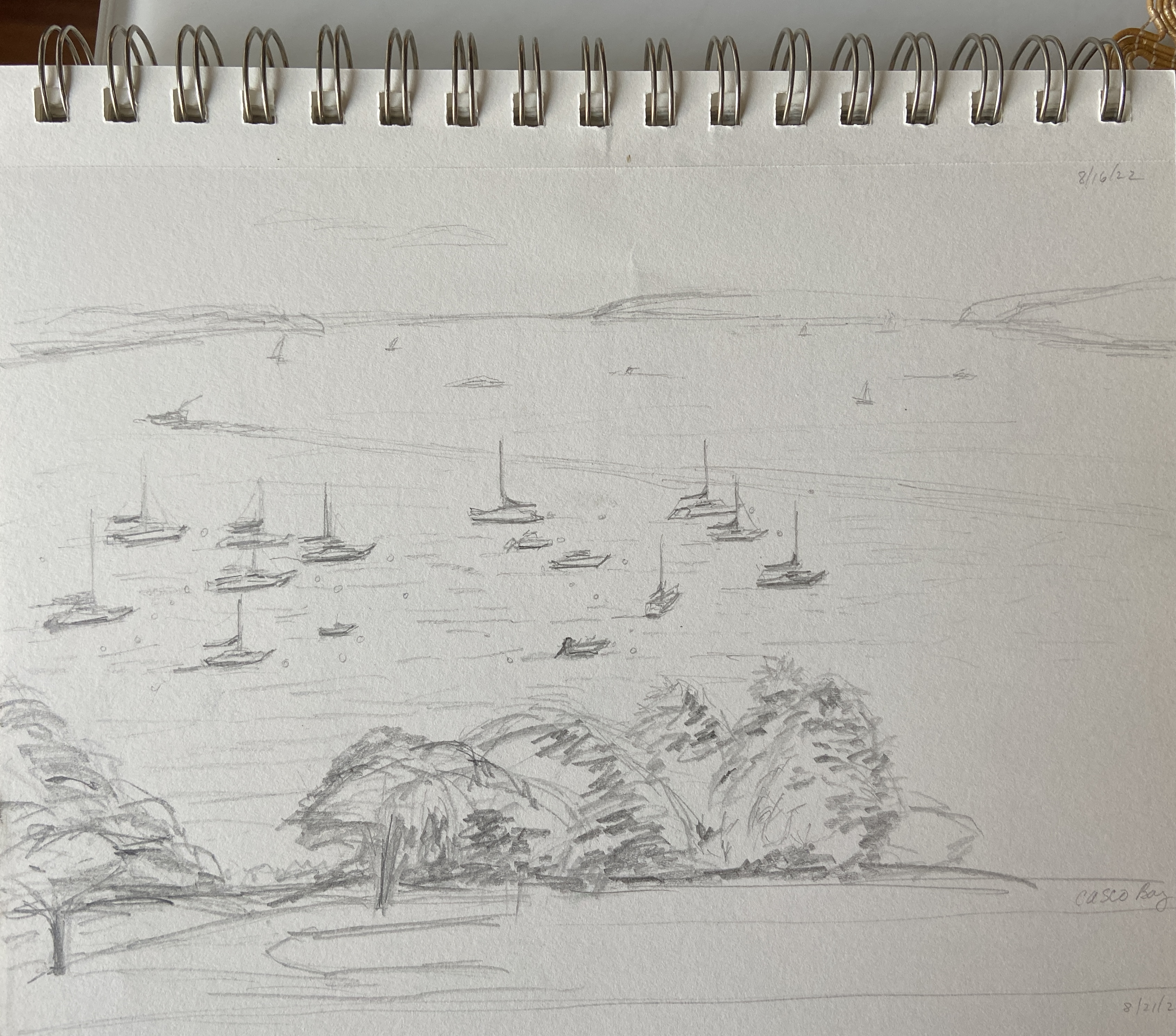
SPRING POINT BOATS is a work in progress from a gorgeous day on a pier overlooking a marina adjacent to Spring Point Ledge Lighthouse. This initial session was about 2.5 hours, half of which was spent establishing the composition structure and a practice sketch to verify the arrangement of the boats. Note that boats move, even when they’re tightly anchored in the marina, so photos of each boat in the desired position are essential to finishing a seascape like this in the studio.
The temperature was perfection in the shade, my wife was with me enjoying the outdoors and providing very helpful compositional tips, and there was a family of Ospreys on the other side of the marina (right behind us) that are the talk of the town… amongst bird people at least. I’ll admit they are interesting to watch, as the parent (not sure which one, I’m not up to speed on Osprey gender identification) was busy dropping off fresh caught fish for the two babies. At some point, one of the bird watchers rounded the corner of the pier where I was painting, said “hi”, and I was convinced she was about to ask to see what I was working on, only to then question “why aren’t you painting the Ospreys?” Of course I told her I hate birds, was dismayed at the tankards of shit they spray all over town, and that their screeching was something of nightmares.
Of course that was with my inside voice. My public self, using my actual voice, told her instead that the Ospreys were entertaining but difficult to paint, an answer she seemed to deem acceptable – perhaps she hadn’t considered the complexity of painting moving birds in a nest of twigs atop a 75’ pole in the middle of the bay. She giggled and shuffled away, apparently never having noticed I was painting. Perhaps some grumpy plein air painters – you know who you are – scared her off in the past and she’s afraid to ask. I digress…
As to this painting, I had already decided this was going to be a 50/50 job, namely half outside, half in studio. The goal was to lay down a solid structure and really balance the massive blue expanse of the sky and sea with the focal points of the boats. The lighthouse should give perspective and some added interest to the piece, but the intent to so give the sense of place sitting on the water watching the day go by. For me, this is still very difficult because virtually all sailboats are dominated by white, either the sails or the top deck, so the brush strokes have to be very intentional and the values need to shift much stronger than what I see “live”, at least that’s how I think it should be done.
Stay tuned for the completed work, which I’ll keep very loose and painterly in an attempt to put the viewer outside with the boats.
This is a follow-up from the Gaggle of Geese post a few weeks ago. The finishing “touches” for the studio ended up being a little more like finish “construction”, but I finally got to a point that seemed good enough.
Let me admit, I don’t like this composition, but I really like parts. Others might see something more appealing, as art tends to work that way, but it seems artists trying to sell works tend to force themselves into liking everything they paint. To the uninitiated, know that they’re lying. There’s not an artist out there who likes even most of their final pieces. At the end of the day, our compositions tend to have really cool elements that we love, and various faults that distract us to no end.
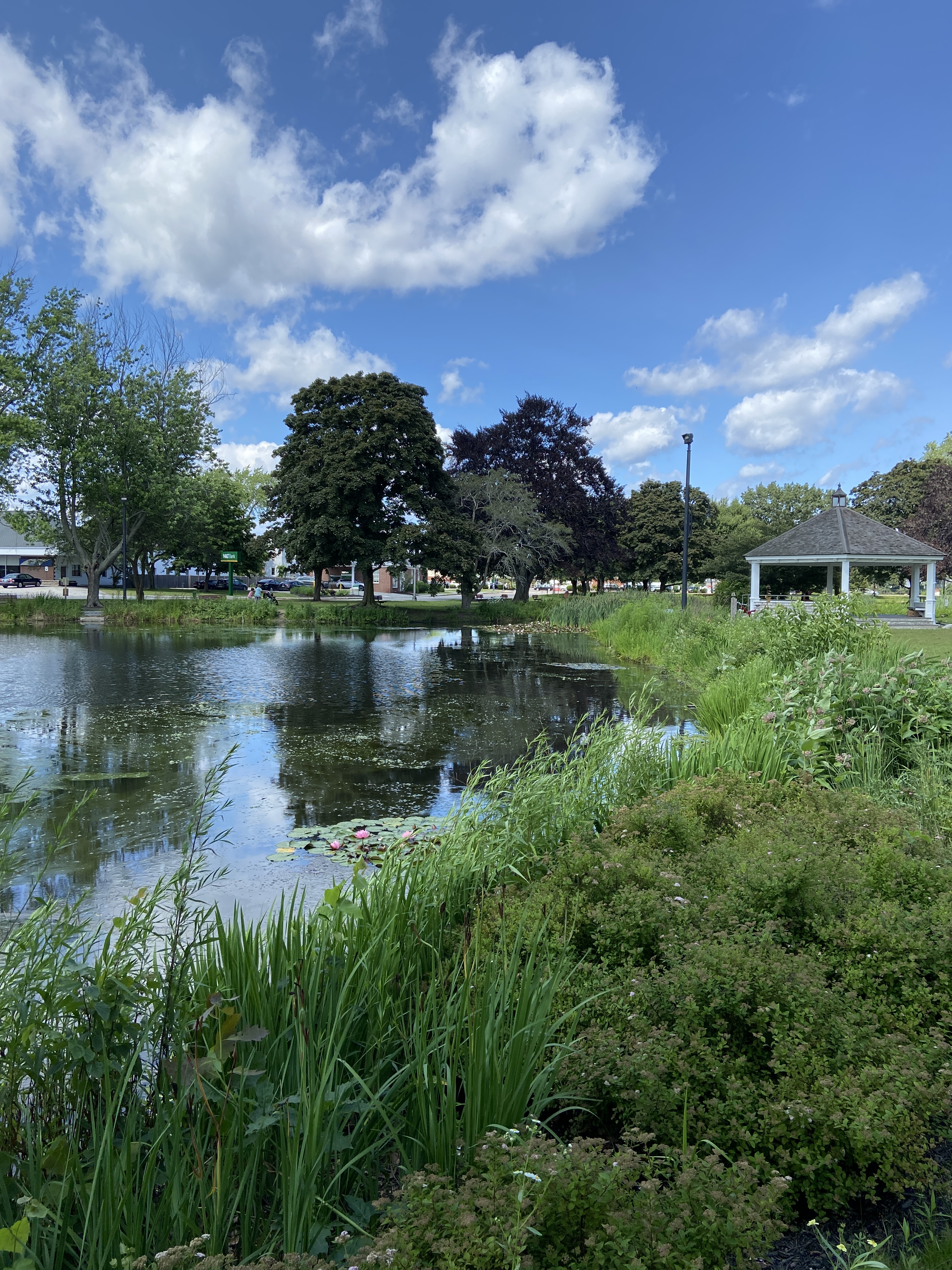
MILL CREEK POND was a joy to paint. If you’ve read the previous post and seen the video of the geese, you understand why. In terms of the studio work, I was really focused on simplifying the trees. Apparently I ignored a few basic compositional tenets along the way and ended up with two trees perfectly aligned left and right, meeting in the middle of the canvas. So annoying, but that’s what happens if you don’t step back frequently at the beginning and take the time to ensure the layout works.
Regardless of the “amateur hour” compositional oversights, I had a lot of fun learning how to simplify the masses of the trees, especially the purple oak. Living in Texas, there are no purple oaks, and everything that’s green has a coating of yellow cedar pollen, so things skew very warm. Painting a very dark purple oak tree with huge leaves that gather in numerous masses is, well, an awkward endeavor and hard to create on the first go. Ultimately I gave up, said it’s good enough, and pivoted to the warmth of the setting sun on the trunks, grass, and lily pads.
Hope you enjoy the final product regardless of my self-critique. It worked out in the end… kinda. Thanks for reading!
In an effort to up my “en plein air” game, I’m going to do a few sessions this summer focused on simplification. The plan is to either find scenes that are lacking details and complexity, or zoom in on the focal area of a detailed scene and cut out the noise in an effort to simplify.
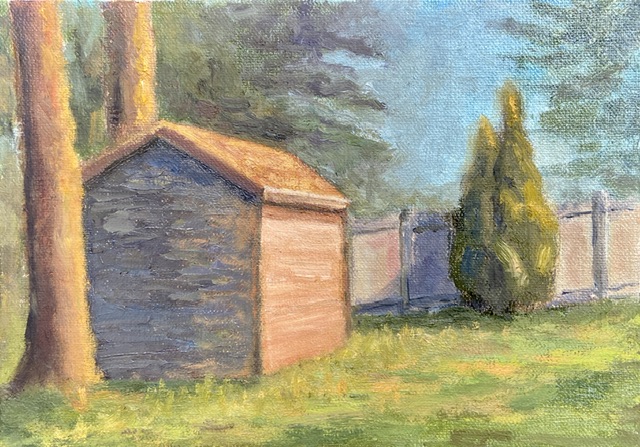
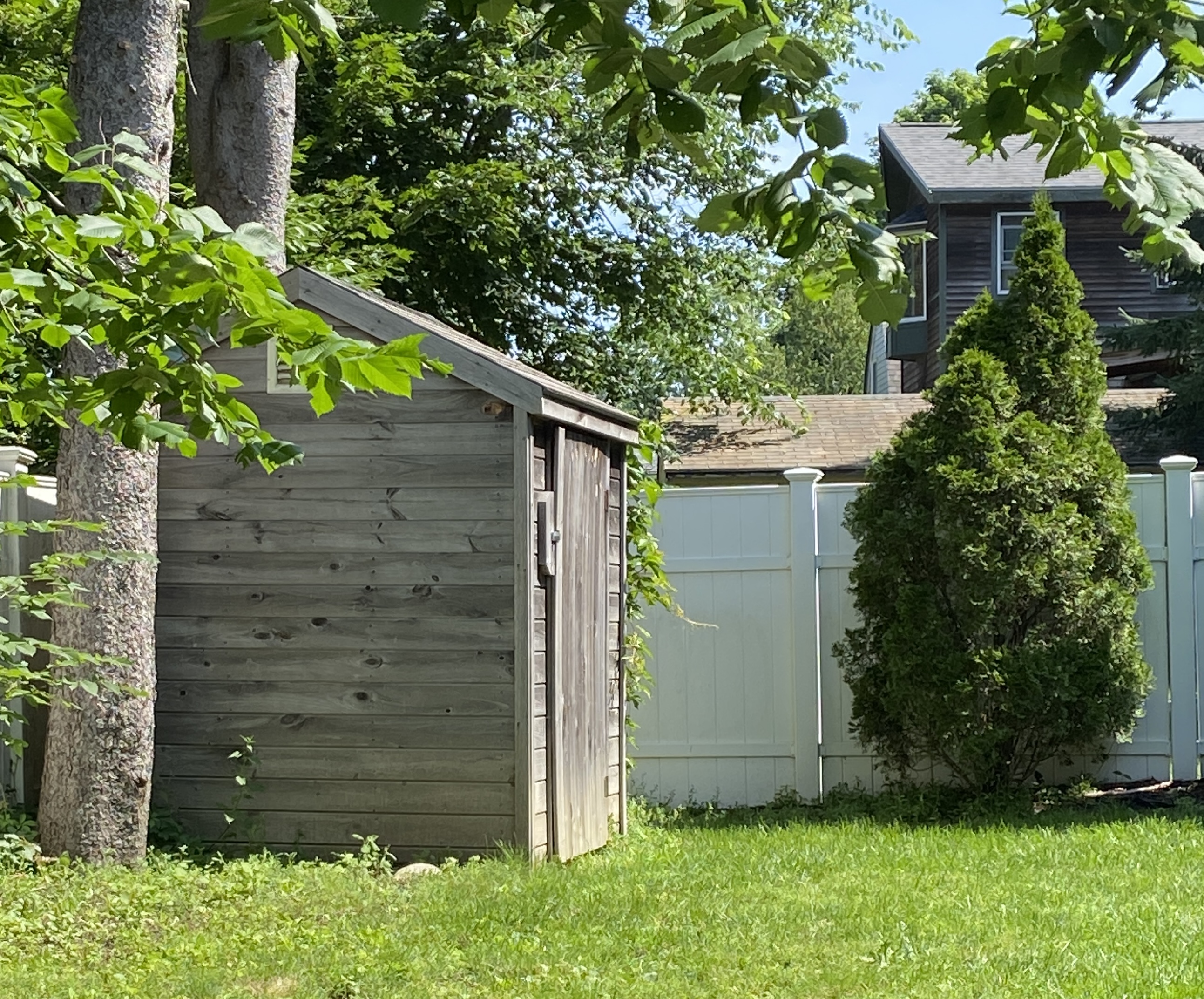
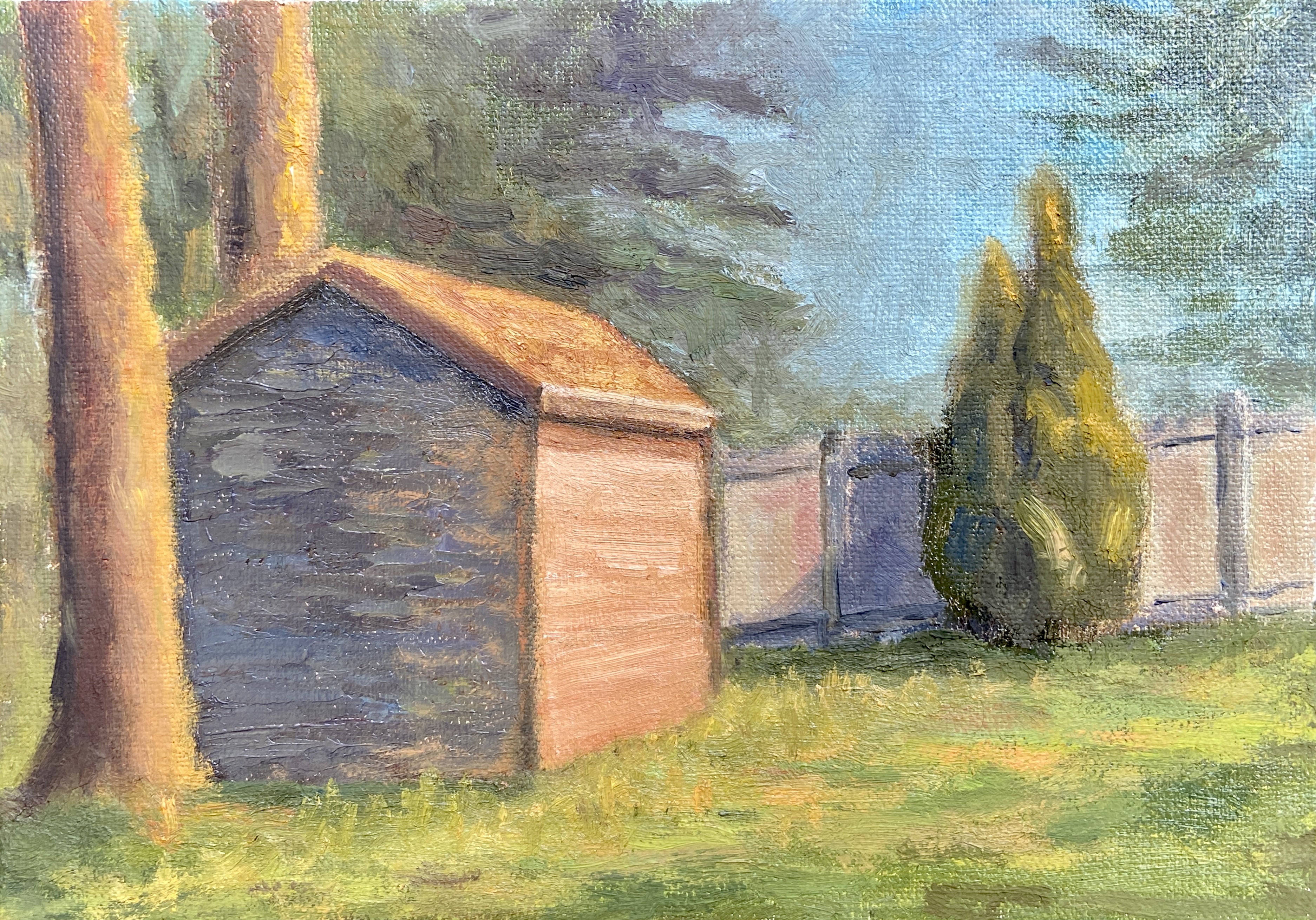
The Preble Shed is an example of the former approach, namely it ain’t complicated… it’s a shed. However, I spent a lot of time also streamlining the background, almost ignoring what trees were actually in the background. I also made a point to blend, perhaps even muddle, the tree edges into the sky. I think it worked pretty well and added atmospheric perspective, something that has eluded many of my previous efforts. Progress!
Not surprisingly, the shed itself was the real challenge. It has a thick coating of paint because there were a number of re-dos as I struggled to find a good light and dark color pairing. I noticed that so many professional artists who do sun-drenched urban landscapes tend to focus on white or very light yellow, using a contrasting blue-purple for the shadowed sides of the structure, which works really well, but honestly strikes me as a little boring. My goal with the shed was to use some hues that could be incorporated into other elements of the landscape – namely the flanking tree in the foreground, the fence in the background, and the sunlit grasses. I went with orange, about the 50th attempt, and can’t tell if I stopped there because I was satisfied or just worn out trying.
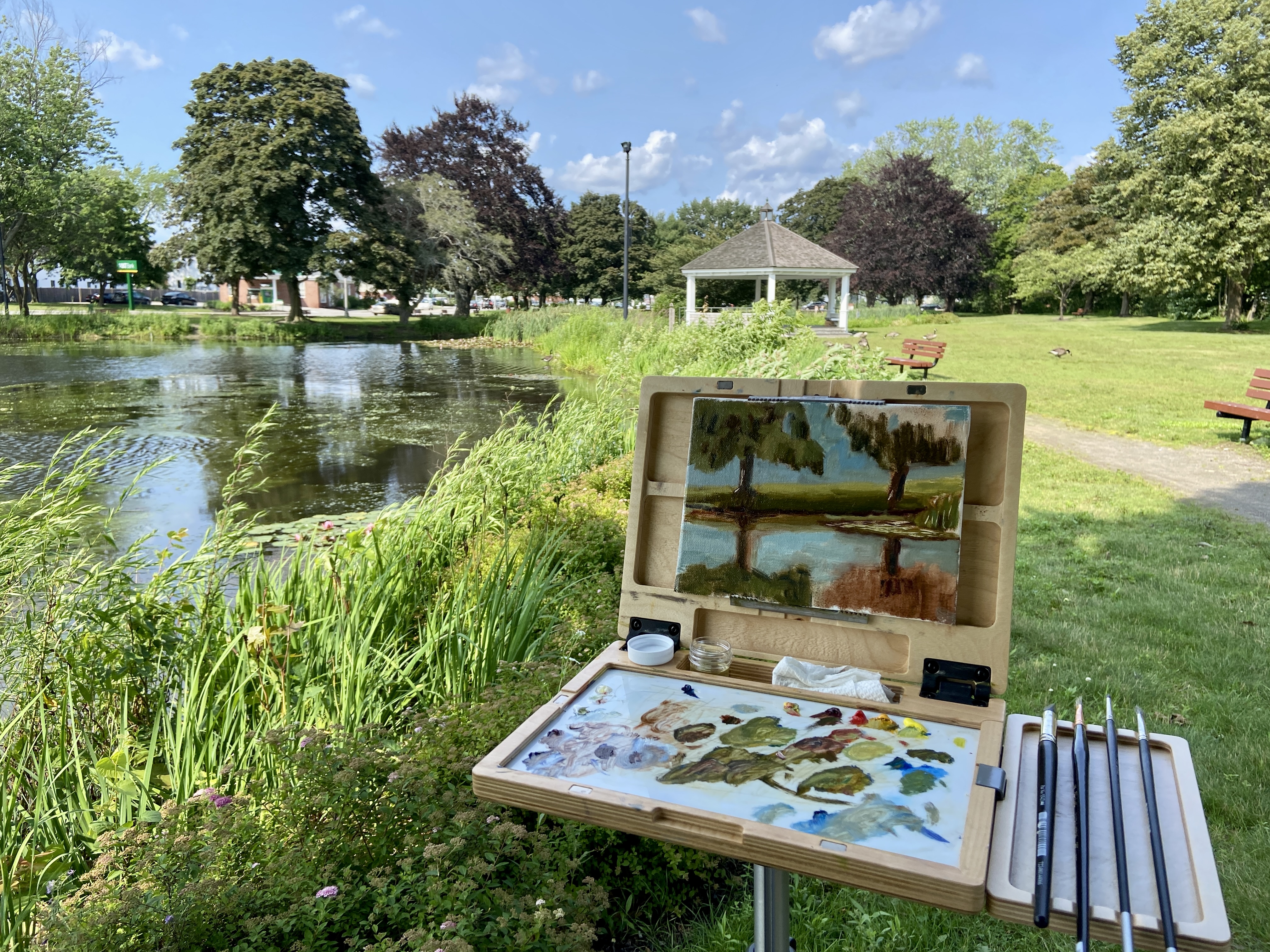
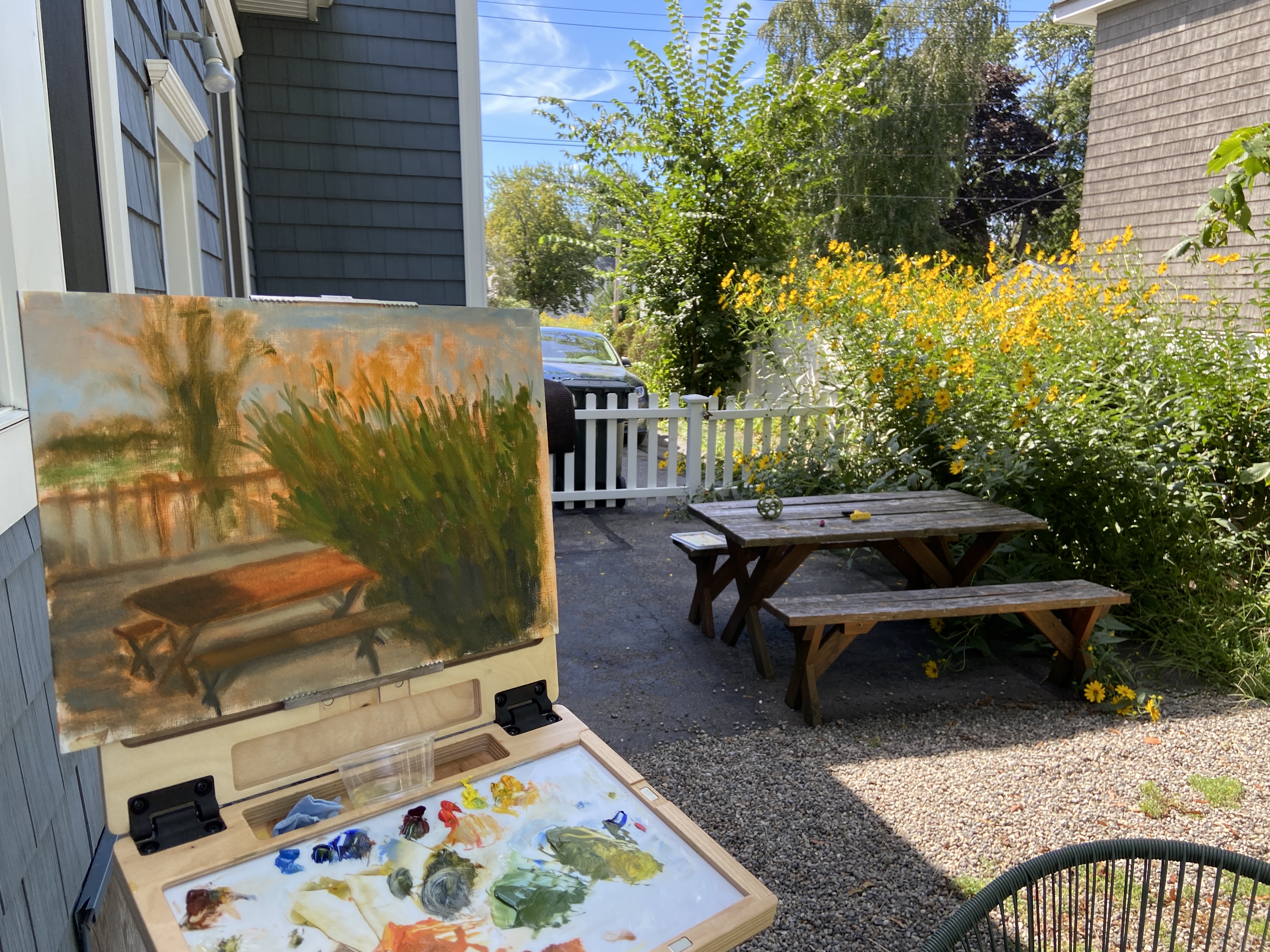
I typically don’t share work in progress posts, but I think that tendency will have to change as I ramp up my “en plein air” sessions. Why? Well, there are so many entertaining things that happen when you’re in the field trying to make art. Some of it can be frustrating, like sudden wind gusts that knock over everything, to entertaining and curious, such as bugs that end up as impasto effects in a painting.
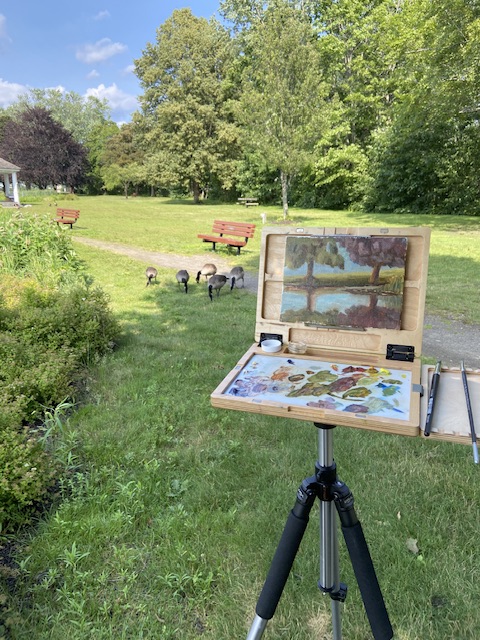
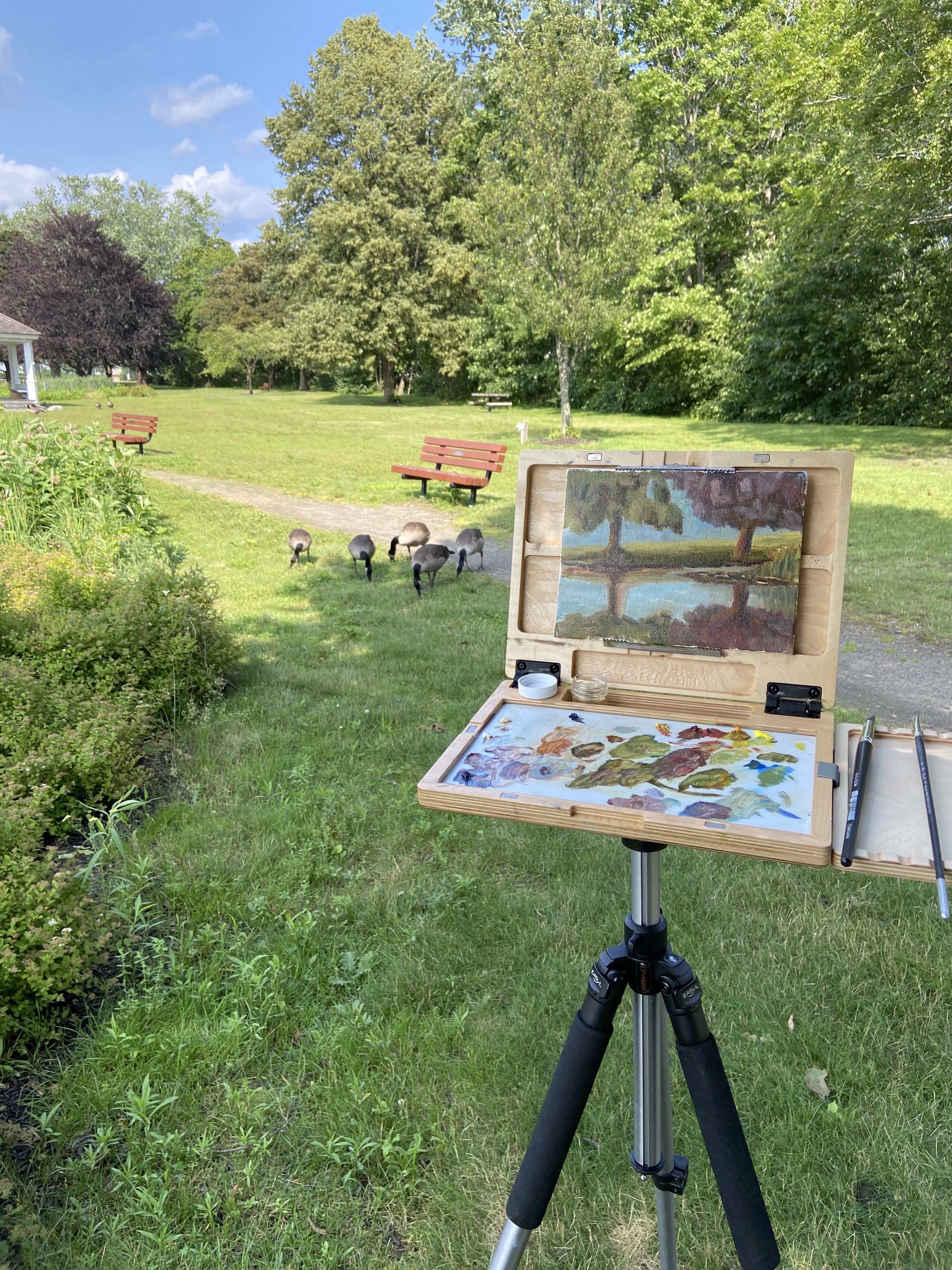
Today, I was painting by a beautiful pond on a calm afternoon, as if that weren’t perfect enough, when along comes a gaggle (is it gaggle?) of geese. Apparently I had setup adjacent to their entry ramp into the pond, but my presence didn’t distract them at all. Usually I have a dog in tow, which tends to keep all manner of water fowl in the water, but I didn’t have my handy apprentice, Zip, with me today. She doesn’t care much about the geese, but she finds goose poop to be the caviar delicacy of the great outdoors.
As to the artwork, the focal point, which is impossible to tell at this mid-paint stage, is the strip of water lilies wrapped around the right side of the composition. I was only in the field for a little over an hour, but I’m happy with the structure of the painting and the aggressive approach with the dark values, which I tend to screw up initially.
Stay tuned for an update of the finished work in the studio. Thanks for reading!
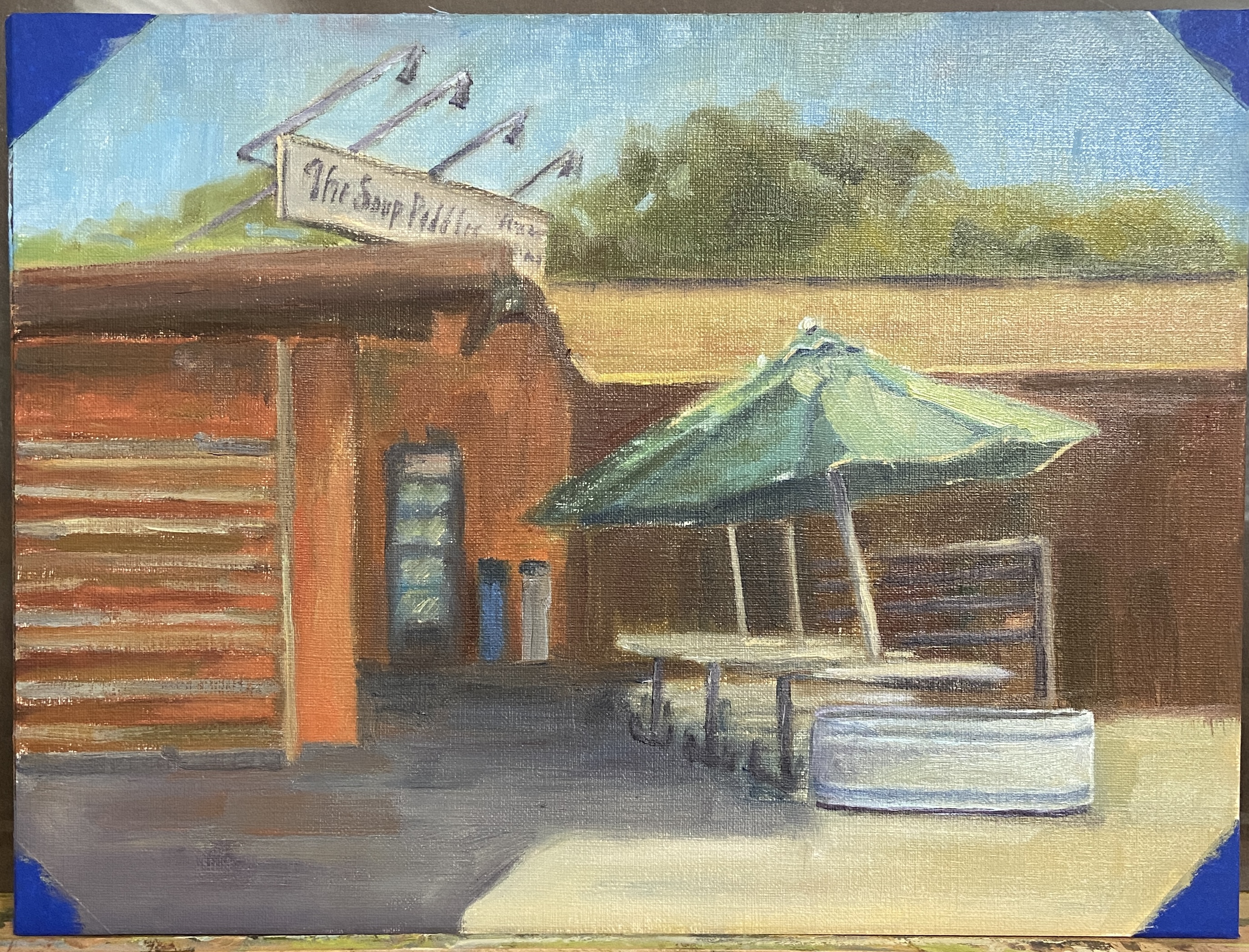
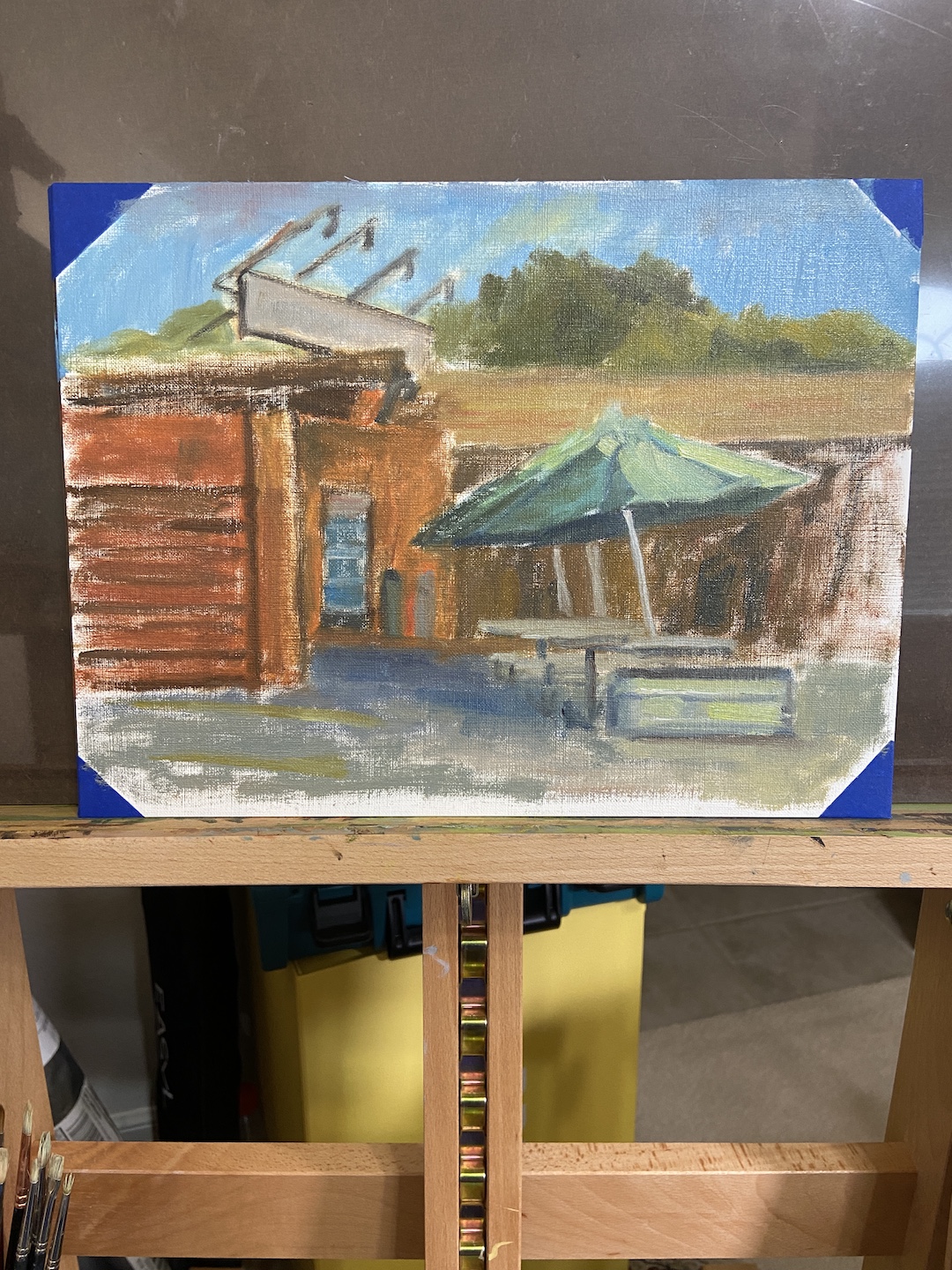
The Soup Peddler (study) | 12 x 9” | Oil on Canvas Paper
I’m learning a lot more lately en plein air, painting outside essentially. In 2023 I intend to get in at least 30 days outside – I’ll keep track and post updates against that goal… more to hold myself accountable, but perhaps it will entertain all of you as well.
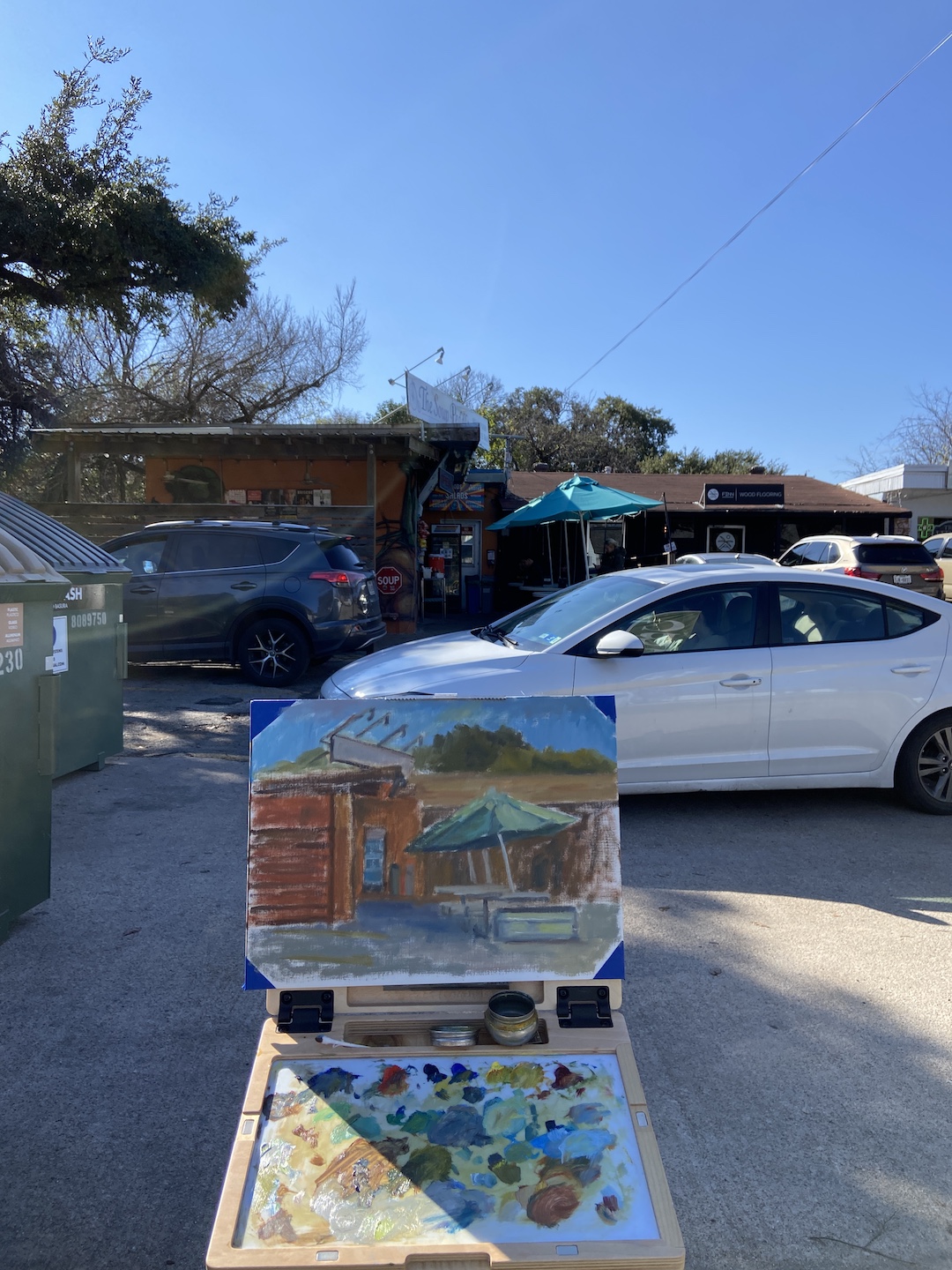
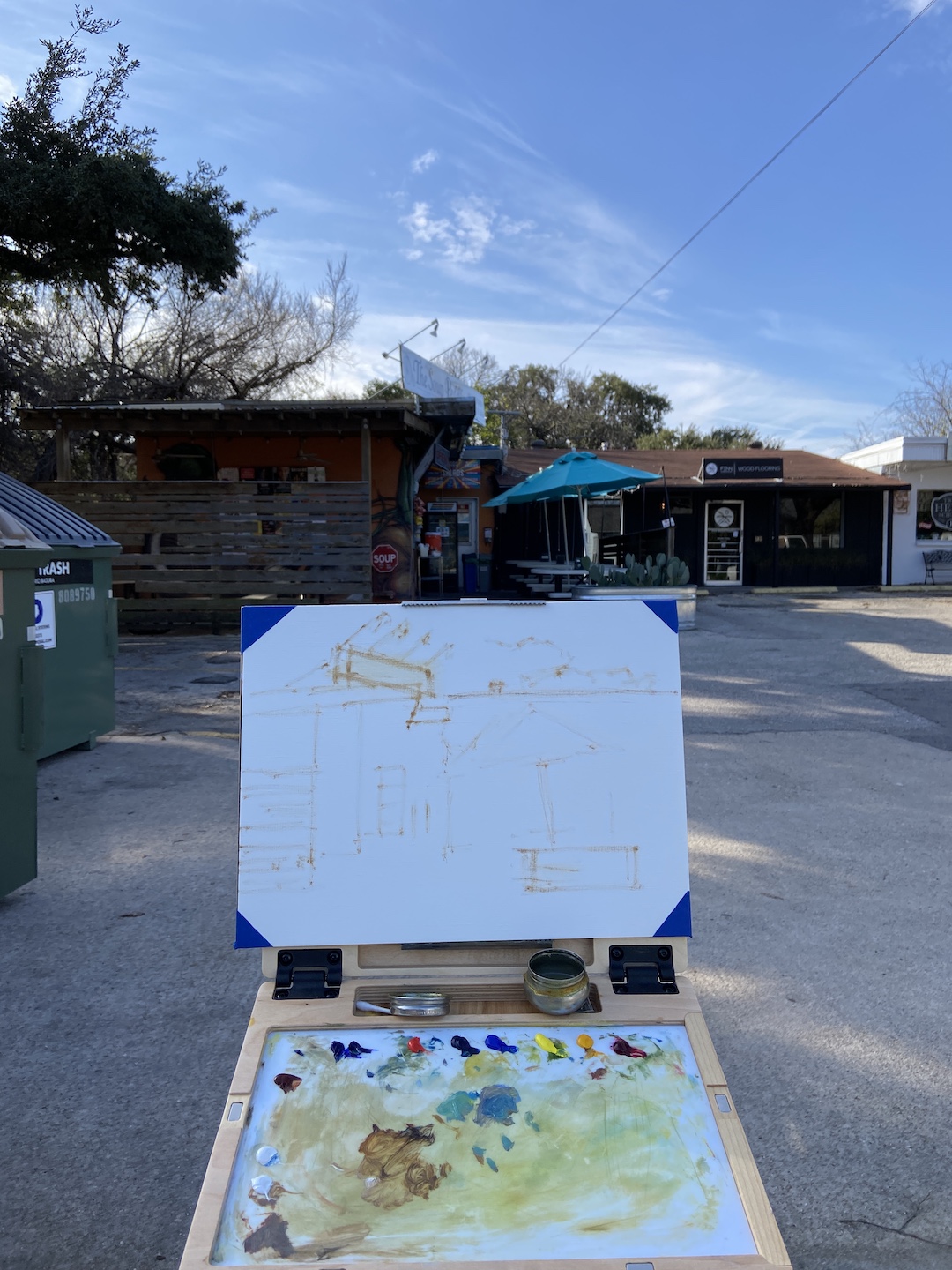
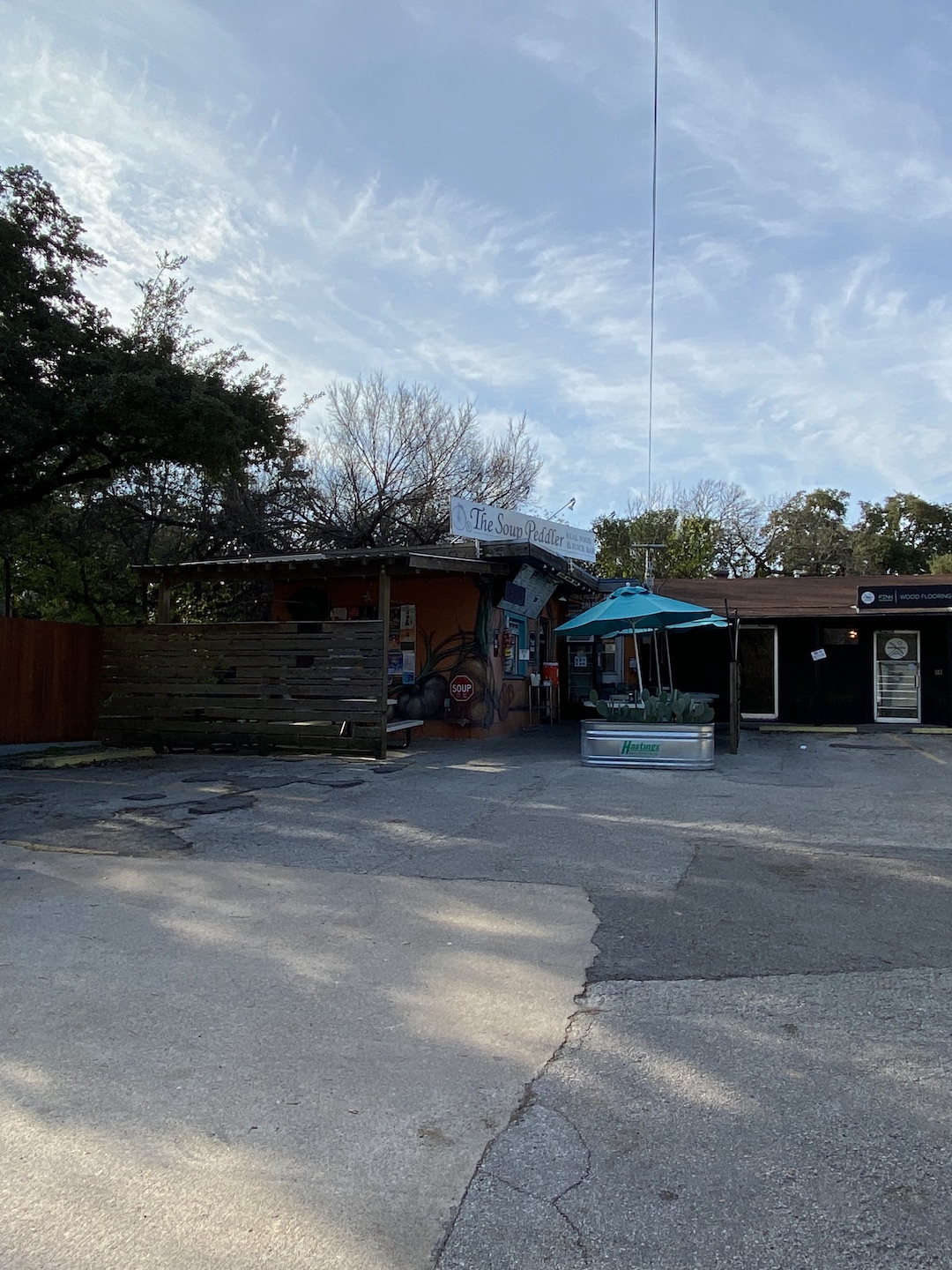
There is a great artist group in Austin called Plein Air Austin (www.pleinairaustin.org), which organizes multiple outings monthly for members – non members are encouraged to come join us to see what it’s all about, too. This particular outing was what we call “Urban”, where we get together in an area of town that has great architecture and buildings, as opposed to nature-based landscapes, and try to capture the scene. This particular outing was on South 1st near Mary Street, which has plenty to work with in terms of urban scenes. I tagged along with one of the other artists who had scoped out these great blue green umbrellas at a restaurant called The Soup Peddler.
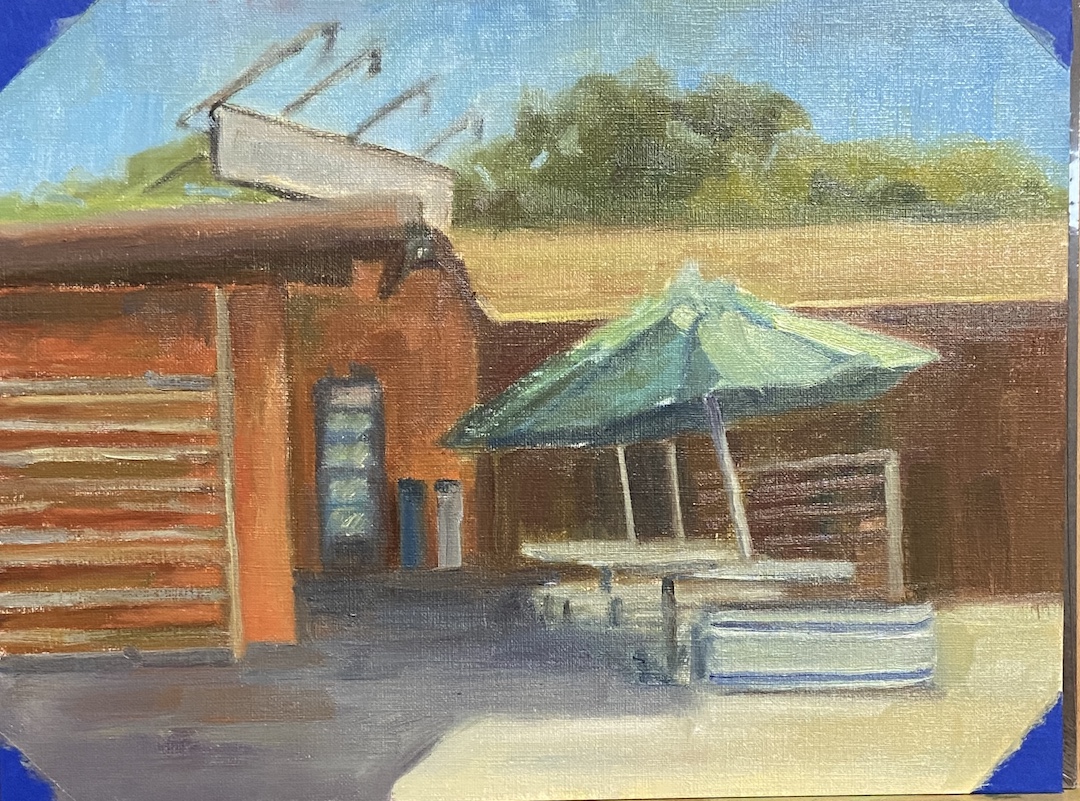
The weather was ideal, a little chill in the air, but the clouds cleared out around 10 and gave us plenty of sunlight. It was tricky to simplify this scene, an ongoing challenge for me with plein air compositions, so I tried focusing on the umbrellas first and building the painting outward. Having just painted umbrellas in a recent studio piece, I was able to quickly get the bones of this piece on the canvas before the lighting changed. Luckily the lighting was steadily improving all morning, so I never panicked due to major shifts in value.
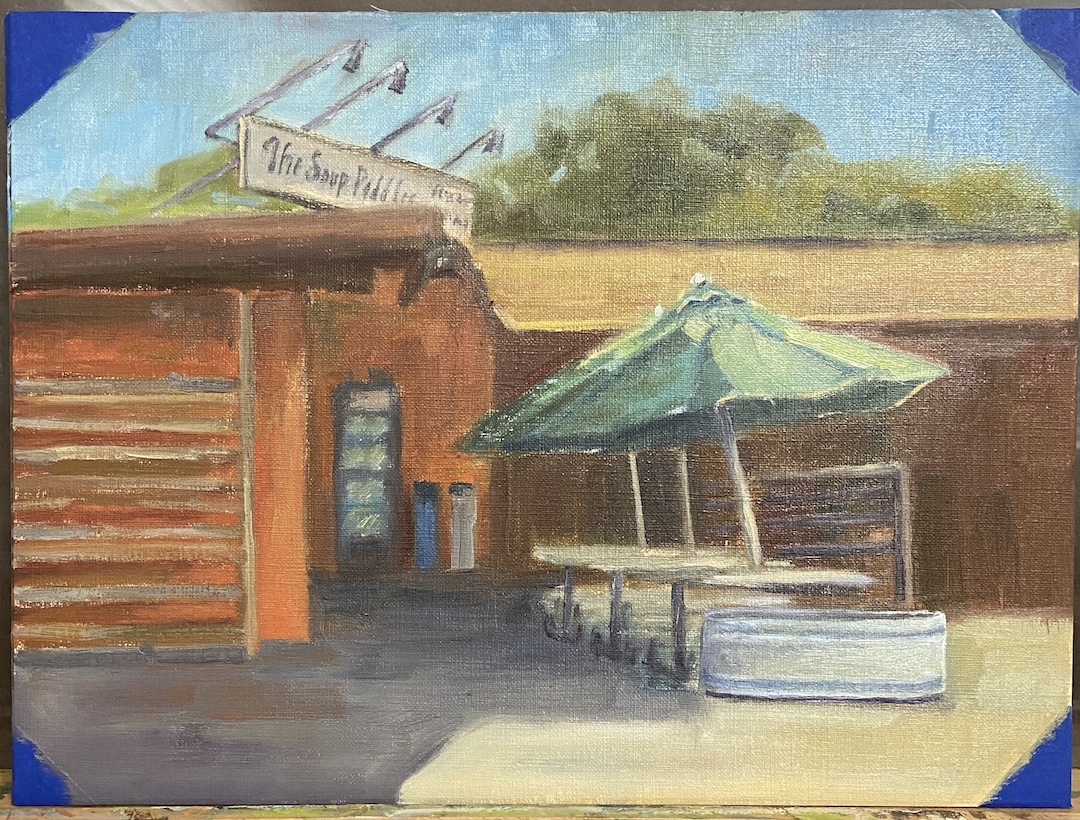
In terms of compositional challenges, I got most of it worked out in the field because I was happy with the umbrellas themselves. I also got very lucky in getting the structure of the building, sign, and patio details on the first try. Sometimes those architectural details trick me and I have to make a few attempts to get it right, or at least avoid having it tank the painting before it even begins. The updates I made in the studio were pretty straight forward, building on what I had already started, but I did leverage some artistic license. Most notably I opted to exclude the cactus coming out of the metal planter, in large part because it was nearly the same color as the umbrellas, and even a deviation from the coloring would have been a distraction. And while I don’t love the final look of the metal planter it serves as a good balance for the composition. Maybe I’ll add some other plants in the future, but for now I’m calling it done.
Finished!Studio RefinementsStarting Studio RefinementsOn Site – Always Alert for CarsSky Starting to ClearAnticipating LightFellow Painter TomEnd of Session Get Together Review
These fishing shacks are located, appropriately, on Fishermans Point in South Portland, Maine. Anytime of day is wonderful to visit the point to soak in the sea breeze, watch the activity in the bay, or simply smile at the beautiful landscape. While this spot has intrinsic beauty and plenty of subject matter for painting, these fishing shacks jutting over the water are inescapably paintable. This is one of what’s sure to be multiple compositions I do at this location.
This was a particularly challenging piece due to the weather. In the photos you can’t see the wind, but trust me it was whipping around like a petulant child, something that wasn’t typical for this location. Despite the wind, it proved to be a stunning afternoon for late day sun, which lit up the shacks in that special way that only the sun can do.
I definitely called on my inner Edward Hopper for this piece. My wife also influenced the outcome, noting a need for color so it wouldn’t be so blah with all the gray wood. Pushing the contrasts was easier than expected, in large part because the magic of plein air really helps with getting the light right.
Plein Air at Fishermans Point, South Portland, Maine
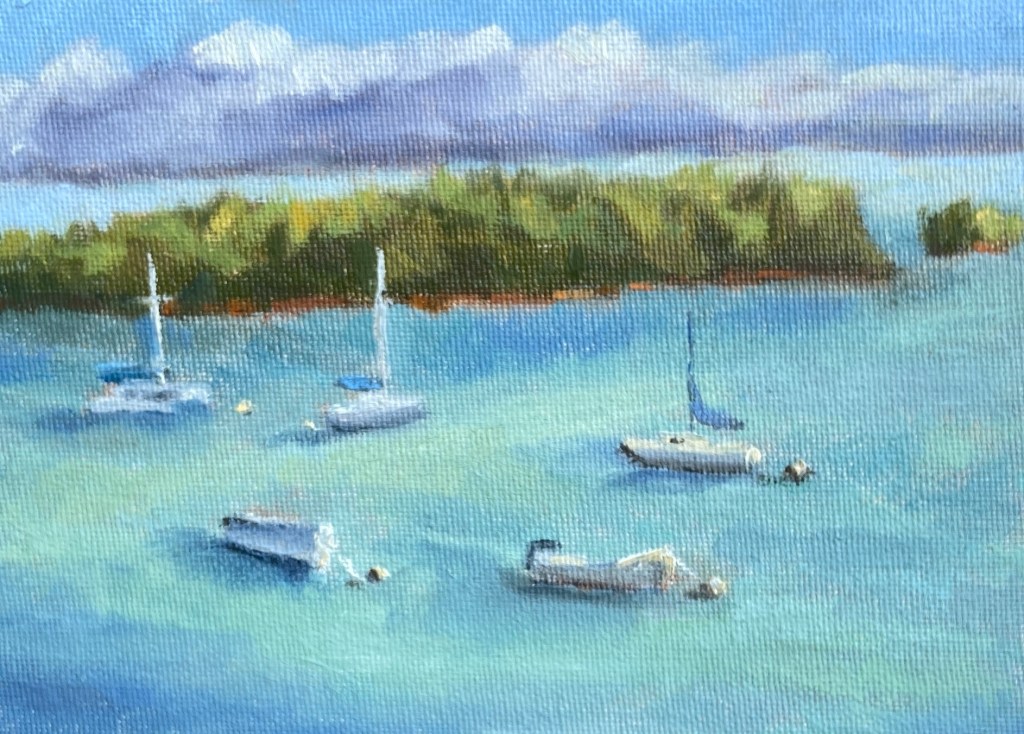
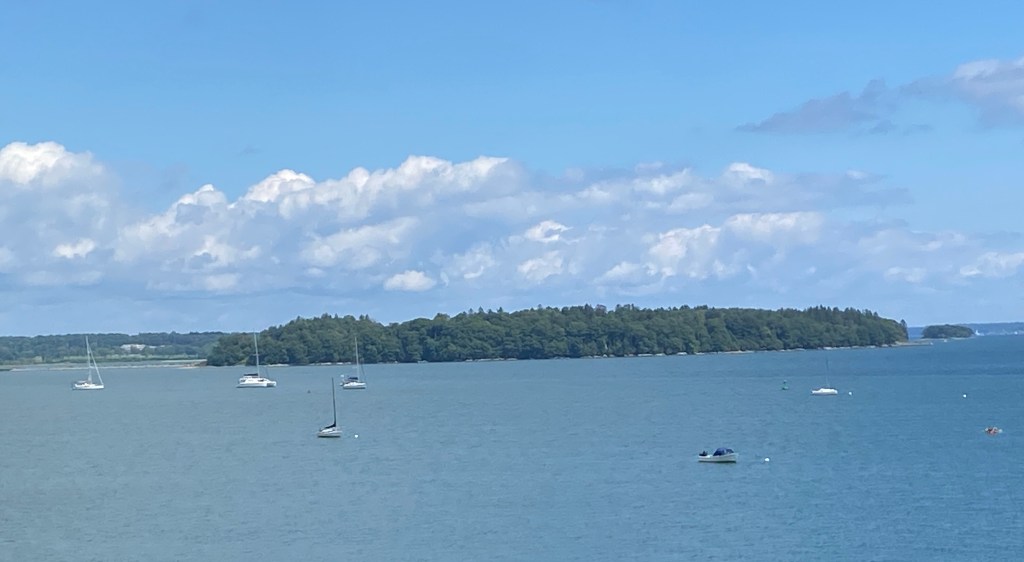
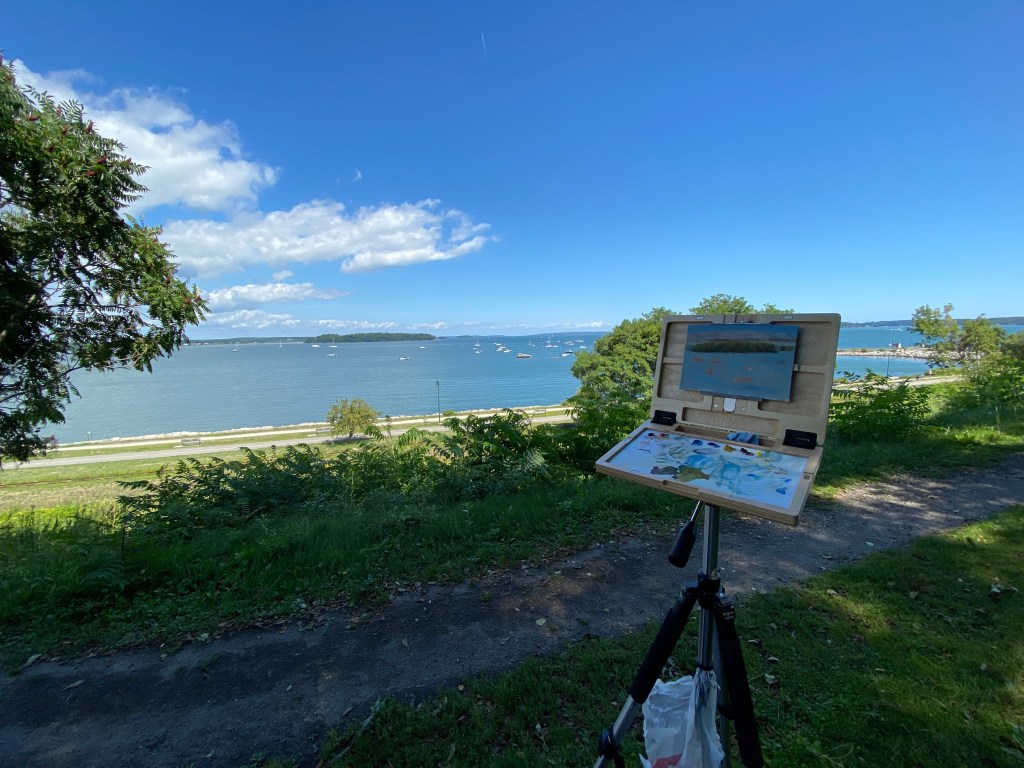
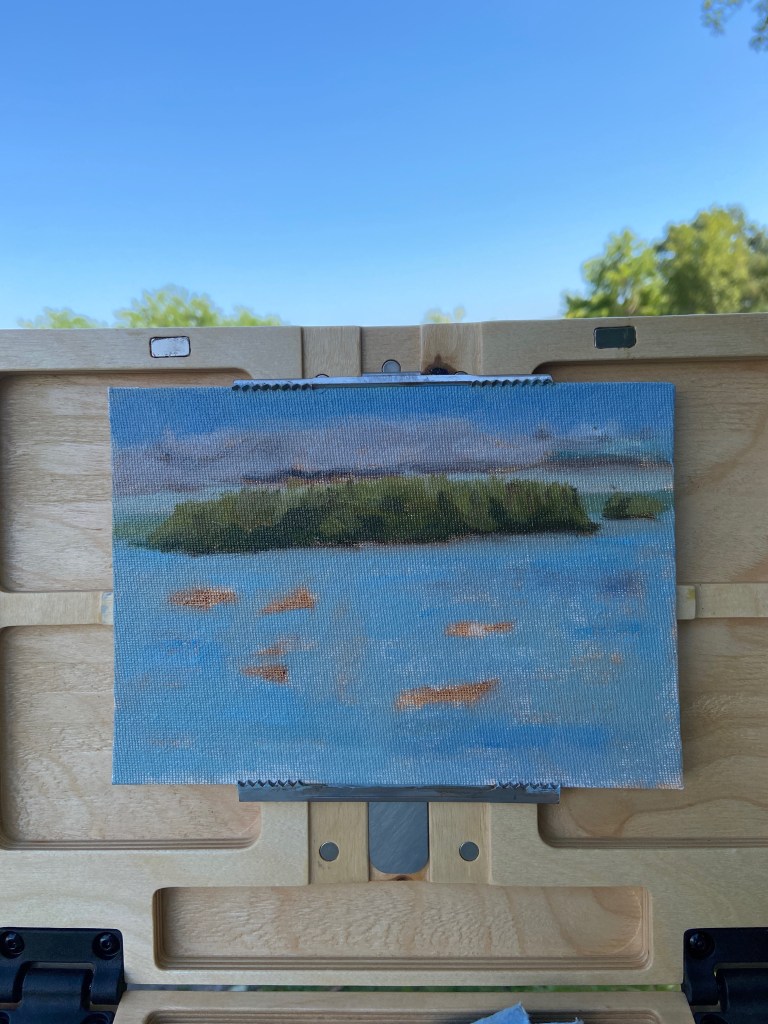
Casco Bay Boats (study) | 7 x 5” | oil on Canvas Board
The weather and views were so fantastic, frankly I didn’t care how this plein air piece turned out. The vantage point was from a hillside trail in the shade looking out across Casco Bay. I had originally setup along the water, but had to move due to the rantings of a homeless guy who felt me and another guy nearby had infringed on his oceanfront property.
The boats were tricky to paint because the scale was so small – this was the first time I’d painted a seascape with various boats on a small canvas. I realized I had to pay more attention to giving the impression of details with singular brush strokes, almost dots in some places. The other challenge with boats, maybe it’s just in this particular bay, but the vast majority of them are white, the entire boat, not just the sails.
Overall this was a successful study and I’m looking forward to future compositions, both in plein air and studio refinements. There are also some great hues to work with in the sky, water, and the backdrop of green forests and islands. What’s not to like?
I’ve been traveling a bit this summer and managed to get in some plein air work! At first it was mostly drawings of coastal scenes – lots and lots of boats and beautiful coastline. But lately I’ve managed to get in some solid time with the paints and I’m working a few pieces in parallel.
I still need to return to a few of the plein air locations before I can finish with studio refinement. One basic change I’ve tried with the recent plein air compositions is essentially simplifying the focal areas and zooming in so there’s less to tackle. That’s been hard for me because I typically want to capture as much of the landscape view as possible in any given composition because it’s so damn beautiful.
Next projects will be some very photogenic coastal lighthouses. I’ve done a few practice sketches to get a feel for how I want to approach the works and not self-inflict panic during the speedy reality of painting on site. What’s really apparent, at least in my drawings, is that the lighthouse is going to be a piece of cake – it’s the rocky seaside that might well drive me insane. But I believe if I keep it “fast and loose” and focus on the lighthouse, the rocks will be simplified in a supporting role.
Hopefully I’ll be able to post a couple of completed pieces in the coming week.
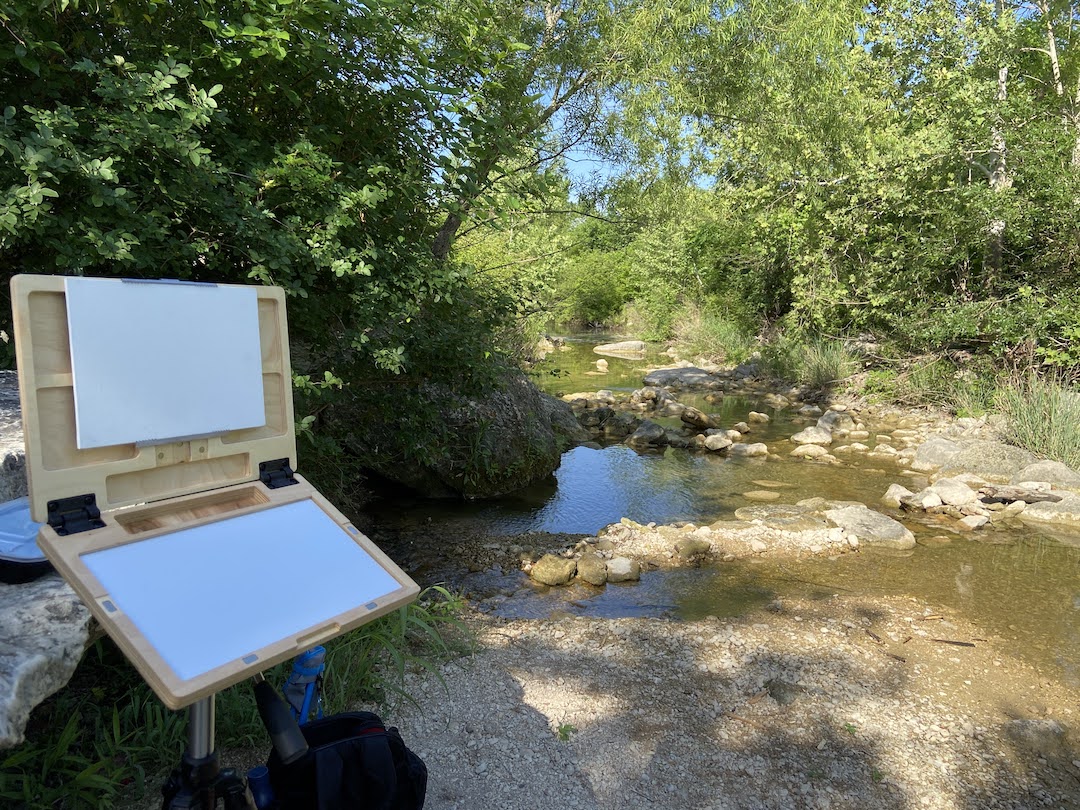
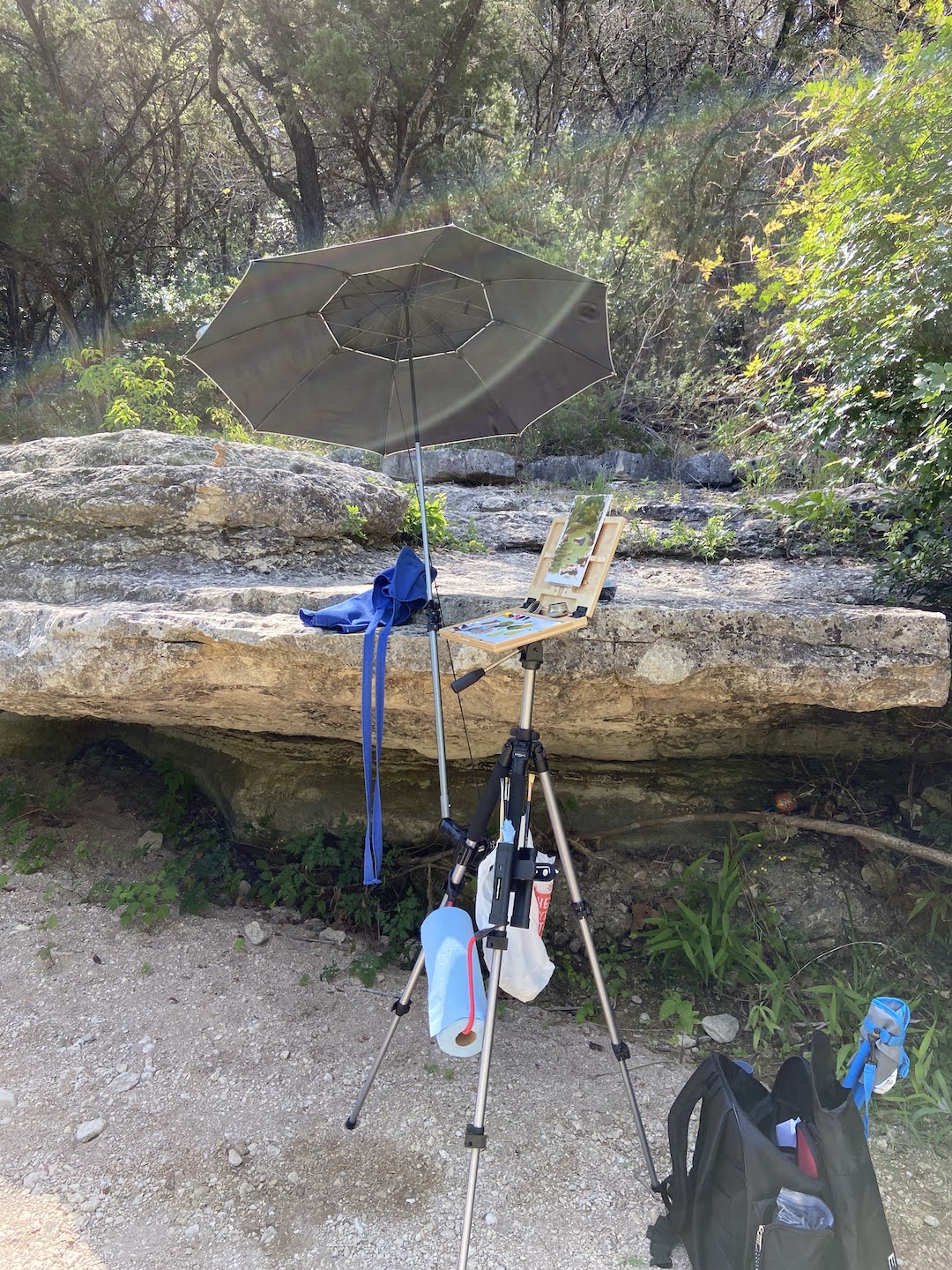
I might have chosen the wrong year to ramp up my en plein air experience, case in point the month of May in Austin is already registering 100 degree days. Ugh! Regardless, the mornings are bearable and I had to break in a new pochade box called u.go. by New Wave Art… more on that later.
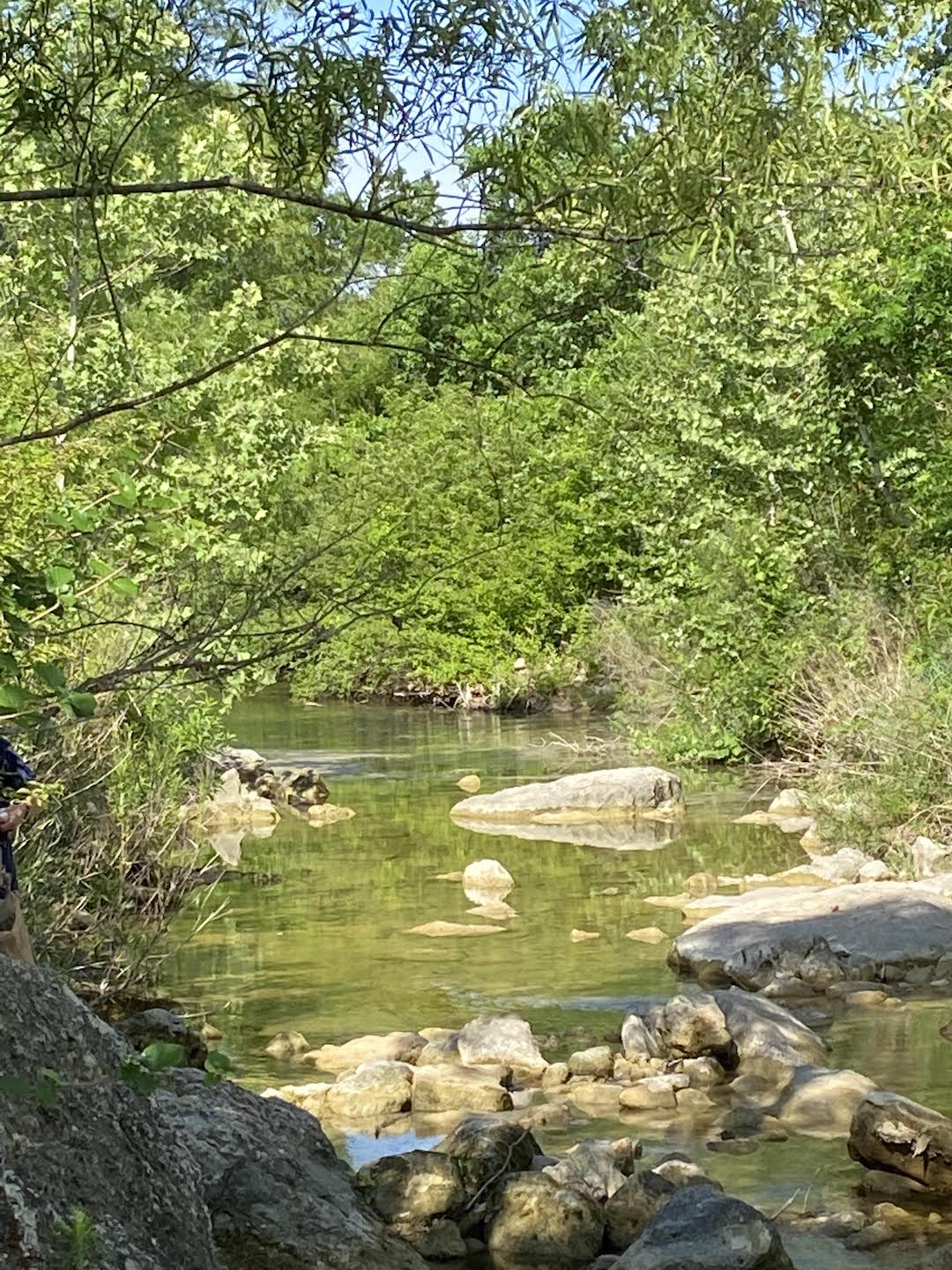
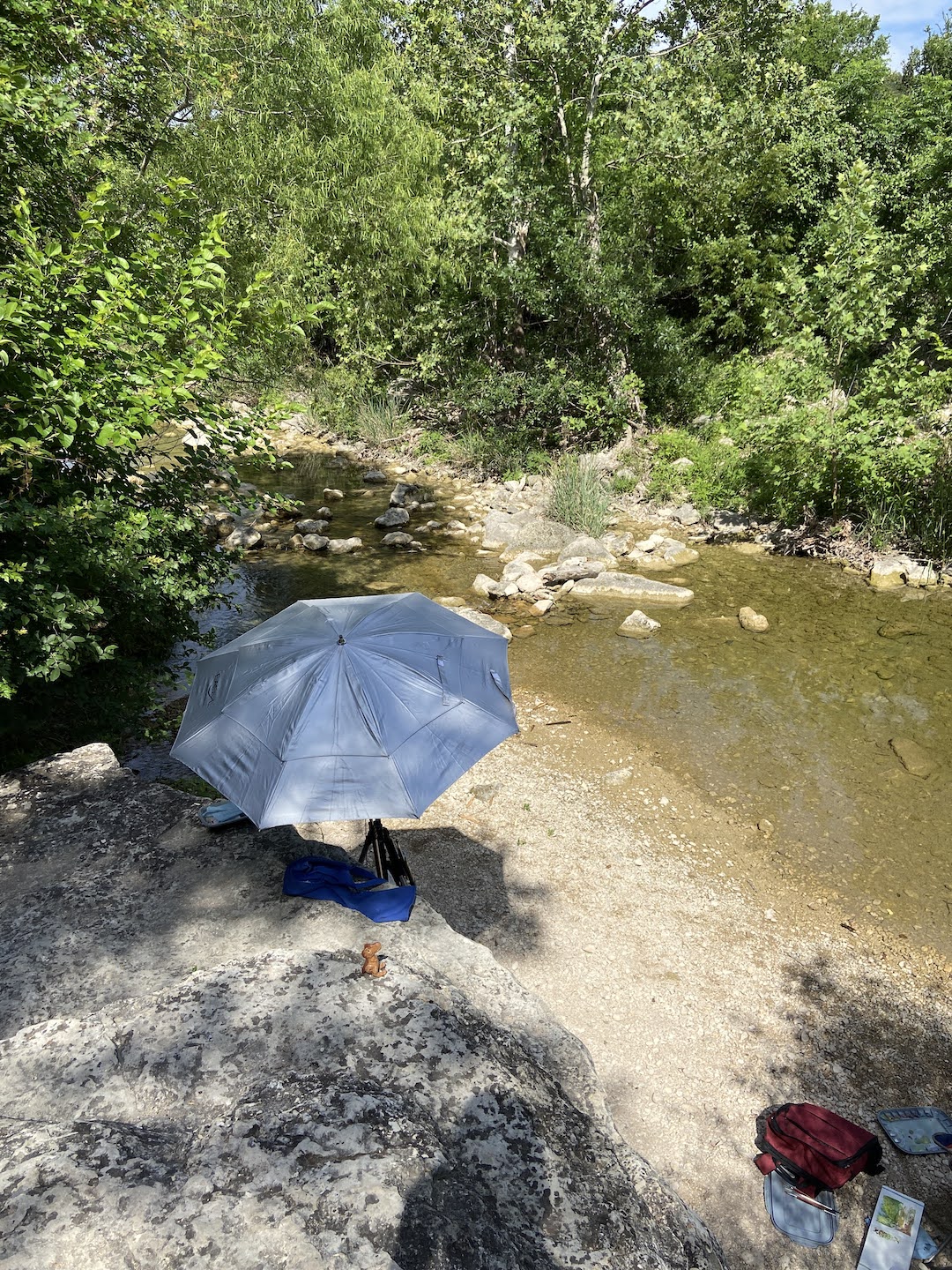
This session was at Bull Creek Park with a few other painters from Plein Air Austin. For those of you familiar with Austin, this is the northern stretch of Bull Creek near the Spicewood and 360 intersection. For the uninitiated, it’s ideal for painting outside because there’s usually some good water options along the creek and lots of shade.
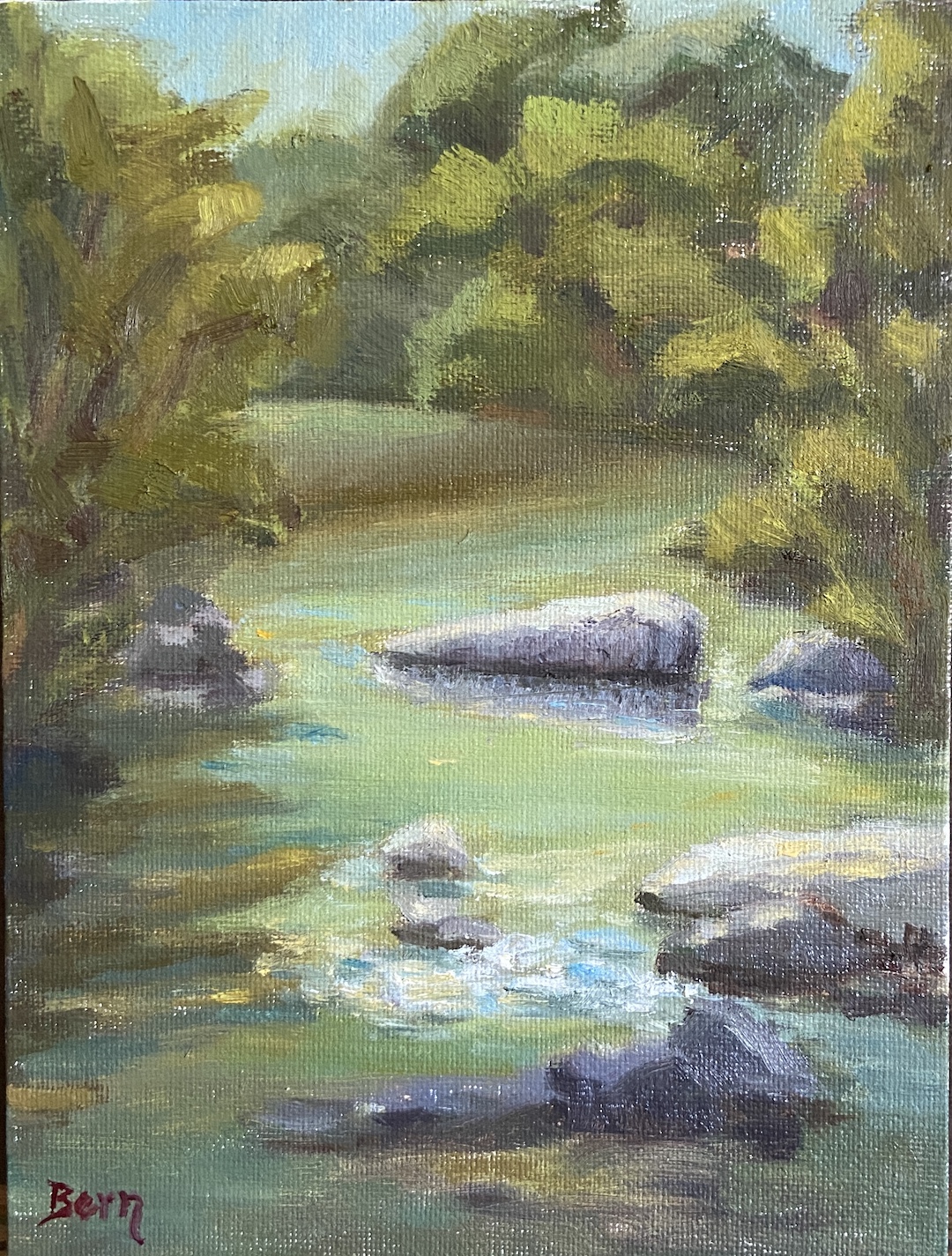
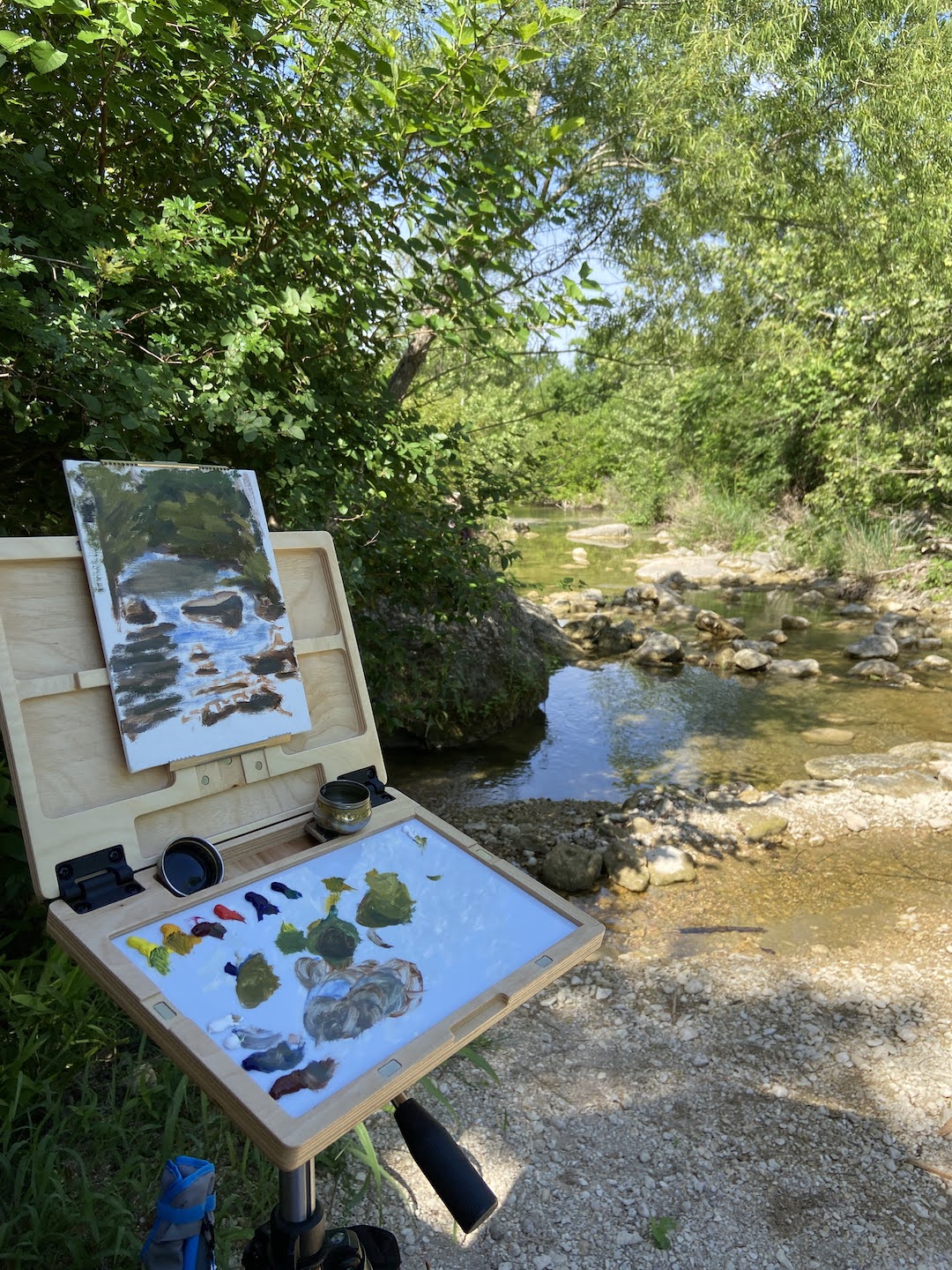
The focal point of this composition was the rocks in both the foreground where the shade and light merge, and secondarily the larger rock bathed in sunlight. I was very happy with how this turned out even before I got back into the studio for refinements. I went into this plein air session committed to focusing on values, starting by driving the darks into darkness-of-a-bat-loving-cave kinda dark, then finding high contrast opportunities for the lightest lights. I took some artistic license in this area, fabricating some water movement that wasn’t there, but it made for a more compelling viewing experience in my opinion.
Additionally I muted the trees on the banks, especially the left side, so as to ensure they didn’t distract from the main focal points in the water. I had initially used much lighter, saturated yellow/greens on the trees, but that muted all the lighter values in the composition, which absolutely killed the scene. I’m pretty sure this is what I’ve done in past plein air sessions that has confounded me. I’ll keep my fingers crossed this will carry over into the next outing.
The use of olive green variations on the shadow parts of the distant water were also a change in approach. One of my fellow painters made this suggestion and it proved to work really well. Painting outside is fantastic! This particular outing was of note because I got to share ideas and chat with the other painters. We even treated it like a workshop and did a mini critique of our works at the end of the morning. This was particularly interesting because of the 4 painters, there were 3 different mediums represented – oil, water color, and gouache.
Lastly, my new u.go proved to be a great upgrade to my plein air armaments. Thank you to my awesome wife for giving me the perfect artist gift! The best part about the u.go is the portability. The length and width dimensions are almost identical to my EasyL pochade box, but it’s very thin, so it fits much easier in my pack. Very sturdy and compact design make it a must have piece of equipment for me.













 Art Bern