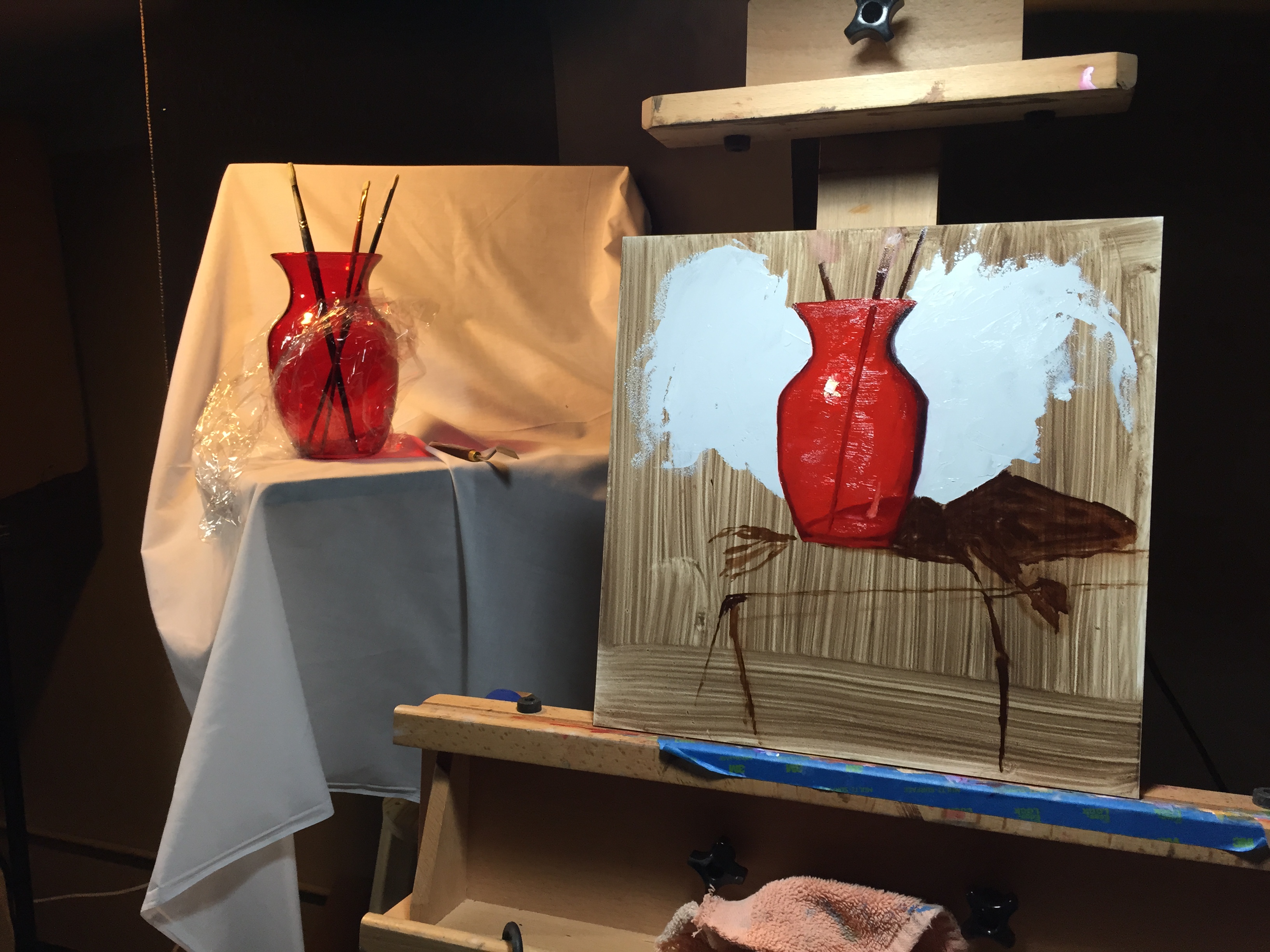
Red Vase and Cellophane – Update

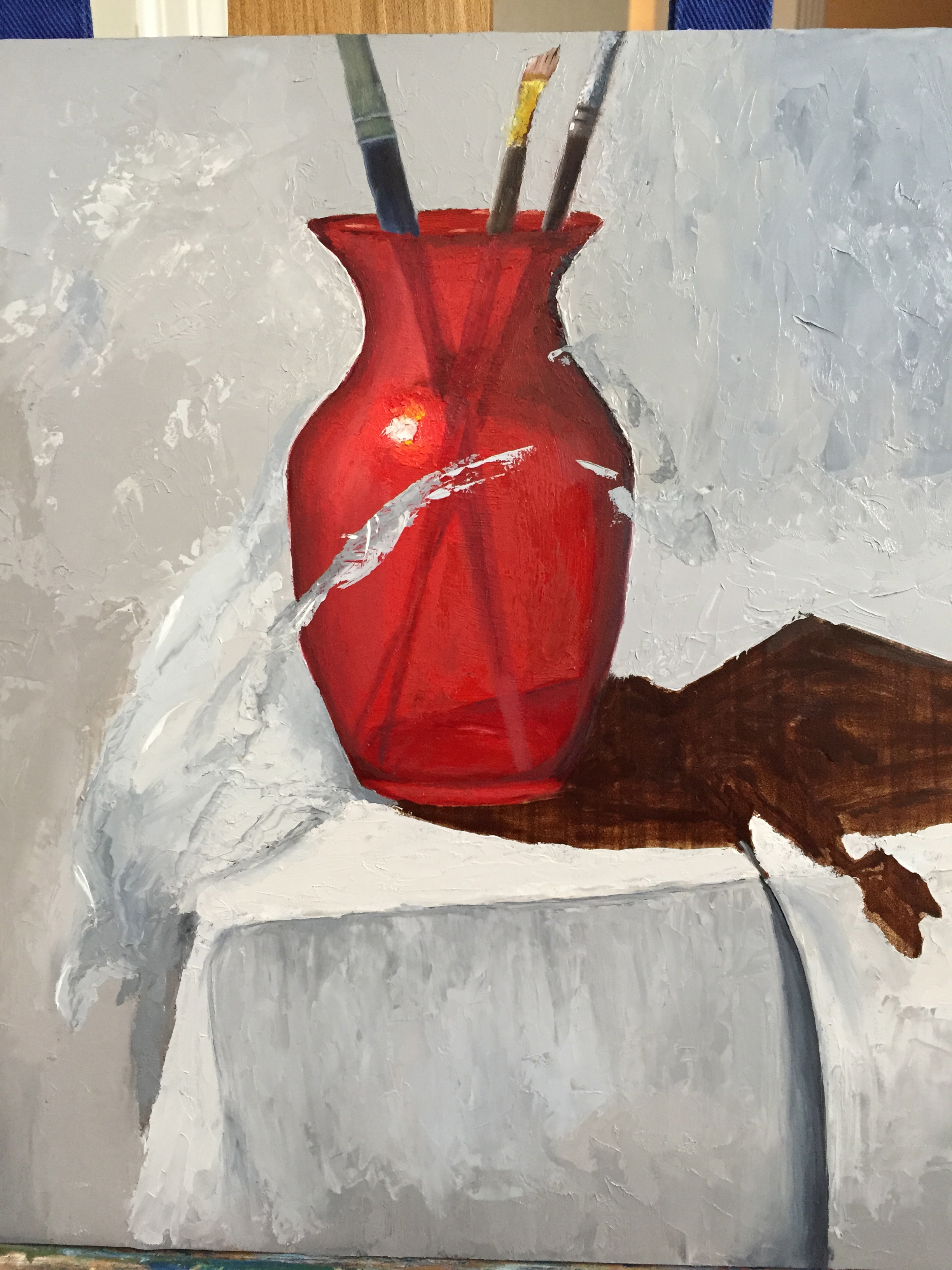
With a few deep breaths, and some tasty wine for liquid courage, I dove into the cellophane stage of this composition. I carved out a little more than an hour tonight to get the ball rolling. I was pleasantly surprised with the progress, but I will admit that my inner artist was struggling with laying gray tones on top of the pretty red vase in the name of cellophane.

It was rough going initially b/c there weren’t enough value contrasts between the white table cloth and the wide range of cellophane grays and cast shadows. Then I remembered the advice from David Cheifetz during his workshop a couple weeks ago – “Value is king! A painting with the right values but wrong colors will still look pretty good.” I’m not about to put that on a tshirt or a bumper sticker, but its great guidance. I stepped away from what seemed like the right dark and light grays and made both ends of the spectrum more extreme, darker grays and lighter grays. It seems to have worked so far.

The real power of the cellophane image won’t really come together until the grays are laid in properly and then the bright, white highlights are added on top. That’s what gives the cellophane it’s shape and texture. I’m still not entirely convinced this will look like the real thing when I’m done, but stepping back from this first stab at it, I was able to see the shape of the cellophane starting to come together. The key is going to be establishing that clingy sensation with the highlights. Fingers crossed…

[The grays of the cellophane are primarily 2 setups: Ultramarine blue + burnt umber + white OR white + ivory black. I’ll probably add a 3rd option for the cooler side of the cellophane (right side, away from the light source) of UB+raw umber+white. ]
IMG_3064

Workshop Day 4 – winter storm cuts things short

Day 4 turned into a hurried 1/2 day due to the winter storm that blew in during the morning.  A couple of inches of sleet and icy roads forced me to head home around 12:30 before the roads south became impassable for the night. Good thing I did because the drive was very precarious for that first hour. But before I had to leave…

David spent another 90 minutes working on the cellophane objects, bringing the piece to its glorious completion. While it’s not as refined and polished as some of his other work of the same subject, it was still very impressive given the timeframe. It was very interesting to see the cellophane come to life, but he also spent a lot of time getting the drapes in the tablecloth just right, which was surprisingly fun to watch. Nothing in his composition is done half-ass; it’s all-in on every element.

IMG_3048
David’s completed cellophane objects. About 4 hours of effort. Amazing!

IMG_3050

I had a little time to work on my vase and cellophane composition before having to head out to avoid the worst of the winter storm. I was able to apply a lot of what I had learned, along with hands-on guidance from David during class, to get the painting in a good position for success. The vase is coming along nicely, and while I didn’t get to start on the cellophane elements, I’m excited to work on this project, very excited!


IMG_3041

I’ll definitely take another Cheifetz workshop next year. He’s an excellent teacher and a true master of his craft. It was also nice to meet so many skilled artists and friendly people during the workshop. It was a great group and there wasn’t an annoying person amongst the lot, which is saying something given there were 10 students. I can’t wait to get the painting knife back in my hands this weekend!

Workshop Day 3 – Another reason to hate cellophane

Another day of the Cheifetz workshop, another day of undiscovered challenges. David started a new composition today, which meant all of his students did, too. One of his most popular, albeit relatively new still life twists, is the use of cellophane. Yes, cellophane, that awful plastic wrap that’s supposed to be used to seal open containers, but all it really does is seal itself around your hands as you try frantically to attach it to your leftovers bound for the refrigerator. Well, as if there weren’t enough reasons to demonize cellophane, David had the bright idea at some point last year to try and paint objects wrapped in the stuff. What’s more curious is that many of the students wanted his second composition to be this subject matter. He’d never done a live demo of cellophane wrapping technique, but he happily agreed to do it live!

Davids cellophane subject
David’s setup and progress after an hour!

I had originally planned to do a new composition today that consisted of an orange or apple hanging precariously off an edge to get that 3D depth effect, but opted to embrace the opportunity to try something genuinely impossible like cellophane wrapped objects. What the hell, right? After all, how many times do you get the chance to see a master like David Cheifetz do a really hard composition like this live, then have a couple of days to try imitating the same thing… with him walking around the room and available to give hands-on assistance! I know I won’t get this right, but I will learn a lot trying and one day when I can do it, I will look back at this effort and chuckle. So here’s to laughing at me and my first cellophane wrapped still-life attempt. Here goes nothing…

Red Vase setupRed Vase - Day 1

Workshop Day 2 – knives aren’t just for cooking, slicing, and stabbing!

Another great day at the workshop. We did a lot more painting today, but things started off with an hour of David doing a demo. He picked up where he had left his painting off from yesterday. Very interesting as he demonstrated more technique and color strategies for the support cast of objects. I learned another volume of painting secrets, well secret to me at least, and was able to apply many things immediately to my painting later in the day. Watching David create one of his signature compositions before my very eyes was worth the price of the workshop alone.

David doing a demo  to start off day 2.

We spent more time working on our paintings today than the first day. I spent a lot of time working slowly and carefully with the painting knife, never picked up a brush today. After 5 hours of painting I started to get much more comfortable with the painting knife, getting a feel for how to manipulate the paint on the surface of the board, as well as gaining more comfort in knowing where the paint was on the knife and where it needed to be on the knife for tricky angles.

David continued to work the room constantly during our workshop today. I spent numerous sessions of 1on1 time with him as we worked through some of the challenges in my painting, of which there are many. He told me that I was tackling a very difficult subject on many fronts – the water pitcher is hard to do b/c it’s reflective, has a wide range of values, the shape is tricky, and the coloring is far from straightforward. No better time to dance out of my comfort range and skill level. Needless to say, David was willing to demonstrate solutions to me directly on my painting.

David Helping

The lighting in the studio is great for our painting work, but it’s awful for taking pictures of the work. I’ve posted my progress below, but will try to get a better shot tomorrow with some decent lighting. It has a long way to go, but I’ve already learned so much that it’s hard to believe it’s only been 2 days.

Progress and Layout Progress 1

Day 3 we shift gears to a new composition, so I’ll have to finish my first knife painting back home later this month.