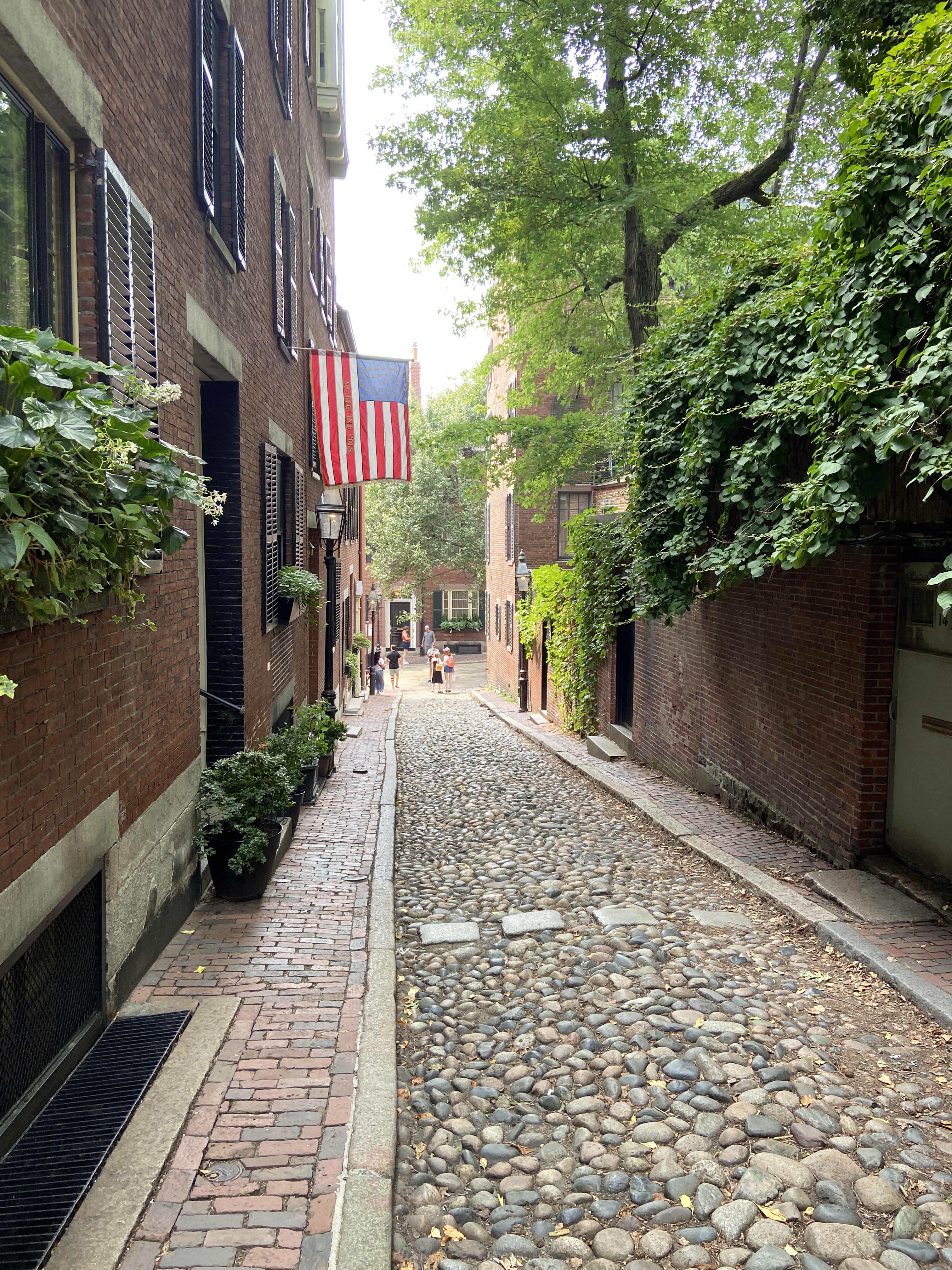
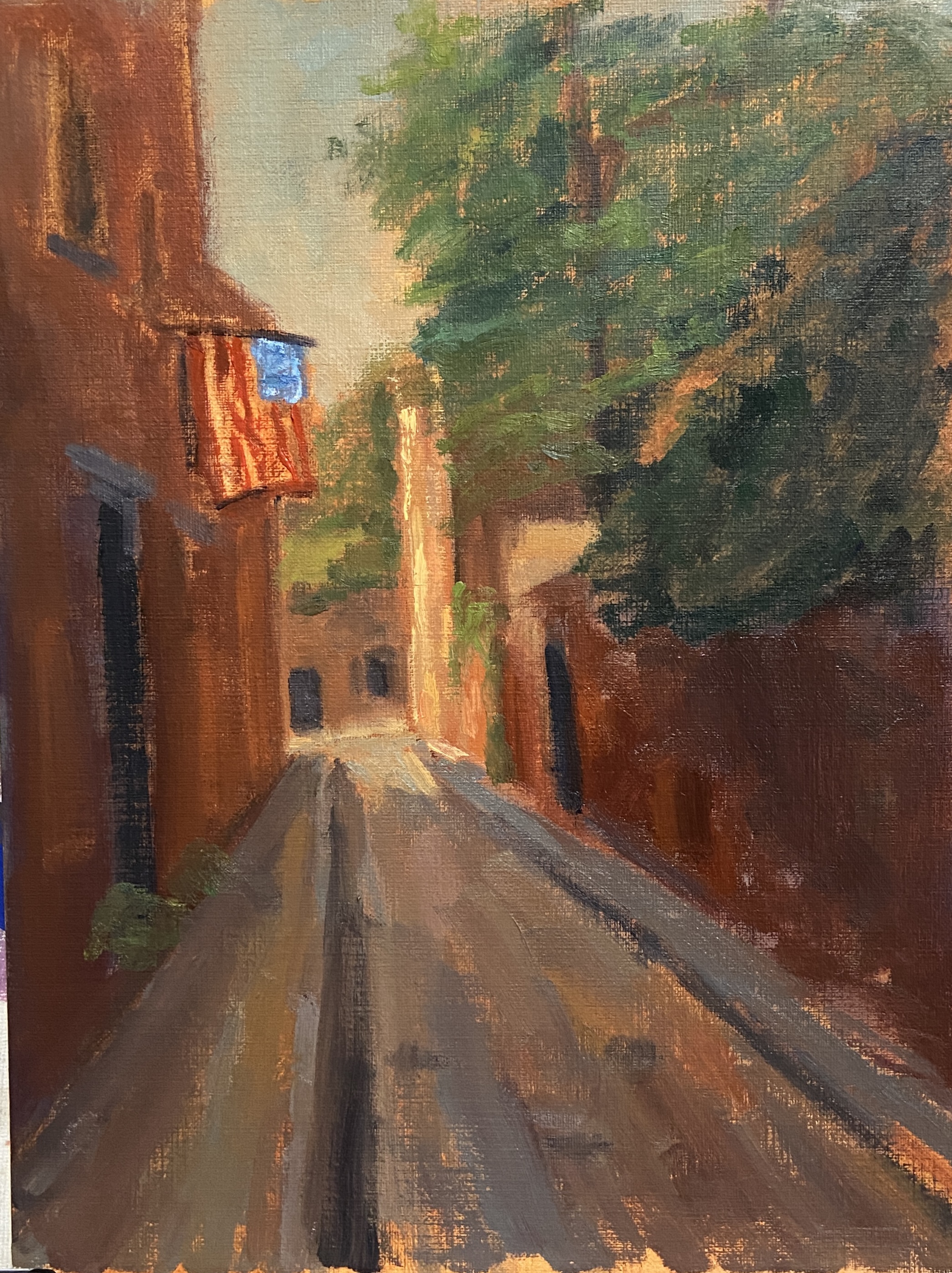
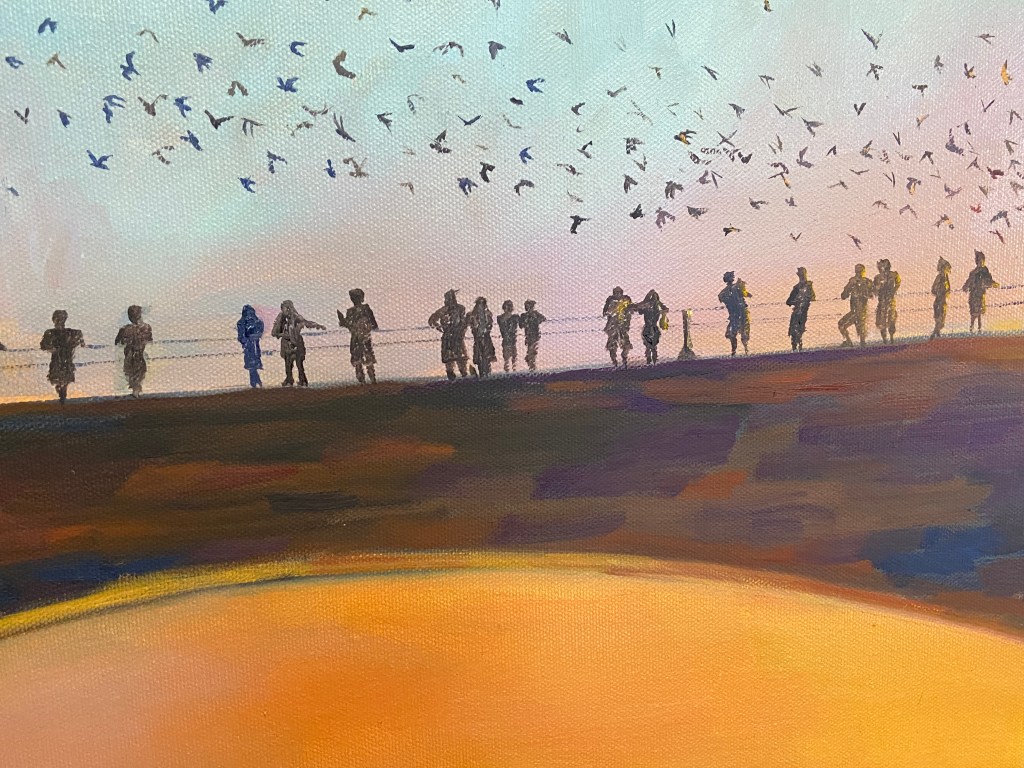
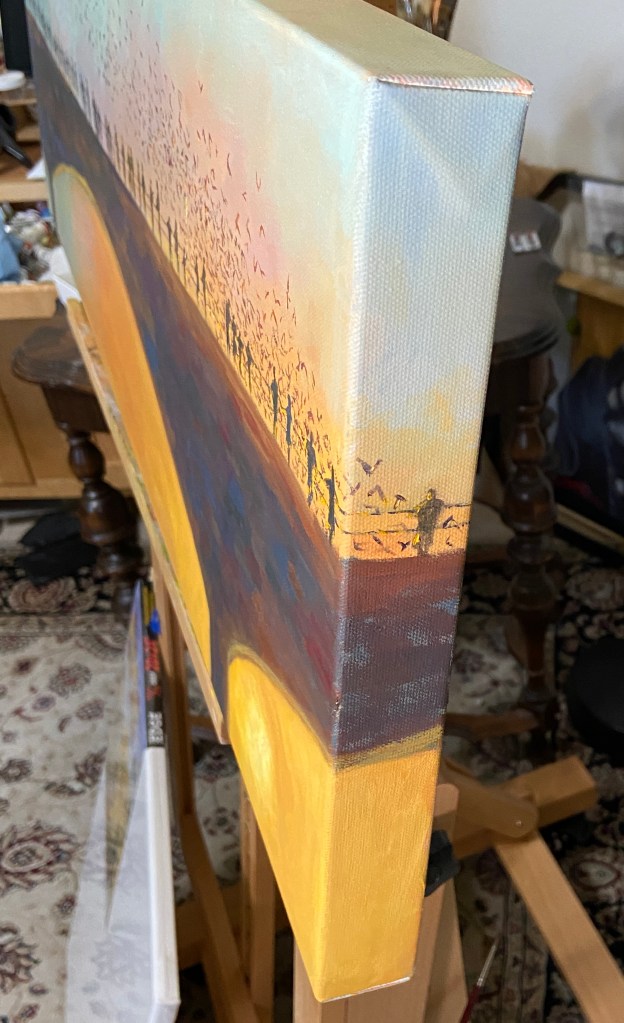
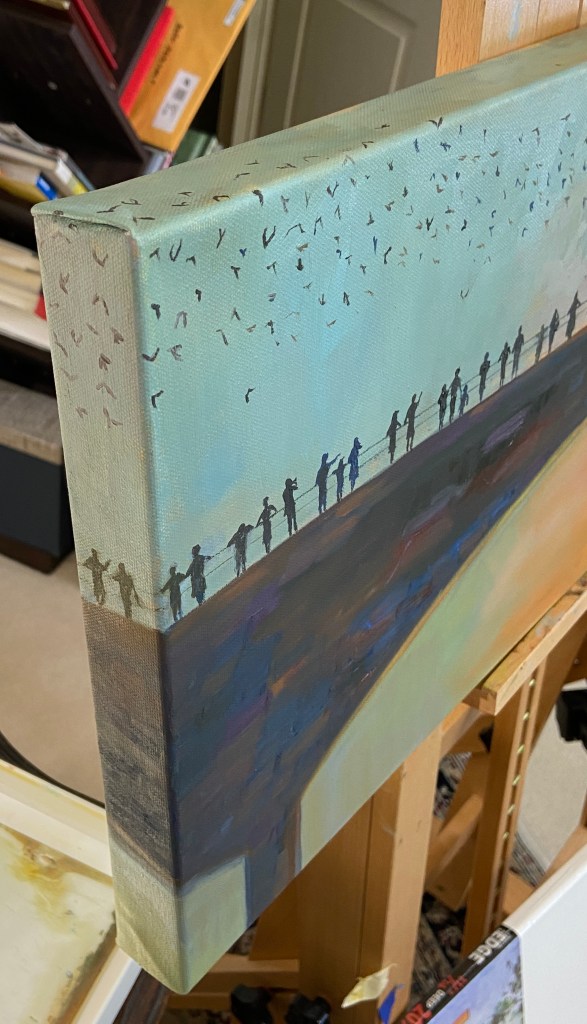
New work-in-progress, ACORN STREET, oil on canvas board. This piece is also serving the purpose of a study for a larger composition, provided it turns out well. It’s off to a good start, though, but it will take a few more hours on the easel to get there. The perspective and values are solid and should provide the foundation for an eye-grabbing painting.
This was also my first session as a student in an open studio class taught by Robin Cheers. Her artwork is beautiful, very painterly, and really captures a sense of place and activity. As an instructor, she made a very strong first impression and provided some great insights that will go a long way to improve my technique.
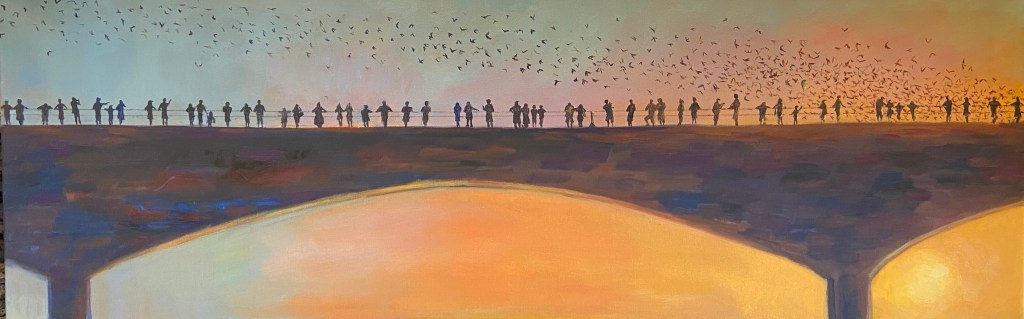
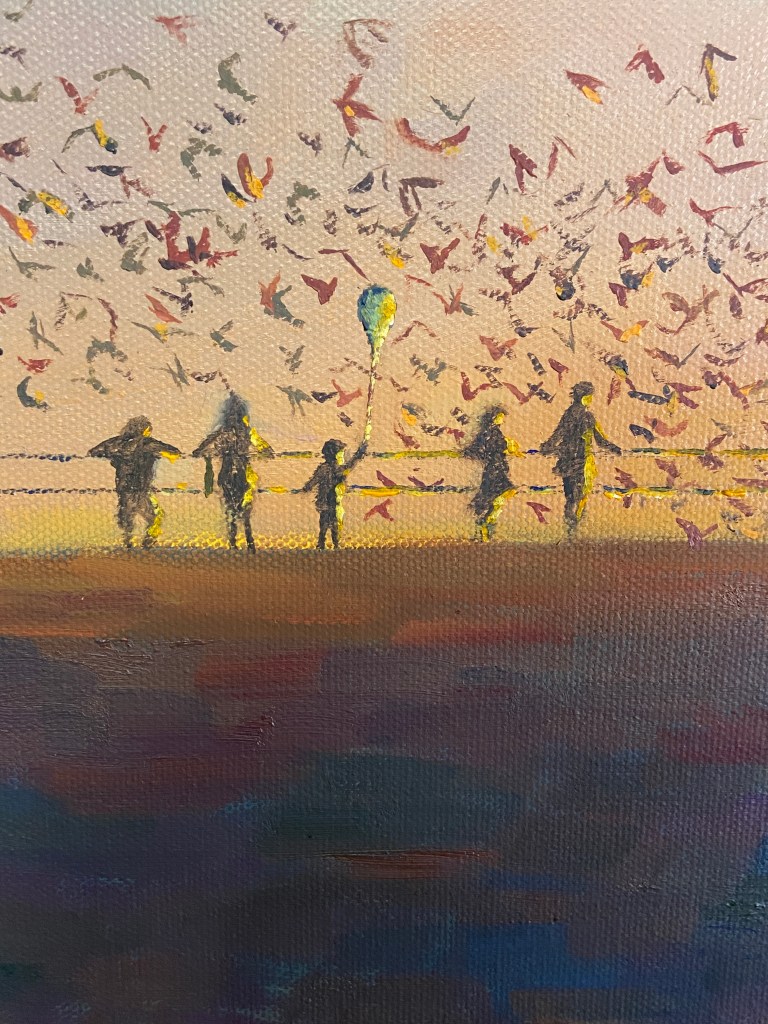
This piece is inspired by the bat colony under the Congress bridge in Austin, Texas, but note they are not the focal point. The 56 silhouettes along the bridge are the intended focal point, which as a group, show the evening observations of the bats on a summer evening. However, as you look at each individual person, you can see how their experience is unique. Hopefully you, as the observer, have some emotional response to some of these folks.
The sun plays a big part in this composition, cascading it’s golden light across the landscape, creating some strong value contrasts not only on the horizon, but also on the silhouettes, especially those on the right side of the bridge. It also creates a balance between warm and cool hues, with subtle purples in the middle creating a temperature transition. Lastly, the sun has been finished with a palette knife for an impasto effect, which helped amp up the brilliance.
Another element of the composition is the use of the 1.5” edge of the canvas, allowing the bats and silhouettes to flow around the frame. The figures on each side are looking into the painting, which should help direct observers into the composition.
Stay tuned for additional bridge silhouette paintings!
The bats are coming! This is a skrawing, or is it a dretch… I dunno, whatever you call the in between gray area of an informal sketch and a structured drawing. Regardless, the plan is to do a larger piece, at least by my standards, of the iconic Austin bats departing their home under the Congress Street bridge.
The focal point will be the silhouettes of the people on the bridge, secondarily the bats. The anchor, not something that’s officially a painting term as far as I know, will be the brilliant sun in the lower right corner, which is very tricky in a drawing, so you’ll have to use your imagination. The value contrasts will be extreme, so balance is going to be key. Why I’m attempting this is beyond me…
3 BOATS ON CASCO (study) | 5×8” | graphite on paper
Figuring out why a composition is failing can be a real challenge at times. If the painting fundamentally sucks, I know it’s a lack of talent or experience on my part. Sometimes, however, it just doesn’t look right. It’s on this latter front that I often find myself with boats.
Granted, I don’t have extensive experience painting seascapes that highlight boats. They’re tricky and I believe lots of practice is the key to get the blizzard of weird angles, maddening levels of detail, and the reality that they move constantly, even when anchored, working in concert as a composition.
Last week I did a short plein air session of boats – it was a total failure, although the outing itself was great time spent on the coast. I decided to try drawing the same scene in the studio to see if I could figure out the issues. As it turns out, this small study solved a lot of problems, of which there were 2 big ones.
First, the viewing angle was too steep, meaning it works better with a more horizontal perspective. The painting I had done was simply too aerial, probably in part because I was standing on a pier and secondly it was low(ish) tide, so everything was below my line of sight.
Secondly, the composition included something very unusual, namely Fort Gorges, which is literally a Civil War era fort seemingly floating around in Casco Bay. It’s an iconic part of the Bay for those who know Portland, Maine, but for those “from away”, it’s basically a big ‘ol WTF part of the horizon. It’s made all the more confusing to the uninitiated because it has a tree filled square in it’s center, which makes Fort What-the-Fuck even more awkward with what looks like a Jolly Green Giant broccoli patch springing skyward. How does one work that convincingly into a composition. NOBODY!
Upon realization that Fort WTF needed to be ignored, aka artistic license, the final version of the drawing was complete. Note that in the pictures there is a before and after version to show the impact of using a drastic design decision to make the composition work. Whaddya think?
UMBRELLA IN SHADE (study) | 5×8” | graphite on paper
This is a plein air sketch from my rental backyard in Maine, which has a big, red umbrella as well as a massive oak tree for shade. At certain times of day the umbrella gets shaded by the oak tree, which creates a neat value contrast underneath. While I didn’t get the pass through lighting just right, its always satisfying to get an object like an umbrella properly drawn.
On a compositional note, I definitely will look to do a future painting of an umbrella from this underneath perspective. I really like the mystery it creates whereby the viewer has no idea what’s happening on the table, or even in the background below 3 or 4 feet. Oddly enough, the lack of a “bottom” seems to continually redirect me back into the composition. Does it work that way for you, too?
This study doesn’t make the cut for a “real” painting, but it was fun to draw, so perhaps I might try another angle one day soon. In the meantime I’ll keep an eye out around town for a bright, colorful patio umbrella for a proper painting effort.