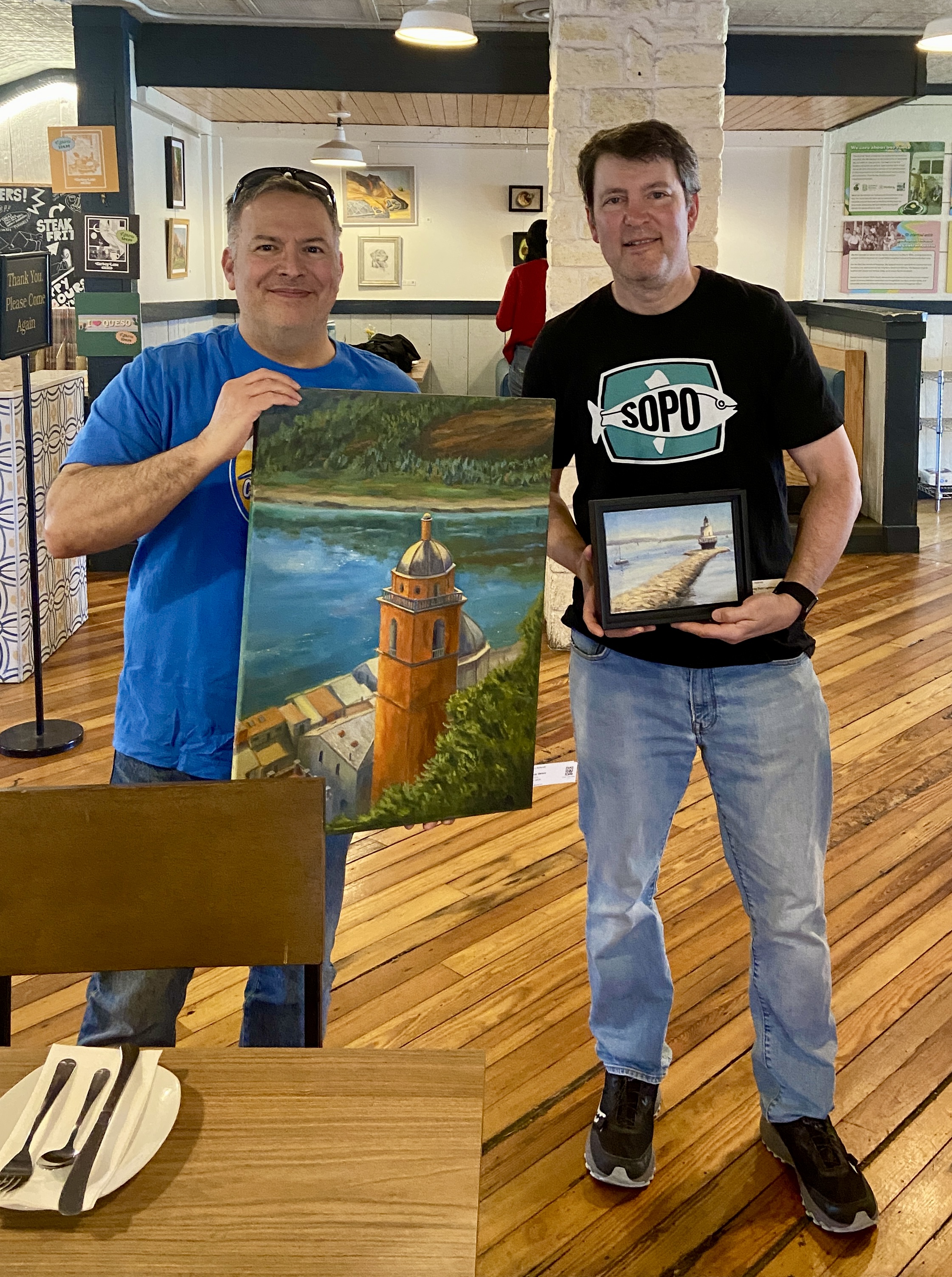
New Collector John with Artist Bern (me, wearing SoPo shirt)
I recently had the good fortune of selling 2 pieces from my solo show, “Something for Everyone”, at Kerbey Lane Restaurant in San Marcos, TX. I got to meet John, who bought 2 of my favorite pieces, “Porto Venere Bell Tower” and “Spring Point Lighthouse”. It’s awesome that he liked two pieces that were different in so many ways – size (small vs large), pallets (bright, warm vs subdued, cool), and landscape locations (Porto Venere, Italy vs South Portland, Maine)! Just proves how versatile art can be!
One of the most rewarding things about selling a painting, even rivaling the cold hard cash, is the chance to meet people who are actually intrigued by something I created. The inspiration I have for a composition isn’t always what piques a collector’s interest. Having the opportunity to chat with new buyers is always an interesting and enjoyable experience for me, as I get to learn about some sliver of their lives and where their newly purchased artwork will fit into their world.
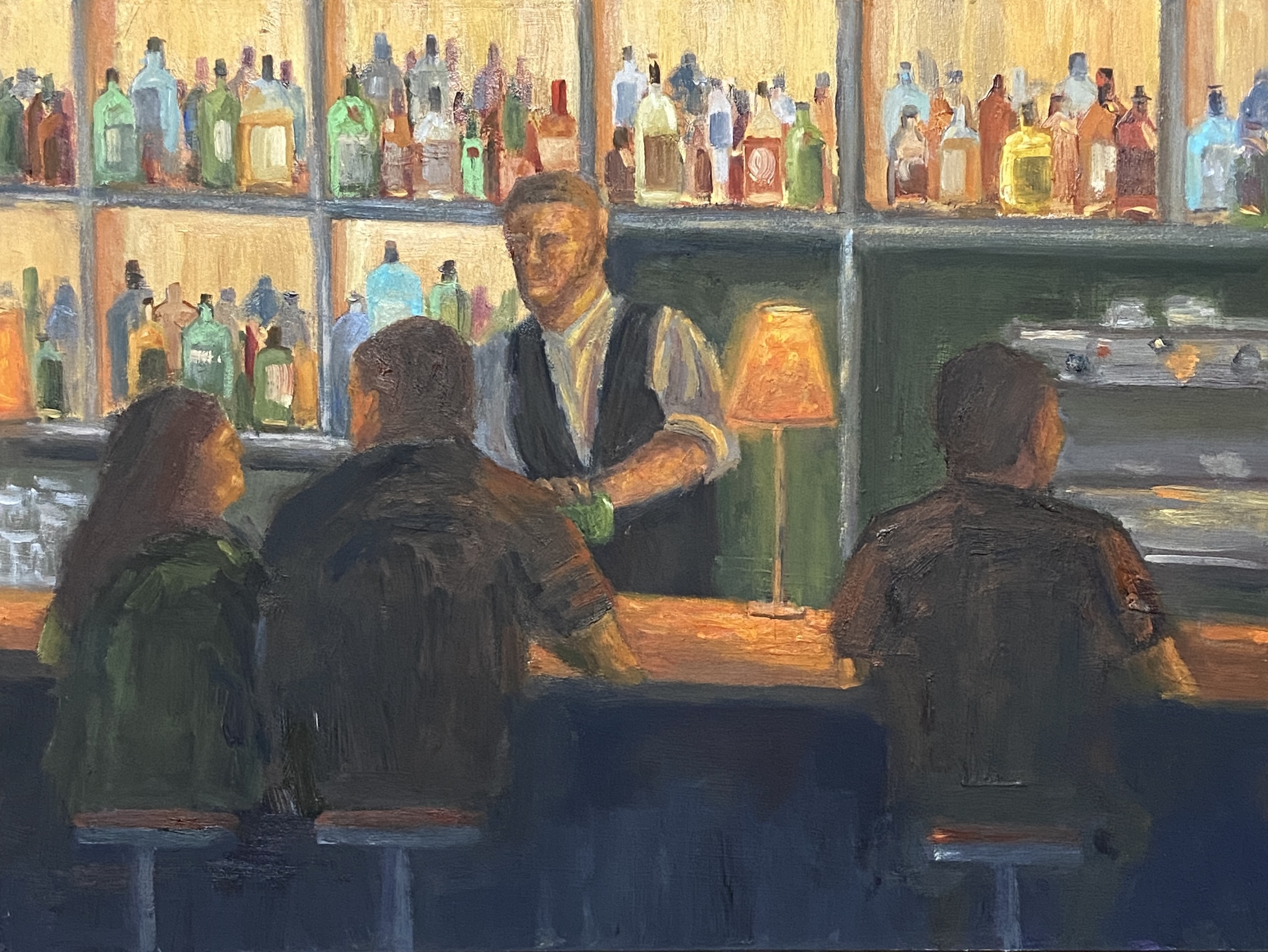
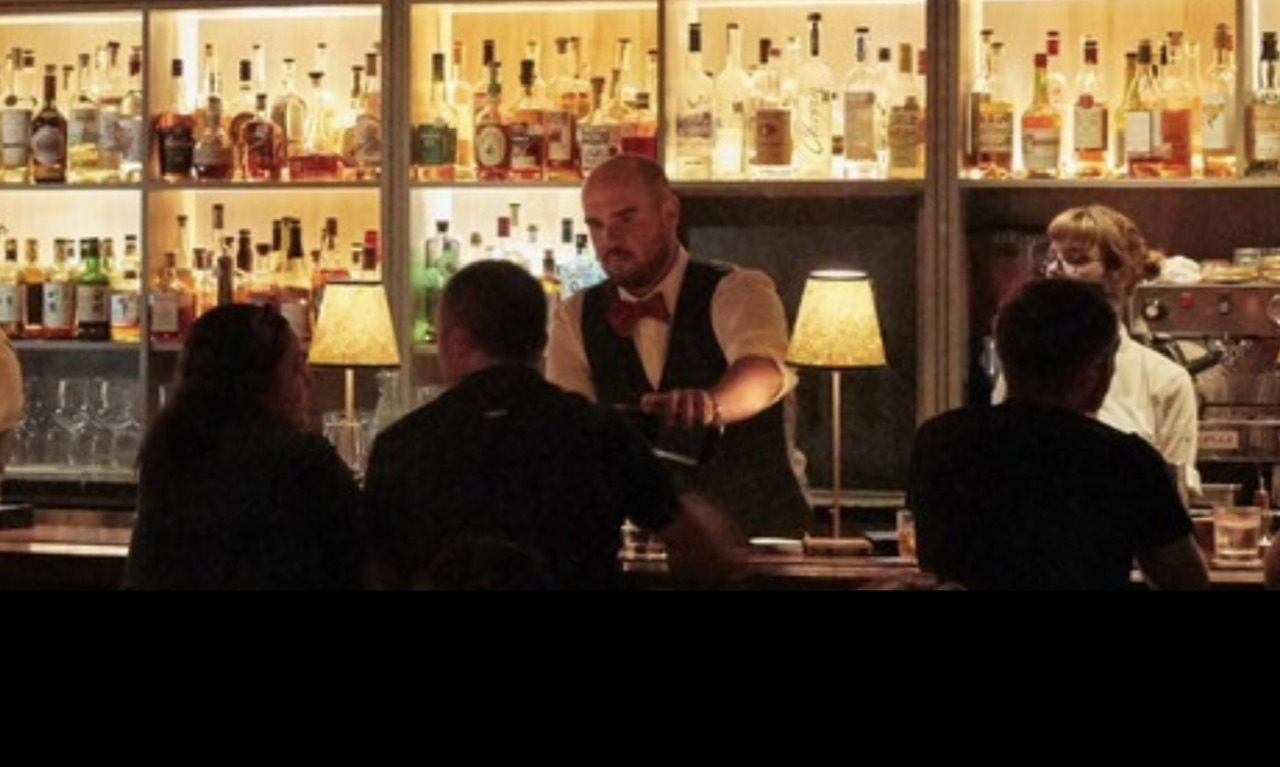
Oftentimes I use my own photos as inspiration for my paintings, but I also use pics from people I don’t know. This is something I believe most painters do, typically for a couple of possible reasons. First, I paint, I’m no photographer, so my photos are, well, not very good. Some things even an iPhone can’t fix. So I might use my own photo as the main reference, but find other options online of the same area to enhance the view. The other main reason for using a reference shot from someone else, be it an individual, magazine, etc., is because it’s something or some place I’ve never seen or been to personally. It’s this latter reason that applies to this new piece, LAMP GLOW.
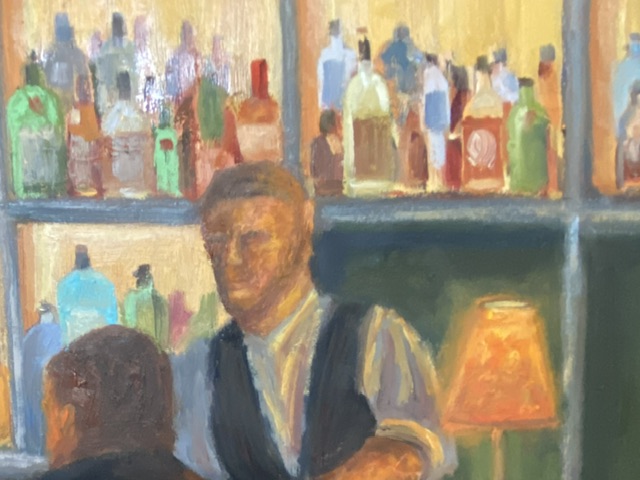
I spent a lot of time on the canvas with this one, which was expected given my lack of experience painting people in detail. In fact, I must have wiped the face of the bartender no less than 6 times, and reshaped the bar patrons many times as well. Ultimately, I’m happy with the result and I learned a lot in terms of technique and what NOT to do.
Lamp Glow Detail
The focal point of LAMP GLOW is the glow from the lamp on the bar, not the lamp itself. Because the glow is a soft light with a mid-range value, it was a little tricky to make it work. Usually, the focal point of a composition is highlighted by things such as high contrast values or sharp edges. Lacking these options I pushed the saturation and ensured the soft, orange light bathed the primary elements in the painting, which (hopefully) makes the glowing lamp a clear focal point given it emanates throughout the scene.
In terms of design decisions, I’m not sure I took the right approach regarding the liquor bottles in the background. While they turned out nicely, I think they’re ultimately a distraction and might be more effective if they were softer and less saturated. Oh, and painting 67 individual bottles is a wee bit tedious.
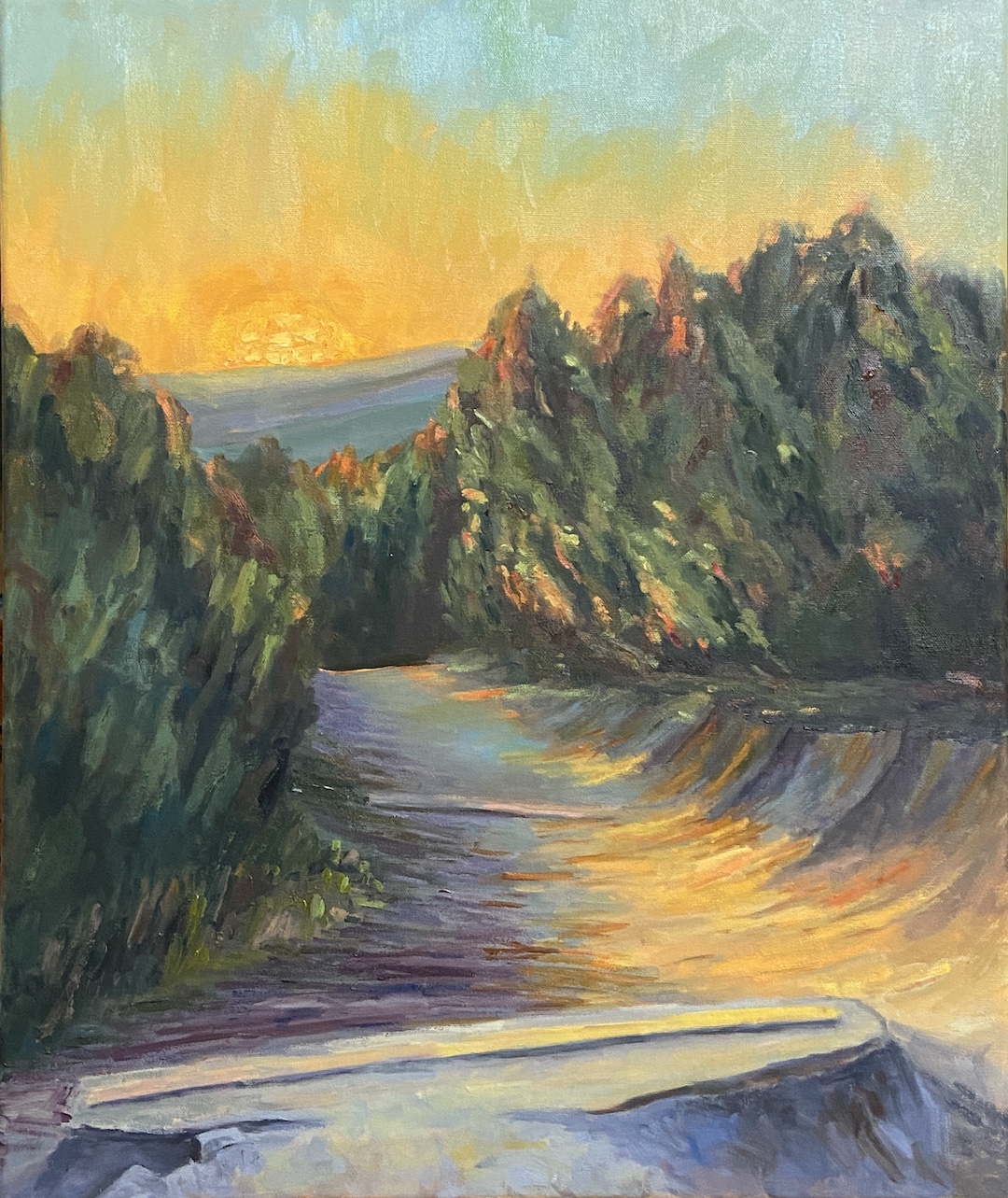
Say hello to the inaugural composition for 2025, HILL OF LIFE. If you’re a mountain biker living in Austin, then you know. For the rest of you, this is the northern endpoint of the Barton Creek Greenbelt, 7 miles upstream from one of Austin’s most iconic sights, Barton Springs.
It’s fitting that the two ends of the greenbelt are polar opposites. The southern end is accessible via a short walk from a parking lot, and is suited for swimming, cooling off, and relaxing in the shade of live oaks. Conversely, the northern entry is a sketchy ride down a steep, rocky, 300 foot drop-in and is suited for mountain bikers with a death wish or adrenaline junkies.
The HOL is actually an old maintenance road that was used (I believe) by the city to access the trail in emergencies, be it fire fighting or EMS services for some poor bastard who’s riding skills couldn’t cash the check their ego was writing. Over the years, the road was decommissioned and all that remains are the cement joints that connected the main sections. Over the years, erosion has created big “steps” off the lip of these joints… and therein lies the focal point of HILL OF LIFE. Oh, and great sunsets, too!
This piece started with plein air sketches, which was easy to do given this location is a 5 minute hike from my house. I had intended to do a plein air study from this location, too, but after the sketches and my own personal experience with this trail over 20+ years, I felt like a study wasn’t necessary. So I teed this up in the studio and started throwing paint at the canvas!
Hill of Life Old RoadHill of Life SunsetImpasto SunHill of Life Kerbey Lane Show
The obvious focal point is the huge setting sun, but I also consider the darkest section, namely the last ledge down the trail, as a main hook for the viewer. The odd looking concrete bar at the base of the painting is one of the aforementioned joints in the original road, which makes a little more sense when you look at the painting and reference photo side-by-side. I spent considerable time ensuring this was more realistic than impressionistic to garner interest in the piece, hopefully without causing confusion for those who haven’t been to the Hill of Life.
Lastly, the sun is done primarily with thicker paint application using a palette knife, which gives it more texture and a stronger presence on this larger canvas. It also allows for more blending, which I find helpful when trying to nail the value and warmth of something as intimidating as the sun.
For those of you in the Austin area, this piece is part of my solo show, “Something for Everyone”, on display (and for sale) through end of June at Kerbey Lane in San Marcos.
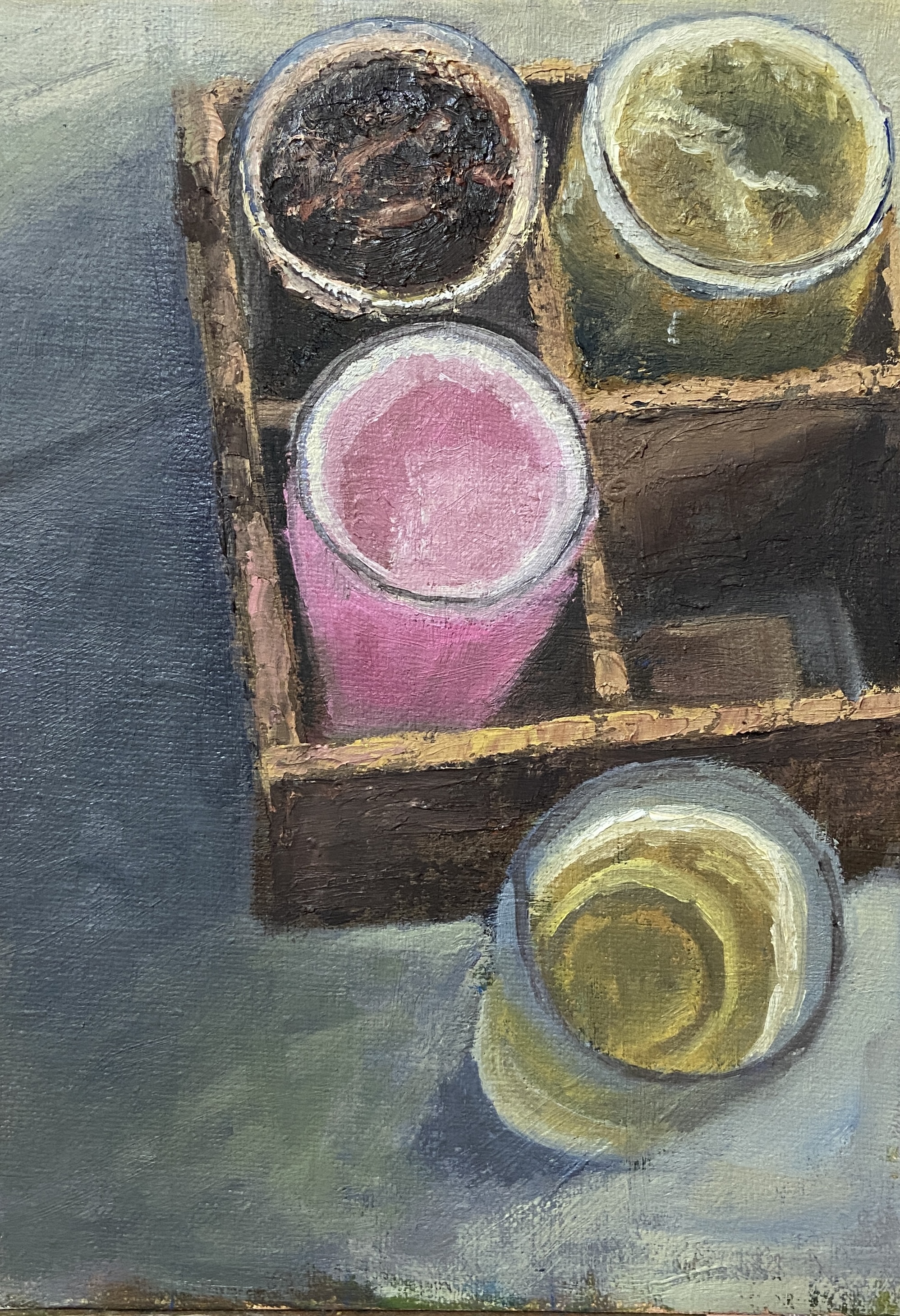
This piece was done earlier this year using a reference photo I took while in Portland, Maine. Most of my works in that area are either “en plein air” or based on my own coastal reference photos. For those of you who have followed my work over the years, you well know I tend to veer to still life from time to time, with a particular affinity for libations. Thus, BEER BOX, technically a beer flight, from Rising Tide Brewery in Portland comes as no surprise.
For the painters out there, remember the use of photo reference is a blessing and a curse. On the one hand, they capture a place or moment for future reference, when perhaps your memory might not be willing to cooperate. On the other hand, they can significantly distort reality and create more problems than they solve. While most of what you read about “painting from photos” (virtually every painting book covers this point) emphasizes the distortions created by photos relative to lighting and hues, IMHO the real terrorist activity of reference photos is their ability to jack with shapes.
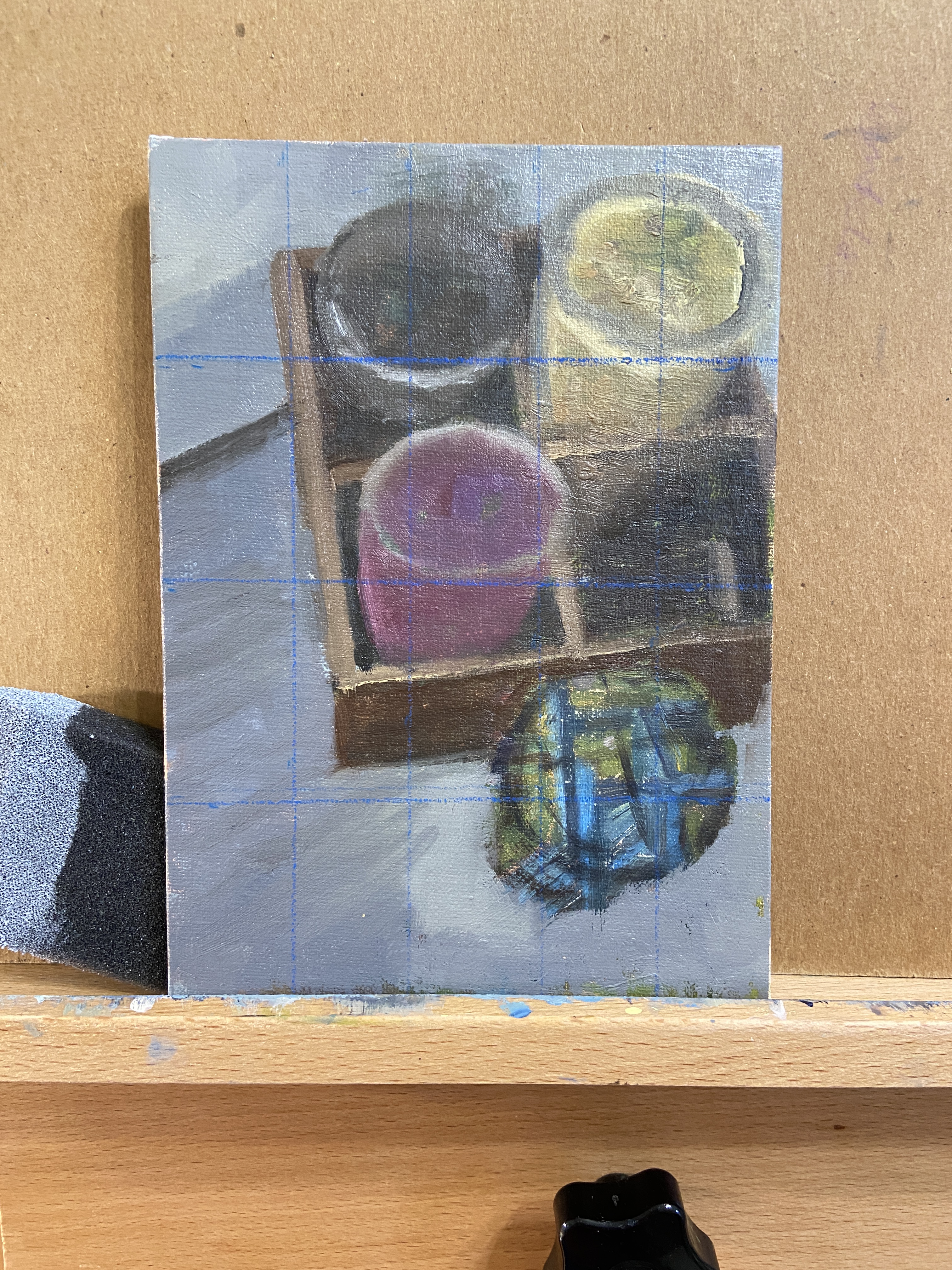
In BEER BOX, I overlooked the shape shifting my iPhone had done to “improve” the photo. I even used a grid to try and get the shapes right, something I rarely employ, and I still didn’t realize the reference photo was just a bit tweaked! It’s hard to notice at first, but the top portion is actually skewed outward, kind of a mini fish-eyed effect. I noticed this after I’d already committed to the compositional structure, so I just rolled with it to see how it would turn out.
In the end, this piece proved to be a perfect mix of frustration and satisfaction. I think it turned out well, despite the odd birds-eye view, and I learned a lot in terms of subtle hue and value changes required to capture the depth of the beer box and how the glassware fades into the deep shadows.
BTW, Rising Tide Brewery makes some great beers and should be a stop on any Portland, Maine brewery crawl. I don’t recall the specific beers in this flight, but the 4 styles were Stout, IPA, Pilsner, and the pink one was a delicious Sour.
Exciting news on the art event front… I’ll be participating in the 31st edition of the Austin Studio Tour the weekend of November 16 & 17th! For those of you in the Austin area, if you haven’t checked out the studio tour in the past, I highly recommend it, even if I weren’t involved. It’s a very rare Austin event that’s chock full of talented artists, free of charge, and it doesn’t take over Zilker Park or Auditorium Shores for the month!
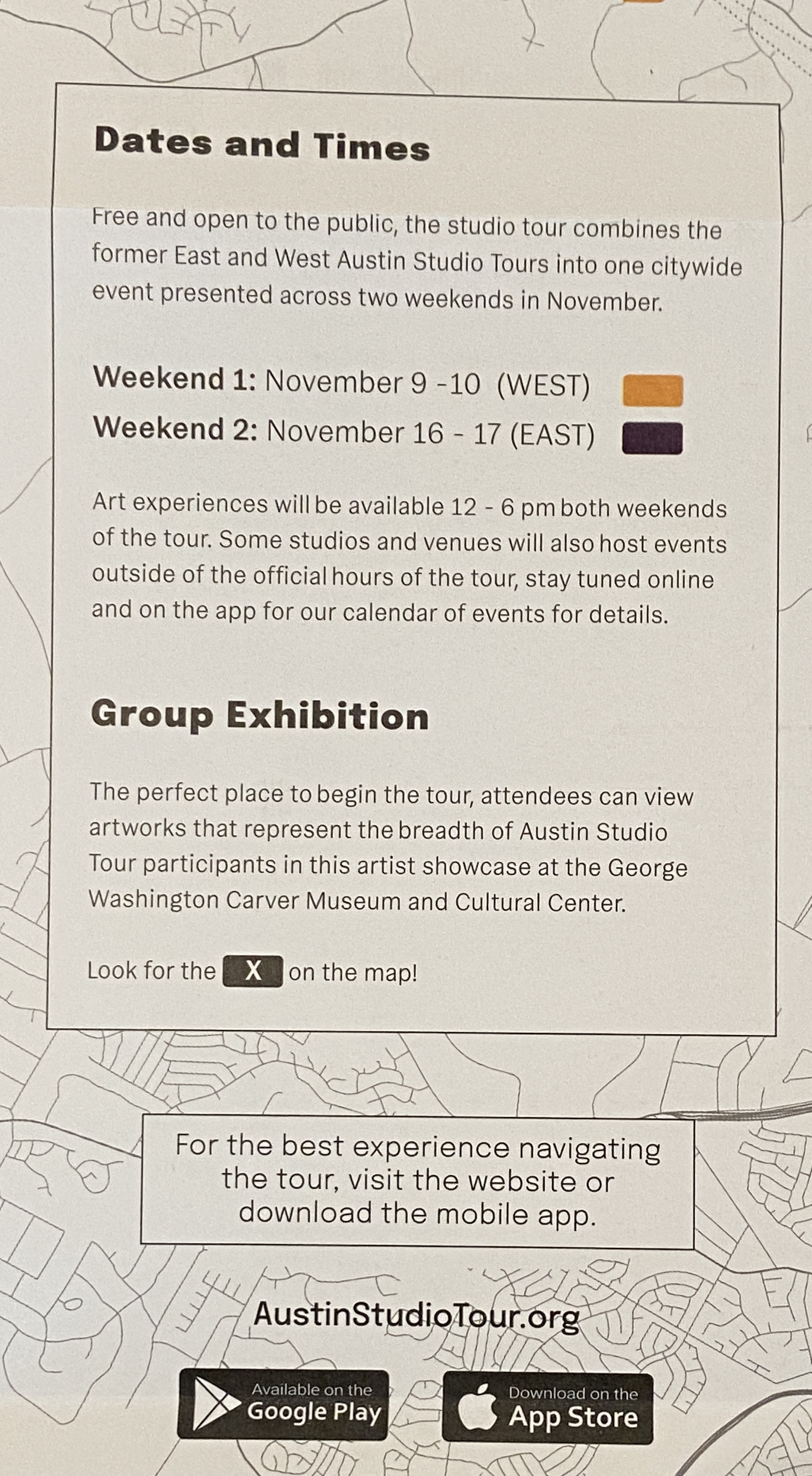
The Austin Studio Tour, in a nutshell: over the course of two weekends, more than 400 artists open up their studios or display in public spaces/galleries… for FREE! The city is basically split into East and West sides (I35 being the demarcation), whereby weekend 1 is “WEST” studio tour, and weekend 2 is what I like to call the OG “EAST” studio tour.
Weekend 1 is today and tomorrow, Nov 9 & 10th, weekend 2 is Nov 16 & 17th. Official opening times are noon – 6pm each day, but there are some that open beyond those times, including Friday evening.
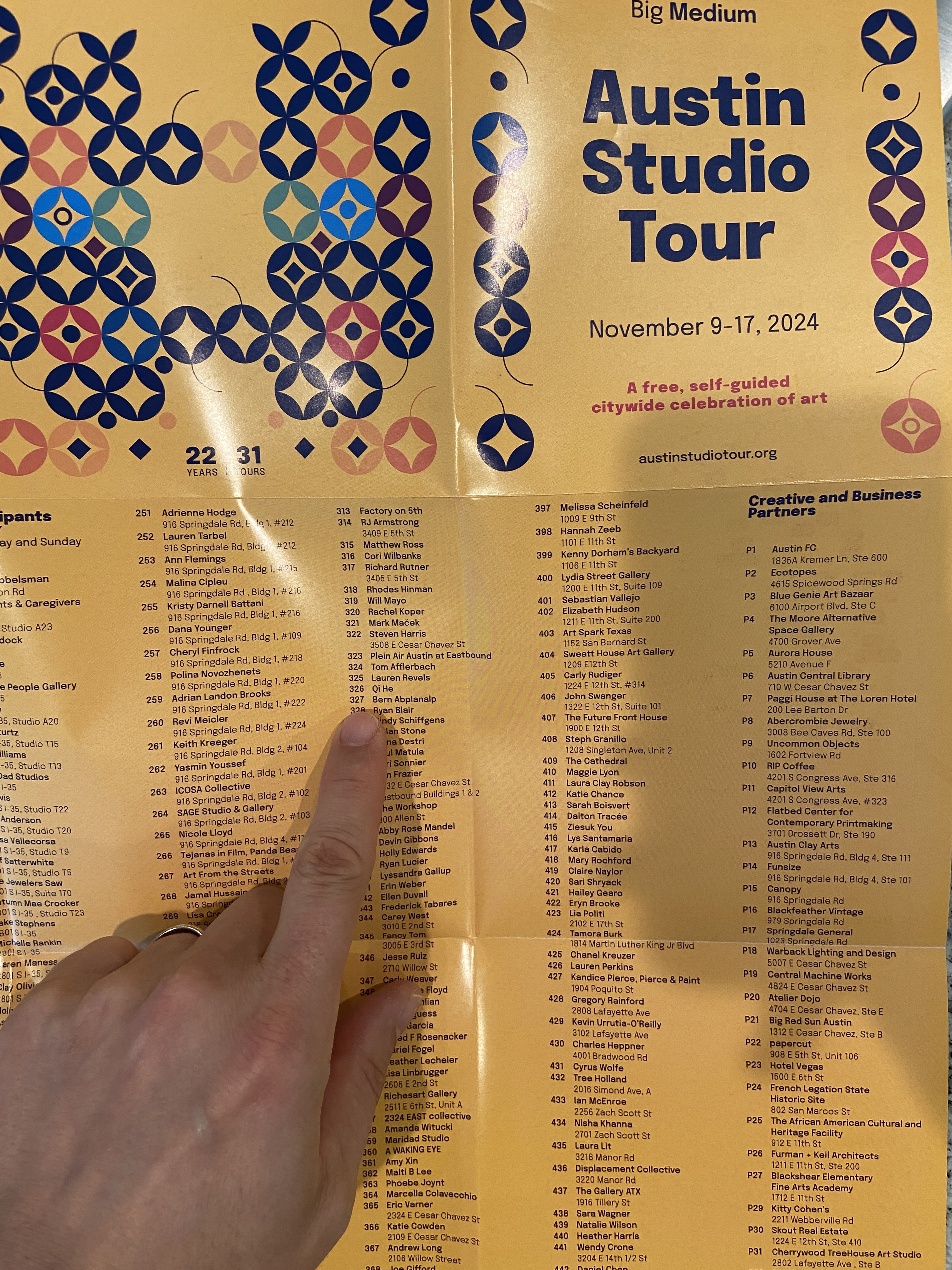
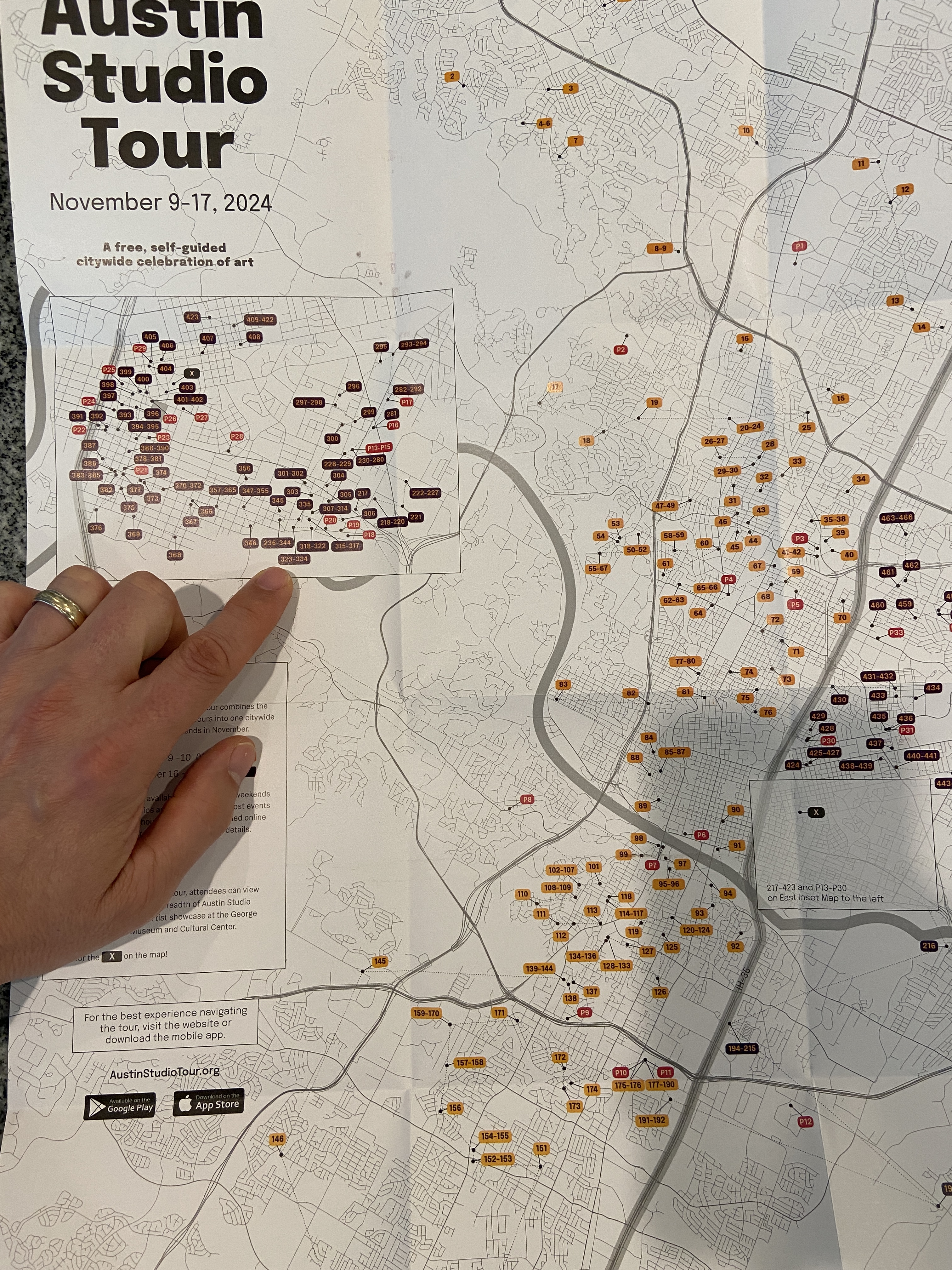
I’m stop #327 at a building called EASTBOUND located at 3232 E Cesar Chavez St. I’ll be joined by a dozen of my painting friends from Plein Air Austin, well, more like I’ll be joining them, so visitors get a chance to see a TON of art at a single location.
I’ll have at least 20 pieces of original artwork for sale, including a bunch of new pieces that will make their debut at this show. It’s a mix of plein air originals, studio work, and per some interest from friends and family I’ll be adding some drawings to the mix.
Stay tuned for more updates, including a list of other artists showcasing their talents at our location, live plein air demo details, and “Beers with Bern” after party locations.
Get out and explore the talent of Austin artists! Hope to see y’all next weekend!
ACORN STREET progress ACORN STREET | 12×9 | Oil on Art Board
As promised, here is the finished work (maybe) of the ACORN STREET study. I say “maybe” because I might opt to add people and give it more activity, but I also like the calm, quiet morning vibe this gives off. I’m guessing the early mornings are the favorite time for the residents of this street as the tourist throngs are still in their AirBnBs second guessing why they hadn’t opted for a hotel with an in-room coffee machine and room service.
I wanted to ensure value contrasts and a loose painting style were key elements of this piece. The flag and sunlit building opposite were intended to draw the viewer down the street, which wasn’t difficult to do as this composition kinda designed itself. The big challenge since the original progress post was adjusting the light from the photo reference so that it realistically “hit” the flag, which meant letting it sneak up the end of the street more than was originally planned.
Lastly, the cobblestones were a last minute addition. I was trying to avoid anything too detailed in an effort to keep the painterly feel, but anyone who’s been on this street knows the cobblestones are integral to the charm. I need to refine my technique in future work, but there are a lot of cobblestone streets that I’d love to paint in the future!
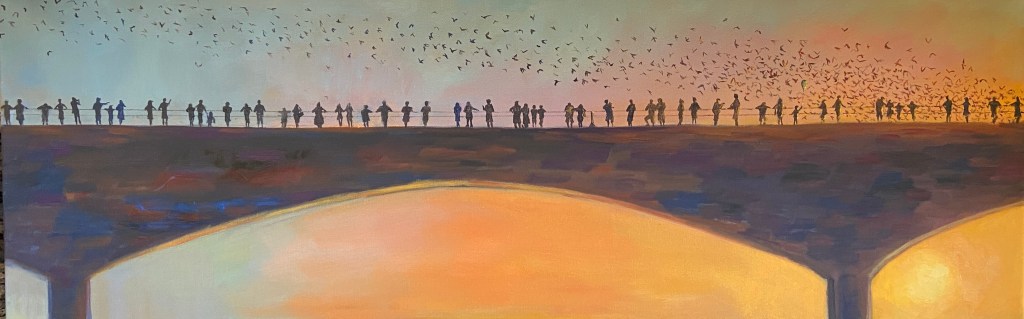
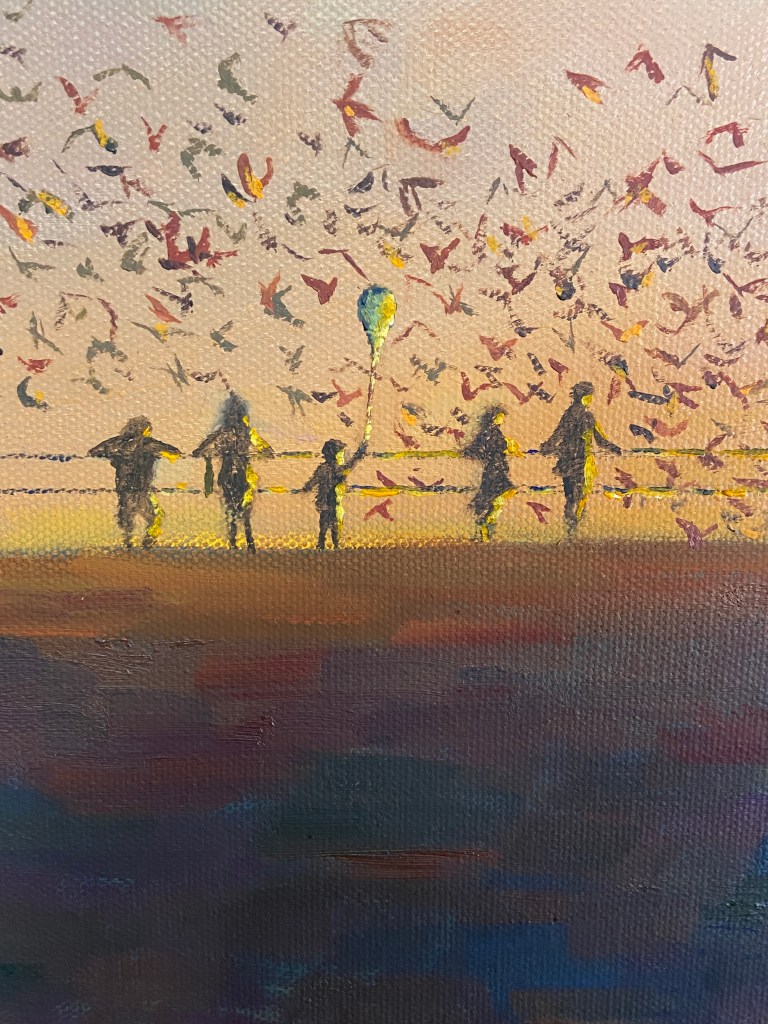
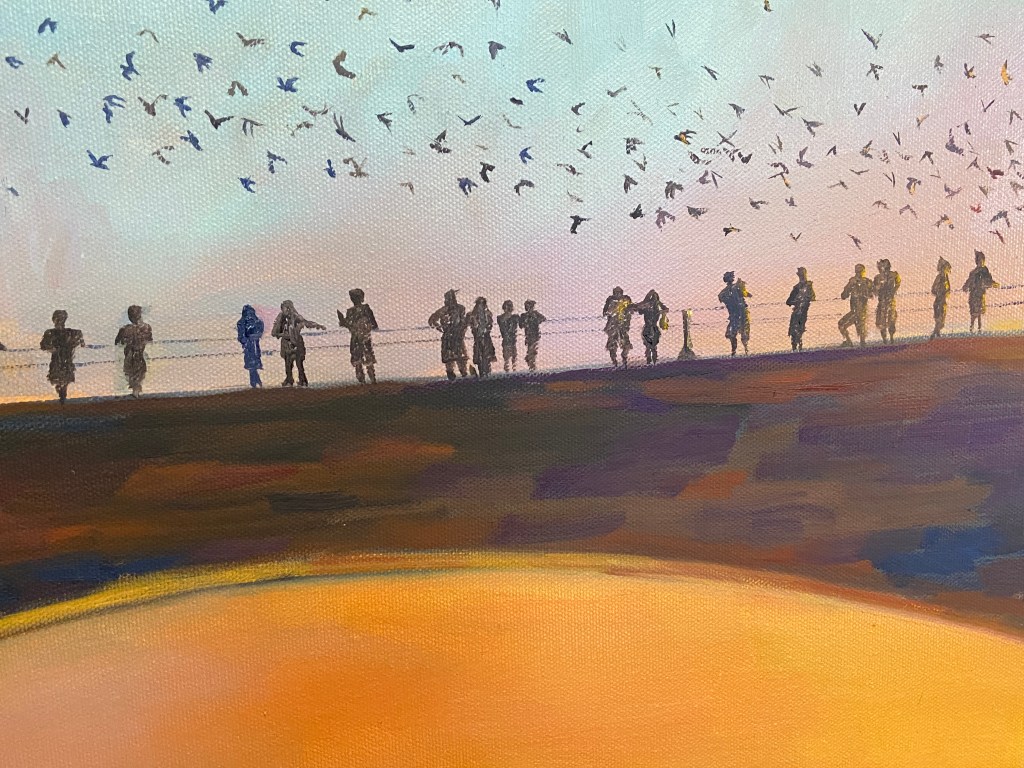
This piece is inspired by the bat colony under the Congress bridge in Austin, Texas, but note they are not the focal point. The 56 silhouettes along the bridge are the intended focal point, which as a group, show the evening observations of the bats on a summer evening. However, as you look at each individual person, you can see how their experience is unique. Hopefully you, as the observer, have some emotional response to some of these folks.
The sun plays a big part in this composition, cascading it’s golden light across the landscape, creating some strong value contrasts not only on the horizon, but also on the silhouettes, especially those on the right side of the bridge. It also creates a balance between warm and cool hues, with subtle purples in the middle creating a temperature transition. Lastly, the sun has been finished with a palette knife for an impasto effect, which helped amp up the brilliance.
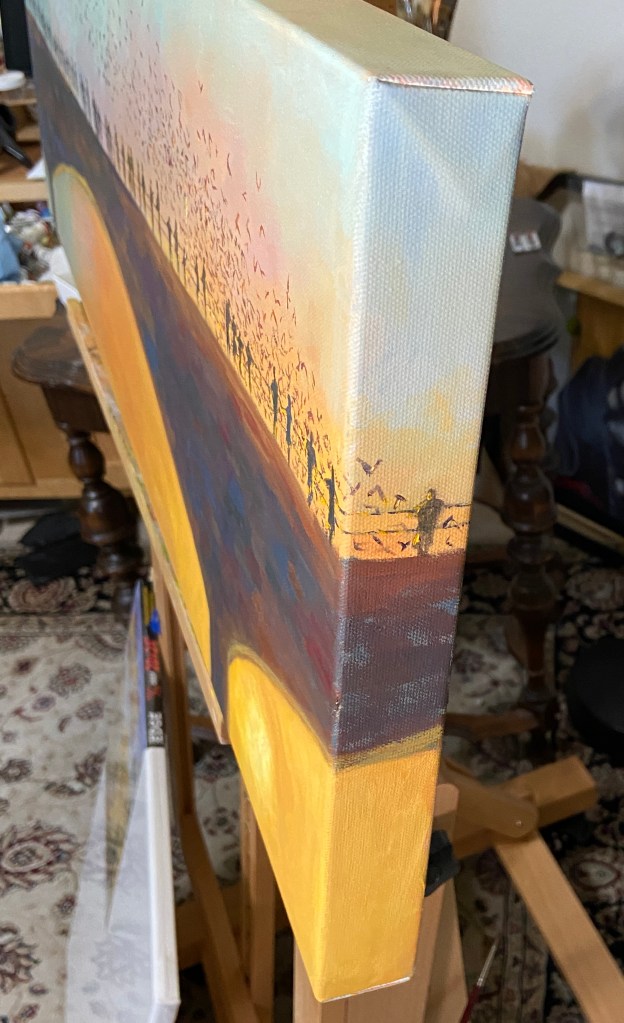
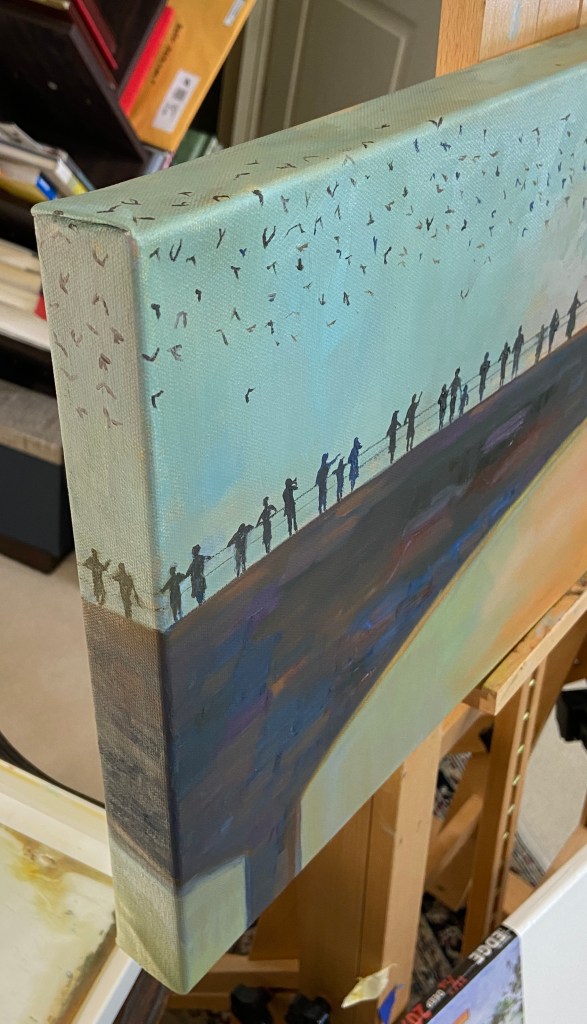
Another element of the composition is the use of the 1.5” edge of the canvas, allowing the bats and silhouettes to flow around the frame. The figures on each side are looking into the painting, which should help direct observers into the composition.
Stay tuned for additional bridge silhouette paintings!
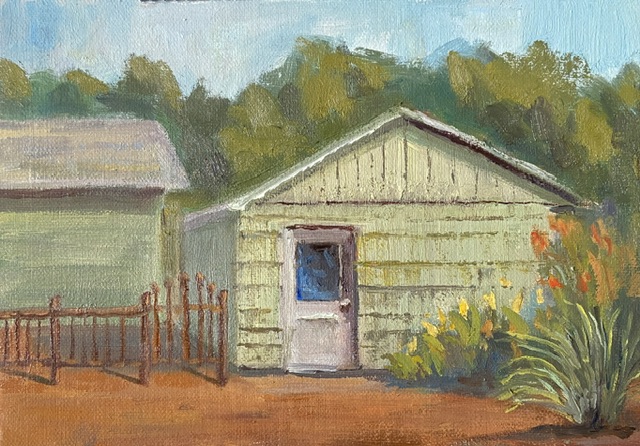
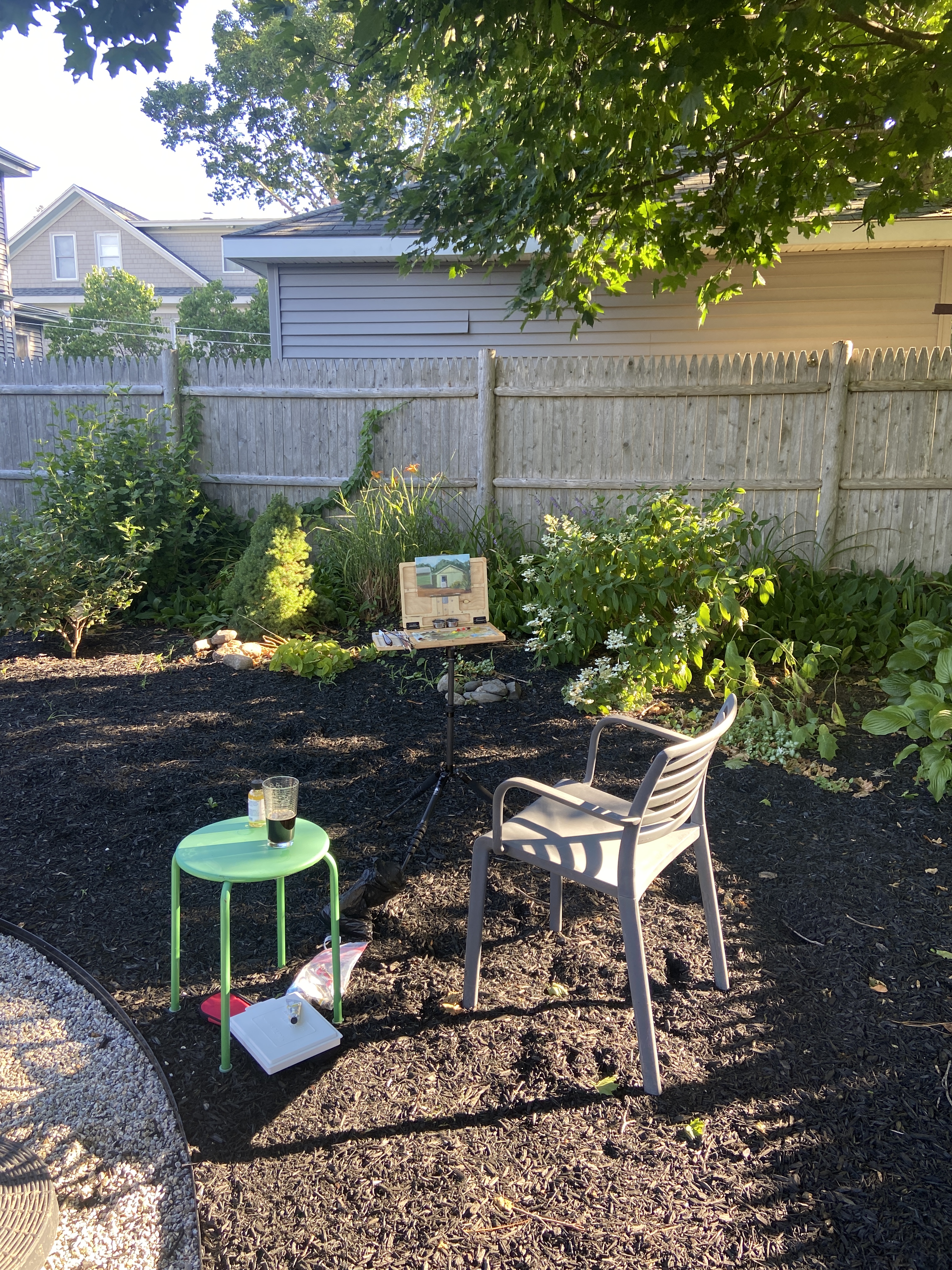
Greetings from South Portland, Maine! Plein air sessions in the July Texas heat aren’t exactly an inspirational setting for creativity, so this piece is brought to you by the cool breezes of the land of 75,000 moose.
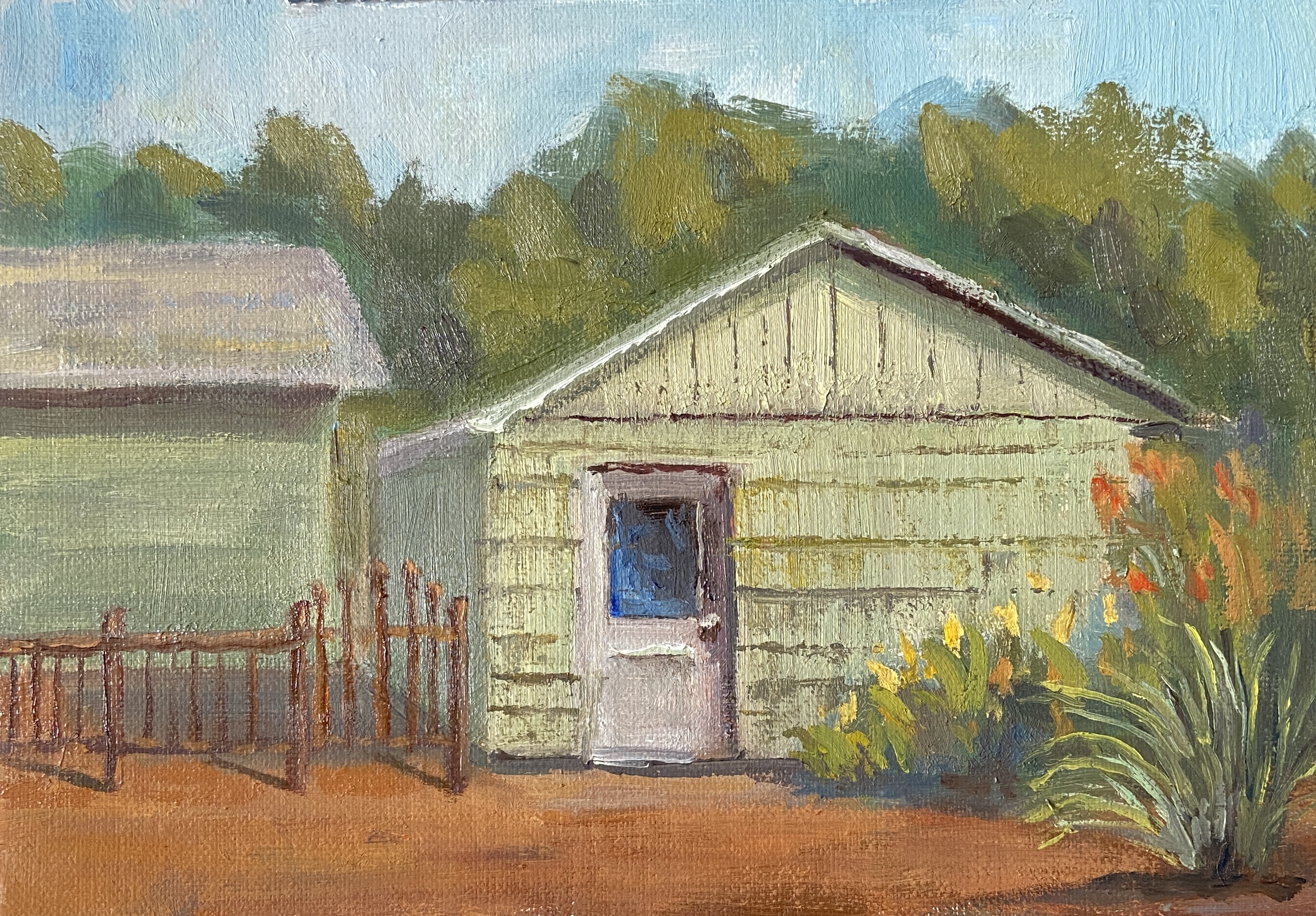
This garage was painted over the course of 3 short sessions in the mid/late afternoon. The shadows created by the sun really make the garage door pop, so I wanted make that the clear focal point without making the white to prominent. The final solution was to tweak it so the black window of the door was the primary focus, using the high contrast in values with the white door as an easy viewing vortex.
In terms of the other elements, a lot of artistic license was taken to pare down the details and keep things simple. That said, it was important for me to include the iron fence and the color of the garage. The fence because the ironwork is very eye catching given the design. As to the green hue of the garage, while I’ll admit it’s not my preferred color, I wanted anyone who’s seen this house and garage to instantly recognize it as “hey, it’s that green garage!”
Lastly, I made a decision in the final minutes of painting, after having thought I was done, which significantly improved the finished piece. Because I don’t have a before and after shot, I can only describe what I did, which was to add the high contrast “rows” on the garage, then scraping down to give the sense of textured panels. I was pretty sure the move was going to muddle the whole thing, but as it turns out it was a vast improvement. I must learn to be much aggressive when painting and this sessions went a long way in validating that approach.
When I first started painting, the term “study” was something I did to suspicious food at a dive restaurant. Over time, I learned that “study” oftentimes meant “practice”, typically done as a trial effort before tackling the same composition on a larger scale. This interpretation is meant to allow the artist to figure out technique, color palette, and orientation of the work. Fast forward to current day, I’ve come to find that “study” can mean a brutal self-critique of a practice painting that becomes more than a mere invalidation of the compositional structure, but rather a realization that you buggered it up entirely!
Of course sometimes a “study” can magically have no serious flaws, the plaint flowed effortlessly, and all your compositional ideas worked beautifully. Sometimes.
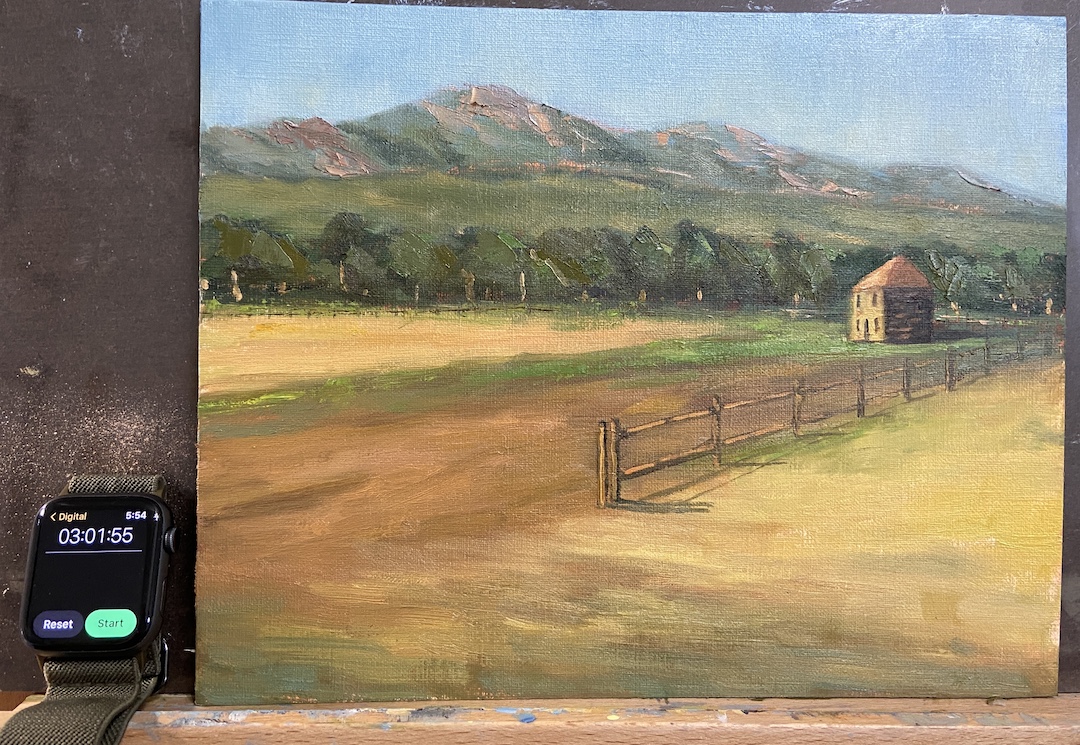
The study FLATIRON HOMESTEAD is proof that this practice has merit! That said, I like this piece because at the end of the day it was a lot of fun, the palette is pretty good, and doing a “real” painting is a likely outcome. There are progress photos per usual, but I’ve also included an annotated version of the completed study to point out the issues of which are detailed below.
This was painted from a reference photo taken by my mom during a plein air session we did last year near El Dorado Canyon, Colorado. It’s a beautiful location as you can see for miles along the Front Range with the Flatirons as the backdrop. To insert a human-made structure as the focal point of the piece felt wrong and awkward, but in the end it worked out.
I did a couple of sketches to mock-up compositional options, taking more time than I normally would, which I think proved beneficial because the core approach turned out to be much more compelling than the reference photo itself. The other key to this study was setting a time limit, which I chose to be 3 hours. The idea being to not overthink it, but give myself enough time to get the core elements fleshed out properly. This worked well because in the end I had to make major design change decisions (see fence line) quickly, focus on values over hues, and avoid the complication of detailed brush strokes.
Following is the summary of what I learned from this “study”:
1. The tree line is oddly symmetrical in terms of height. Not good! Need to change that next time and always be conscious of varying heights.
2. The fence line is a little too straight, even after the compositional decision to remove part of the fence so it didn’t cut the painting in half.
3. Light source is inconsistent. This would never happen if I painted this en plein air because it would have been impossible to ignore the sun, but drop me in the studio and things can get whacky. The sun is overhead for the flatirons and fields between the trees and the mountains, but the foreground and focal point are clearly lit by a sun that’s more on the horizon, albeit not sunrise.
4. Cast shadows of the fence line are critical and extremely effective. On a larger piece this will really grab the viewer and suck them into the painting.
5. The homestead building angles aren’t right, most likely the front side that’s lit by the sun needs to be a little less wide. This is the only real negative I found by having a time limit because I could have taken the time to repaint this part… then again, why bother if this is a “study”?
6. The highlighted tree trunks, meant to capture the high value contrast of the sunlight coming across the field, are effective and something I want to use in a larger piece, but in this study they are way too big/wide. Should have used a lighter touch with a think brush.
7. The sky color is excellent! I made an adjustment in the 2nd hour to the sky, deciding it was too blue and dark. This has been a problem for me in the past with landscapes, but I think this provides better awareness going forward, namely start lighter than I think it accurate and darken if needed.
8. The flatirons look really good, even though they’re just supporting background to the main elements. I used a palette knife to scrape the granite colors into the greens and that worked well. Need to remember that trick for future efforts.
So, that about sums it up. As you can see, you can learn a lot if you “study”!
Flatiron Homestead ReferenceBlock In – Values!Uhm… lotta greenPalaette and Values WorkingFence Line Needs Help3 Hours Limit!Final FLATIRON HOMESTEAD
If you’ve lived in South Portland, you knew the Fishing Shacks. If you don’t, please get out more and explore the wonders of your own backyard!
For the uninitiated, the last of the 3 remaining, dare I say “iconic”, Fishing Shacks were sucked into Casco Bay on January 13, 2024. Over their 120+ years, these historical structures had endured whatever the tumultuous Maine coast could throw at them, but a record tide (14.57 feet) coupled with a massive storm surge was a one-two punch they simply couldn’t withstand.
Many Fishing Shacks On Willard BeachShacks Stored Fishing Gear… Maybe Bodies 🙂Fishing Shacks With Metal RoofsReference Photo of Fishing Shacks – August 2023
Despite their absence, they leave many fond memories, a rare marriage of human structures and the natural environment which, together, made Fishermans Point a better place. As an artist, one of my primary inspirations is to return to a fond location and remember the time I spent there by recreating a view or experience on the canvas. Regarding the Fishing Shacks, my wife and I spent many happy hours soaking in the sights, sounds, and sea air on Fishermans Point, the shacks standing guard. It was, and still is, our happy place… just a little different now.
The painting (not my first of the shacks, see Fishing for Edward Hopper) is meant to capture that unique light at the end of the day when the world is bathed in golden rays and everything looks just a little more inviting. I used very little artistic license regarding the shacks themselves, as I wanted to preserve their actual structure as much as possible, including their positioning on the rocky point.
Experimenting with color to figure out the right palette for the waterZoom In Shacks
I used a painting knife and broken color on the illuminated side of the shacks to ensure they were the focal point of the work, most notably the railing leading to the first shack, guiding the viewer into the work. The use of high contrast values of the railing against the sunlit side of the shack should pull you back to that point every time you look at the piece, supported further by the diagonal cast shadows of the railing on the shack wall.
Compositionally the piece could be unbalanced and wonky, the shacks and rocky point stacked on the right side.To offset this issue, I incorporated a lot of high value, strong chroma setting sun reflection in the still(ish) blue waters on the left side. This is a relatively new compositional strategy I learned from another artist, Jeanne Hougen , who I had the pleasure of taking a class earlier this year.
Lastly, there is some hidden meaning in this composition, most notably the lack of the rocky point and the supporting stilts of the shacks in the water’s reflection. This was done intentionally and is meant to represent the physical disconnection of the shacks from Fishermans Point, but also a reminder of their powerful presence in the memories of all of us who shared time with them looking across the bay.
Reference PhotoBlock InProgress – Sky Sets ToneBright Blue Water Aint RightWorking in ReflectionsSunlight Reflection for BalanceSHACKS OF GOLD | 20×16″ | Oil on Canvas













 Art Bern