And now for something completely different! Lo and behold the first abstract piece I’ve done in years. Why, you ask? It was a gift for my niece, who had seen something similar on eBay but she didn’t win the auction. Arty farty uncle to the rescue! Well, truth be told, my wife was the one who asked if I could help out and create something similar.
Of course! I love the challenge of making a copy of an existing painting. On the occasion that my imitation successfully mimics the original, I get quite the painterly adrenaline rush!
There were two primary enhancements I made to this abstract piece, one a brilliant suggestion from my wife, the other a need to play with impasto mediums. First, my wife noted that our niece is a big Cowboys football fan, so why not substitute the metallic gold of the original with silver. For the uninitiated to the cult of Jerry Jones, the team colors are blue and silver, thus the resulting palette. The other detour was the introduction of thick impasto elements, which I felt would add further interest to an otherwise limited composition.
I was quite happy with the outcome, although I think the use of gold per the original piece is a better look… for me. Customizing for my niece gave it more meaning, and makes for a better art story when there’s something personal driving the trajectory.
I’m inclined to dabble with more abstract compositions from time to time. It’s a nice pivot from the more exacting nature of landscapes and still life works. I can also experiment with palettes that deviate from my standard setup. Should prove interesting!
Original Reference ArtworkImpasto ElementsFinished Piece
What makes something iconic? “Widely recognized and well-established” is the Merriam-Webster technical definition. For me, it’s something that is instantly recognizable and evokes a sense of place, which means that one person’s “iconic” is another person’s “what the…?”
As an artist, creating an artwork based on an iconic place can be a tall order, something that the voice in your head quips “you better get this right”. There’s also a category of artists, the ones with more ego than talent or sense, who consider many subjects beneath them and not worth the flex of their brush. For these nimrods, the most egregious waste of their precious time is painting something iconic, cataloging the entirety of these subjects as passé, predictable and pedestrian.
What the aforementioned dolts don’t seem to understand is that most people gravitate to artwork that’s relatable, and there’s no better way to make something relatable than to make it recognizable! When it comes to leveraging the power of an iconic subject for a painting, I think its important to “get it right”, whatever that really means, but also put it in a setting or context that grabs the viewer’s attention. One way to pull this off is to present the icon in the evening, known as a “nocturne” in fancy art vernacular, whereby the setting is atypical yet still recognizable.
ONE NIGHT ONLY is, hopefully, instantly recognizable by any resident, past or present, of Austin, Texas. The Paramount Theater, and arguably to a lesser degree, the State Theater, epitomize the Old Guard that is downtown Austin. The Austin skyline has transformed over the past 15 years at an insane pace, but it’s hard to wax nostalgia over skyscrapers, in large part because, in my humble opinion, none are iconic, with two possible exceptions. First is the State Capitol, the original skyscraper of Austin, which held the crown of the tallest building in Austin for more than 70 years! Second, the Frost Tower Building (full disclosure, it’ one of, if not my wife’s favorite downtown building), which while it held the crown for a meager 4 years (2004 – 2008), was such a beautiful piece of architecture, residents readily recognized it in pictures and movies… by name! In other words, it was iconic.
Finally, there are a few technical details you might find of interest, and perhaps elicit some additional joy from the painting. Or not.
First, there was a lot of simplification, which was driven by equal parts fear and intent. As chance would have it, the very basic, loose structure of the dark buildings in the background turned out to be a happy accident. Initially, these were a simple dark value block-in that were necessary to contrast the very bright elements of the signs. I never bothered to go back and refine this area, frankly forgot about it, and then realized it did a fantastic job of directing viewers to the focal points. The second bit of artistic license was the exclusion of pretty much all of the Paramount building details. This is the fear factor, whereby I didn’t want to tank the composition with the distraction of what would have certainly been mediocre windows and brick detail. The cast shadows on the roof paired with the glowing orange wall is meant to anchor the right side of the work, which would have been difficult to do with architectural details.
As you can tell from the progression gallery below, the lettering of the signs was done by hand, no stencil and it evolved quite a bit over painting sessions. I practiced the lettering on separate paper canvas, experimenting with different brush shapes and sizes, as well as variations in paint load.
Regarding the Paramount marquis, the ultimate focal point of the work, it has virtually no paint! I washed the underpainting off of that area early on, and like the simplified background buildings, I never went back to it until the very end, and that was only to add “ONE NIGHT ONLY” lettering.
Lastly, note the lack of people on the street. This was intentional, but I struggled with the decision. I like adding people to urban scenes like this, in large part because they add interest, motion, and a sense of place. However, without them, the scene has that feel of a theater that has a full house and nobody is lingering outside. Hopefully that intent translates to you, too.
ONE NIGHT ONLY will be making its public debut this week at my solo show at Kerbey Lane Cafe (Westlake), “Paintings and Pancakes”. Come by and check out the 25+ pieces of artwork while enjoying the sweet nectar of pancakes and syrup!
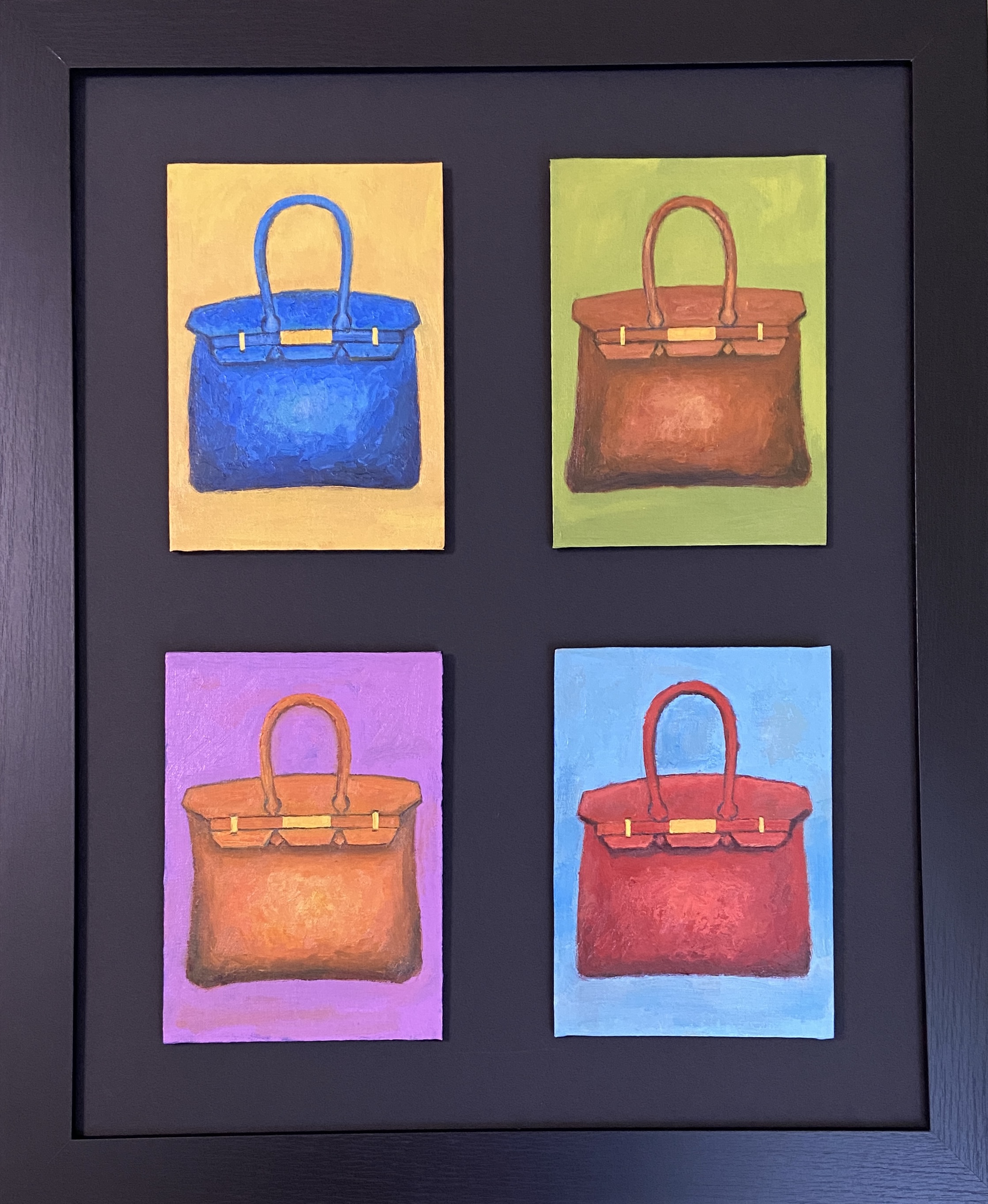
ENVY | 4 @ 5 x 7”, Grouping 16 x 20” | Oil on Canvas Boards
Finally, the Birkins are done and assembled as the ultimate quadriptych, ENVY! Hopefully it’s readily apparent that this composition is inspired by Andy Warhol, which is somewhat ironic because Warhol’s work never resonated with me. That said, I can’t deny he had some uniquely creative compositions that piqued one’s interest.
The Hermès Birkin Bags (Sotheby’s has an Interesting article about the origin of the Birkin name) make for excellent still life models, I guess… given they cost $15,000 and beyond, I didn’t have one handy for modeling in the studio. However, between my wife’s distractingly pink knockoff “Firkin”, and the internet’s infinite library of images, I was able to cobble together plenty of reference material.
I really enjoy doing still life pieces, but things like purses and clothing have very tricky shape and textural challenges that are, quite frankly, intimidating to translate on canvas. To help me temper the difficulty level, I allowed myself the flexibility to NOT create 4 identical purses, but rather focus on the design elements that are common across a given Birkin release and really blow up the interest level with colors. The end result was 4 Birkins that have very similar handles, hardware and shape, but none are identical.
In terms of focal point and compositional strategy, the quadriptych lends itself to some interesting options. Ultimately, my intention was to allow the viewer to pick the focal point, which was done by looking around the composition and evaluating for themselves which bag they liked the most, thus the focal point… for them. My wife, who has a real eye for framing, had the bright idea of using a black background and black frame to ensure the panels really pop for the viewer. Given the high key value of each panel, the use of black readily achieves the goal of pushing the paintings at the viewer.
One last note regarding ENVY, notably the custom framing. I used a matt board cutter to replace the white background that was original to the frame. The panels themselves are “stuck” to the matting using Command Picture Hanging Strips, which are essentially heavy duty Velcro that “clip” together. This makes the panels float above the matting a little – I had to paint the extremely skinny, almost non-existent edges of the panels black so the white of the canvas board wasn’t visible in the raised structure.
ENVY will be added to my solo show, “Paintings and Pancakes” at Kerbey Lane Cafe in Austin (Westlake location), Texas. Swing by and check out the 25 pieces currently on display and available for purchase!
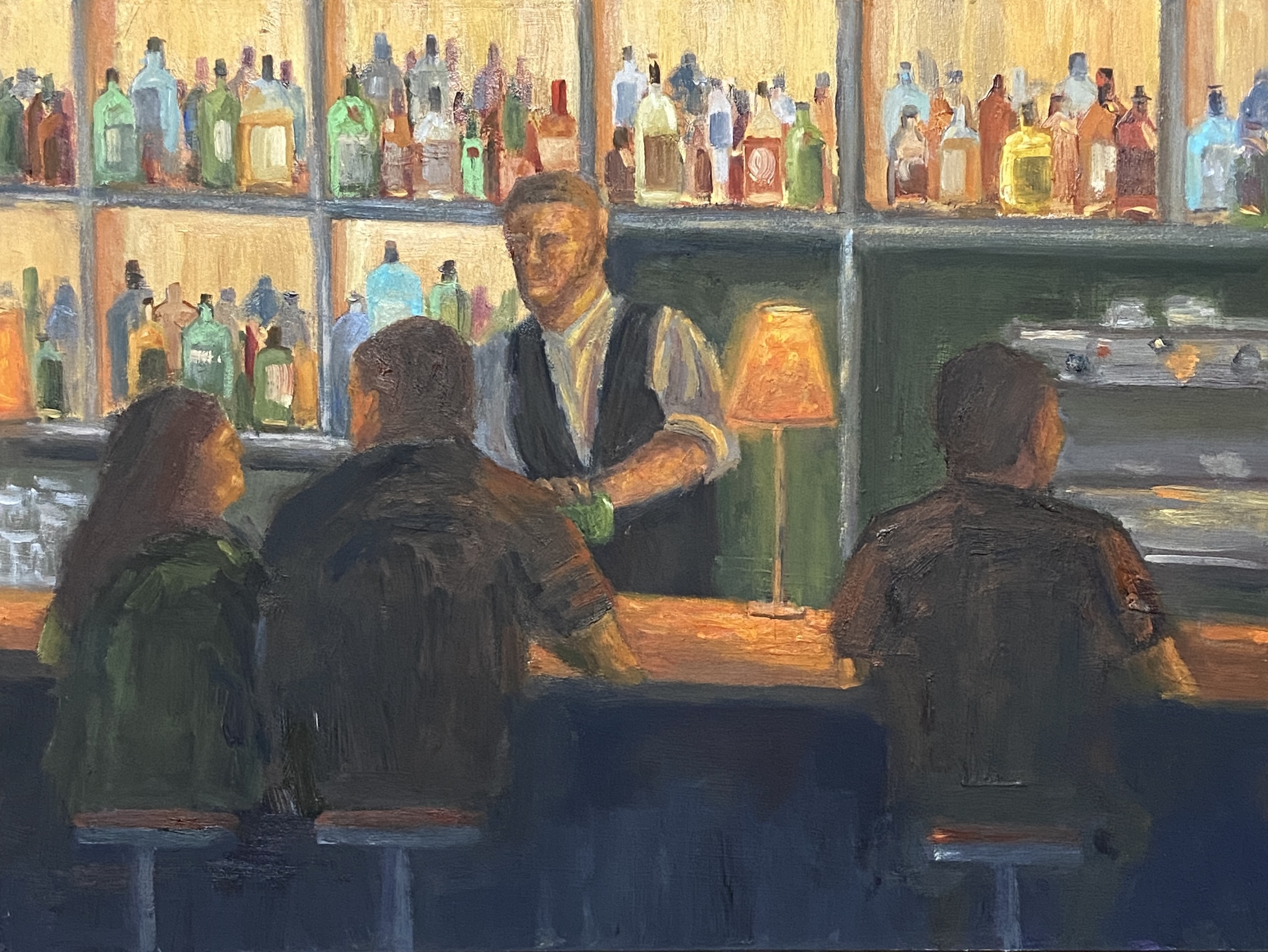
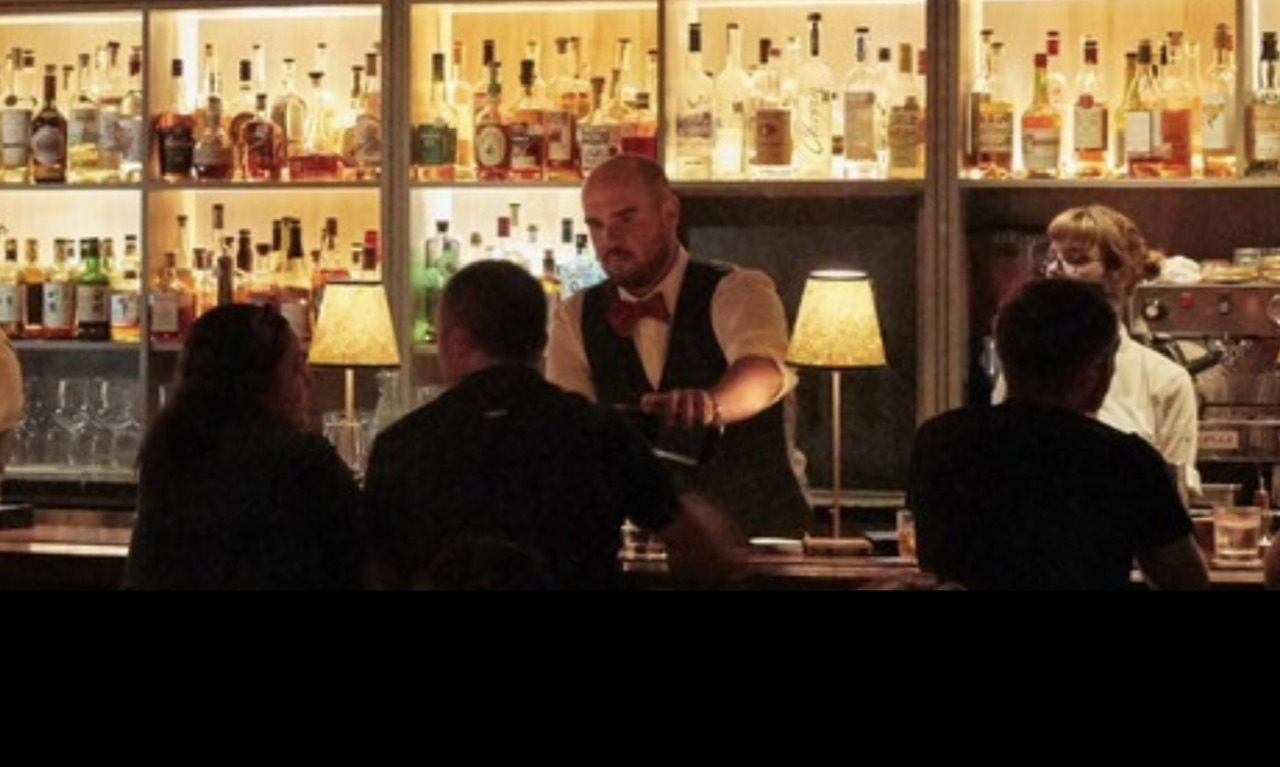
Oftentimes I use my own photos as inspiration for my paintings, but I also use pics from people I don’t know. This is something I believe most painters do, typically for a couple of possible reasons. First, I paint, I’m no photographer, so my photos are, well, not very good. Some things even an iPhone can’t fix. So I might use my own photo as the main reference, but find other options online of the same area to enhance the view. The other main reason for using a reference shot from someone else, be it an individual, magazine, etc., is because it’s something or some place I’ve never seen or been to personally. It’s this latter reason that applies to this new piece, LAMP GLOW.
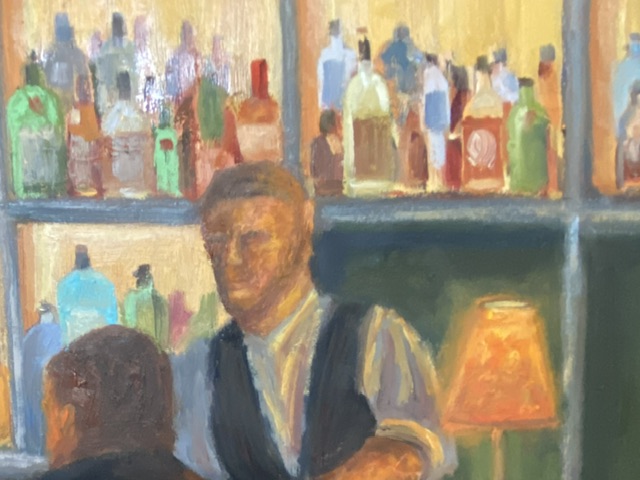
I spent a lot of time on the canvas with this one, which was expected given my lack of experience painting people in detail. In fact, I must have wiped the face of the bartender no less than 6 times, and reshaped the bar patrons many times as well. Ultimately, I’m happy with the result and I learned a lot in terms of technique and what NOT to do.
Lamp Glow Detail
The focal point of LAMP GLOW is the glow from the lamp on the bar, not the lamp itself. Because the glow is a soft light with a mid-range value, it was a little tricky to make it work. Usually, the focal point of a composition is highlighted by things such as high contrast values or sharp edges. Lacking these options I pushed the saturation and ensured the soft, orange light bathed the primary elements in the painting, which (hopefully) makes the glowing lamp a clear focal point given it emanates throughout the scene.
In terms of design decisions, I’m not sure I took the right approach regarding the liquor bottles in the background. While they turned out nicely, I think they’re ultimately a distraction and might be more effective if they were softer and less saturated. Oh, and painting 67 individual bottles is a wee bit tedious.
This is the first of numerous drawings I’ll be doing over the course of the coming 30 days. There are a number of goals involved with this exercise. Initially, I was going to set a lofty goal of a drawing-a-day, but reality has set in and the target has been tempered to draw-a-day.
This drawing, ROSE, is from day 3 of the challenge. I’ve done a painting called YELLOW ROSE in the past, based on the same reference photo, so it was interesting to return to this after a few years. I was surprised how quickly this drawing came together; some sort of long-term artistic muscle memory.
The other benefit of a self-imposed 30-day draw challenge is that it drives me to practice potential new compositions. Doing a quick sketch of a painting subject is helpful in the field for plein air, and for studio work, but sketches are typically done to refine the compositional strategy. However, doing a more complete drawing answers the question, “do I want to paint this?” Sometimes, you get into the details of a painting and realize that it’s not any fun because it’s either beyond your skill set, too tedious, or simply not very exciting.
In the coming weeks, stay tuned for more drawings auditioning to become paintings!
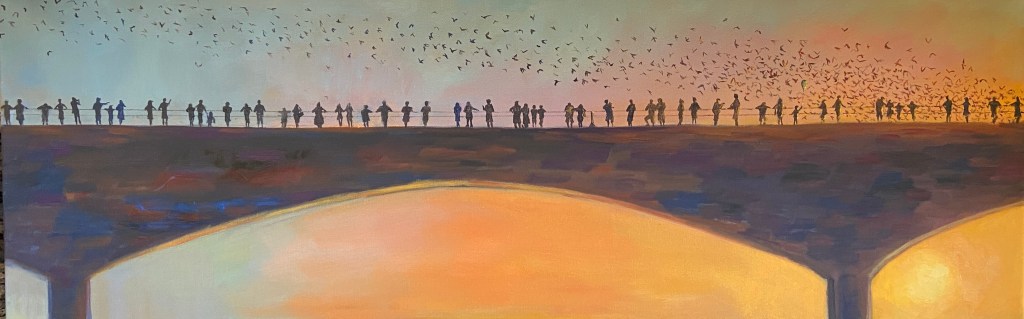
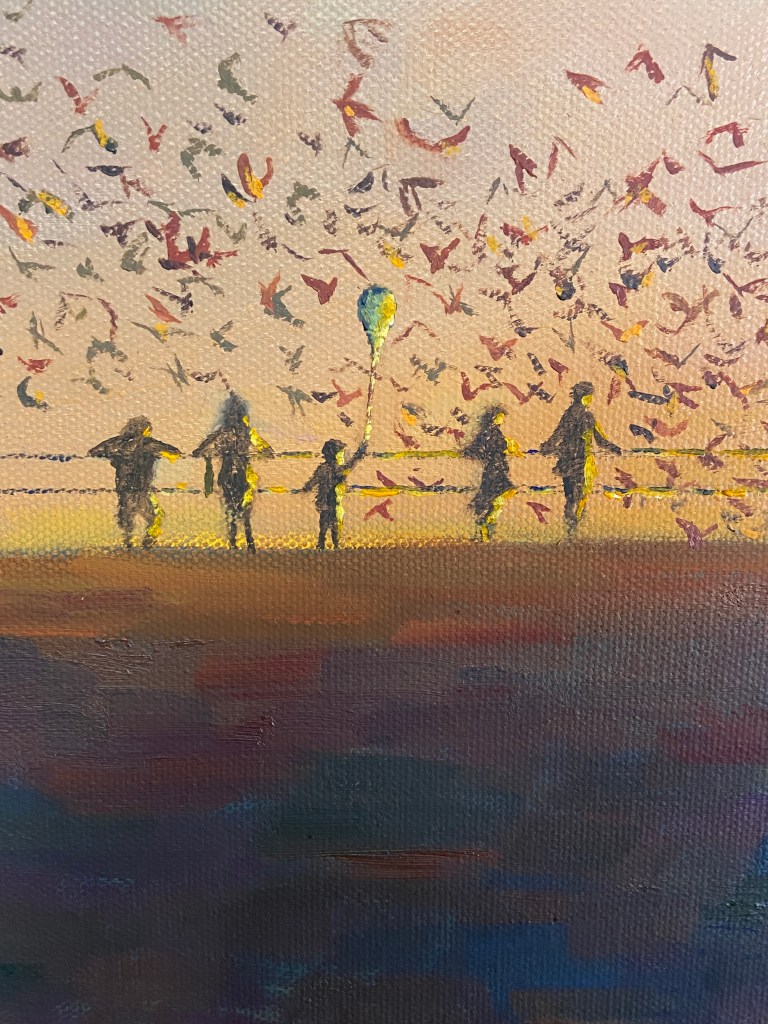
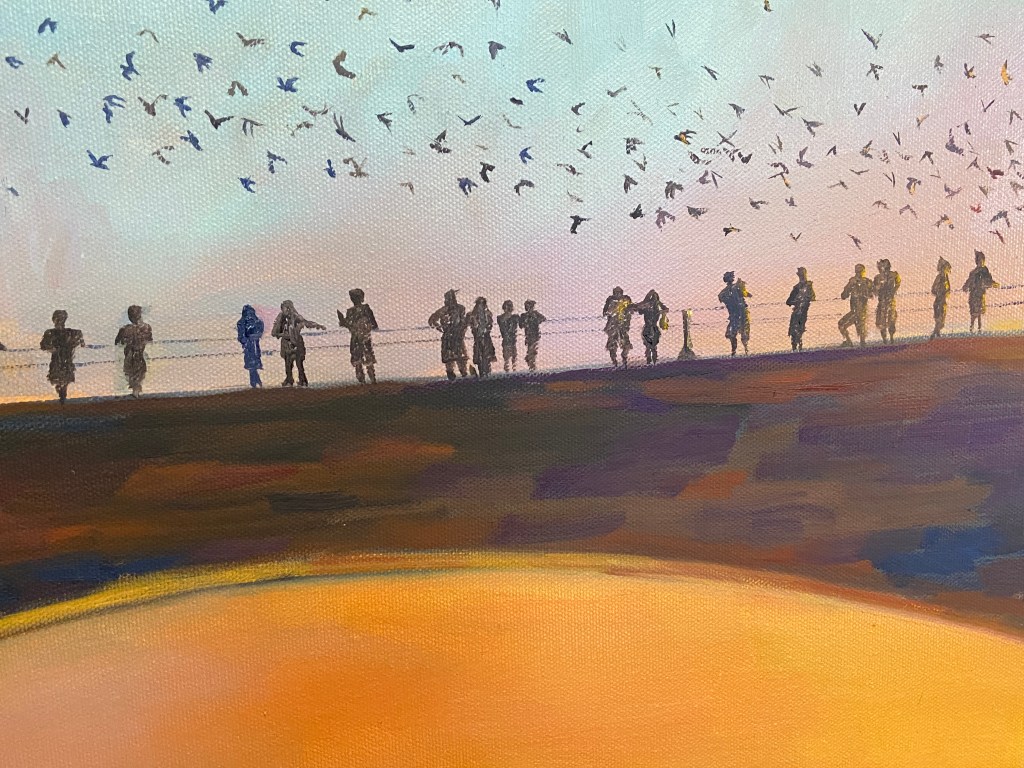
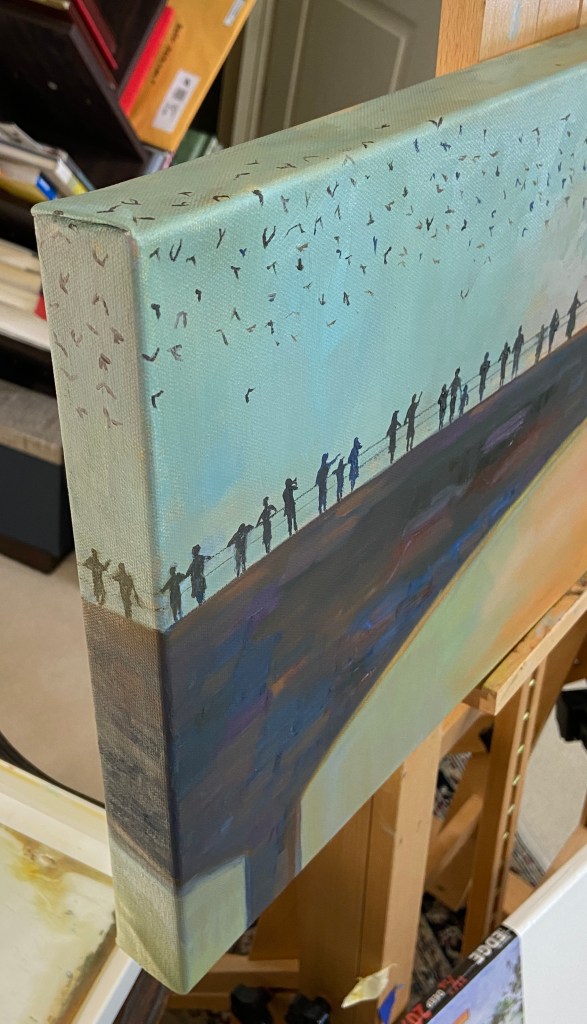
This piece is inspired by the bat colony under the Congress bridge in Austin, Texas, but note they are not the focal point. The 56 silhouettes along the bridge are the intended focal point, which as a group, show the evening observations of the bats on a summer evening. However, as you look at each individual person, you can see how their experience is unique. Hopefully you, as the observer, have some emotional response to some of these folks.
The sun plays a big part in this composition, cascading it’s golden light across the landscape, creating some strong value contrasts not only on the horizon, but also on the silhouettes, especially those on the right side of the bridge. It also creates a balance between warm and cool hues, with subtle purples in the middle creating a temperature transition. Lastly, the sun has been finished with a palette knife for an impasto effect, which helped amp up the brilliance.
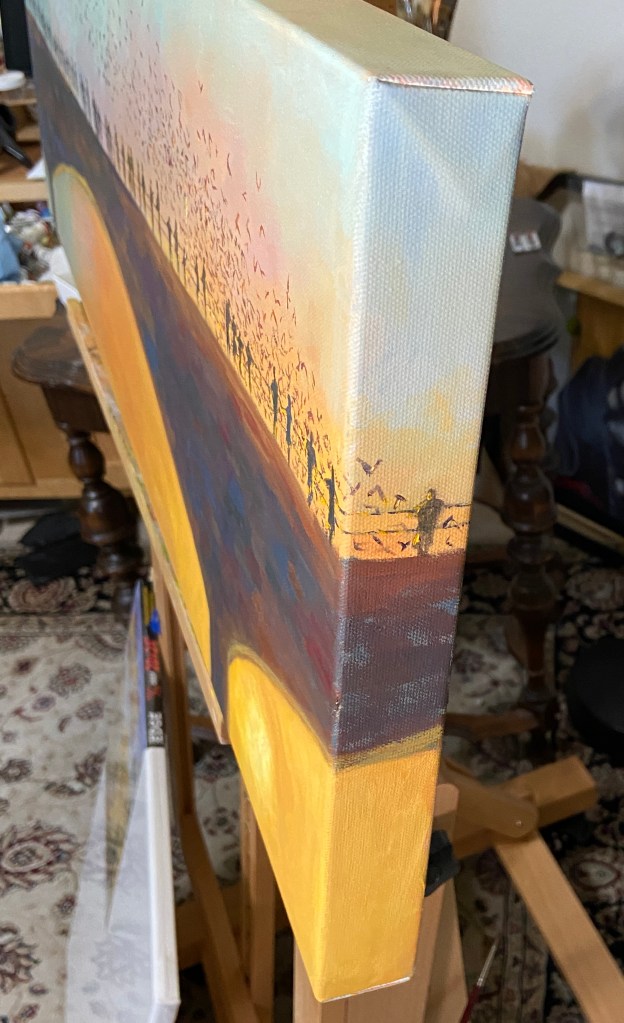
Another element of the composition is the use of the 1.5” edge of the canvas, allowing the bats and silhouettes to flow around the frame. The figures on each side are looking into the painting, which should help direct observers into the composition.
Stay tuned for additional bridge silhouette paintings!
The Flower Study painting series continues moving forward. Now that we have 3 studies completed (click for previous posts on this series: Study #1 Poppies, Study #2 Hydrangeas), it makes sense to line them up at the start of each related post to see how things are moving along. I want to continue exploring different compositional ideas so I can make an informed decision, both with respect to my actual skills as well as artistic considerations (what looks good), before taking on a large, formal piece for the house.
Today I wanted to share some simple varnishing techniques that can quickly and easily protect a painting. Nothing earth shattering here, but if you haven’t done a lot of varnishing of finished artwork before, or simply curious about other techniques, hopefully there are some tidbits for you in this post.
Supplies:
Varnish – I use Gamblin Gamvar Picture
Cosmetic Wedges
Rubber gloves
Paper towels
There are various types of varnish that can be used to get a good protective coat on a finished painting, but I like this particular varnish because it’s virtually odorless and very easy to use because it doesn’t become tacky too quickly. Instead of a wide soft brush to spread the varnish around the painting, I like to use cosmetic wedges instead because a) they don’t shed hairs like a brush does, b) they’re cheap, and c) it’s easier to spread varnish.
I’m varnishing 2 pieces, one large canvas and one small panel. I’ll focus on the larger canvas piece, but I wanted to provide the smaller panel periodically to illustrate another surface.
Varnishing Setup
This painting, Zip’s Flowers, was finished a couple months ago and has been stored on a drying rack, largely away from dusty conditions. Even in a nicely controlled drying condition such as this, I still take the time to wipe down the painting surface to get rid of the dust. What I find works best is first sweeping the surface with a wide clean brush, preferably one that hasn’t been used before, followed by a few wipes with a Swiffer dust cloth. The idea is to ensure that there isn’t a fine coating of dust anywhere on the painting, otherwise it’ll clump up when you apply the varnish.
To apply the varnish, lay the painting flat on a covered surface with some bright light overhead. Pour some varnish directly onto the painting. I like to pour a small puddle, about the size of quarter, in the middle of the painting, then slowly spread it around using one of the cosmetic wedges. Don’t overthink this part – just pour and spread. This allows me to see how the varnish will spread and the kind of coverage I can get with a small amount to start. It’s much easier to add more varnish than it is to try and gracefully remove excess; trust me, it’s not pretty. For every one of the DIY YouTube videos demonstrating varnishing techniques out there, I assure you there are 10 deleted videos of instructors slopped in varnish and/or furious at brush hairs drowning in tacky varnish.
Add more varnish as needed to get the entire painting surface covered, but remember it’s not about thickness, just coverage. The reason I suggested having a bright light overhead is to allow you to see the reflection of the surface and thereby quickly find spots that you missed.
First Coat Complete
Another advantage of using the cosmetic wedges over a brush is the complete mindlessness involved in spreading the varnish over the surface. Again, go back to any of the DIY YouTube videos and you’ll see how obsessed they are with brushing carefully so you a) don’t end up with too many brush hairs in the varnish, and b) getting a smooth surface. By contrast, the wedges are very soft and don’t even snag on impasto areas of the painting, so you can easily manipulate the varnish around the painting. Note that you might end up with some very tiny bubbles if you’re spreading quickly or pressing down too firmly, but they will go away in a few minutes and in my experience are never an issue.
After the varnish has been applied, I return the painting to its dust-friendly rack and let it dry. The varnish I’m using dries pretty fast, but I wait another week before applying a second coat. You can see in the gallery at the end of this post the results, but to set expectations remember this is not a high gloss finish, although you can use varnishes that give a more intense finish. Ultimately I’m looking for what I like to call fresh protection for the painting, meaning the varnish recharges the hues and vibrancy of the painting which also providing a protective layer that will allow your masterpiece to last a few hundred years.
Unvarnished
First Coat (wet)
Second Coat (Wet)
Varnished and Dry
Small Panel Varnished and Dry
Varnishing Progression (NOTE: a before & after comparison is hard to capture with photos)
The whole process takes about 15 minutes for the initial session and it’s very simple so there’s not a lot of trial and error involved.






 Art Bern