Wolfgang Portrait

Graphite on Paper | 4” x 6” 

Wolfgang Portrait

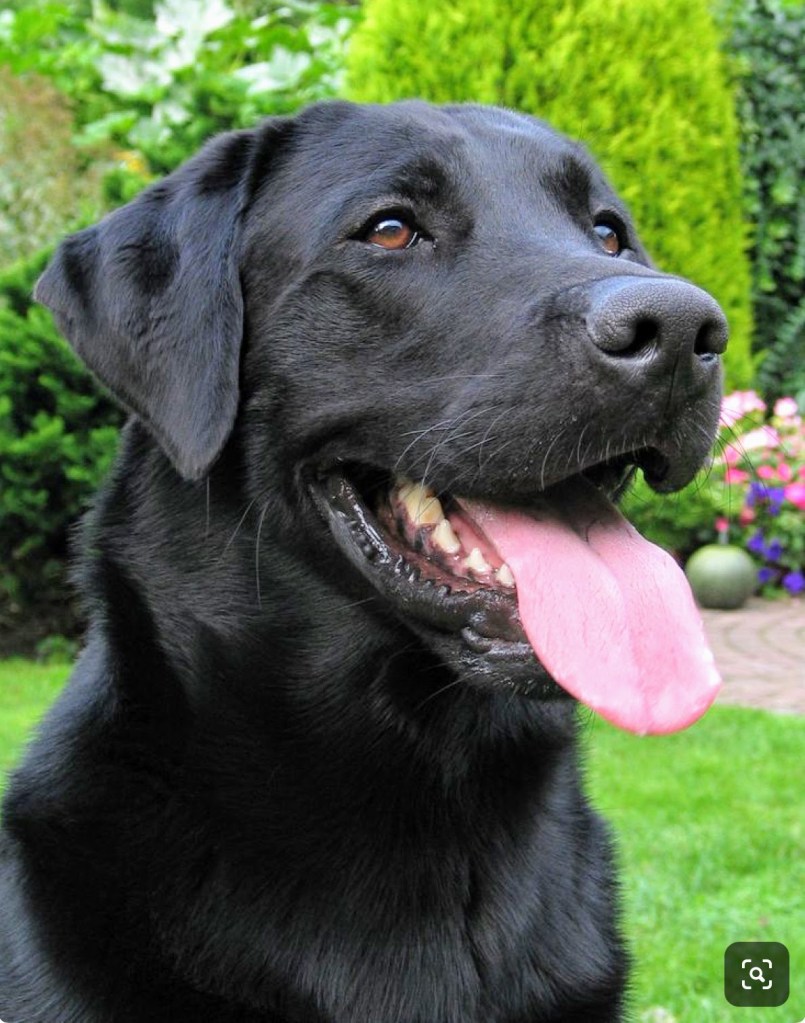
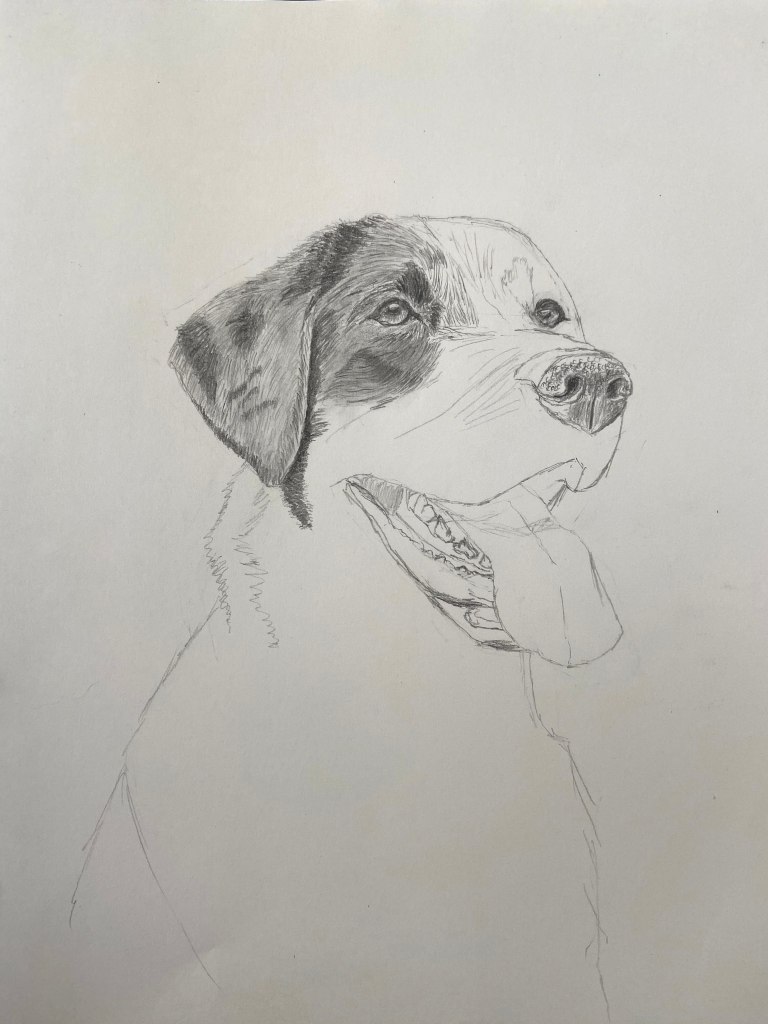
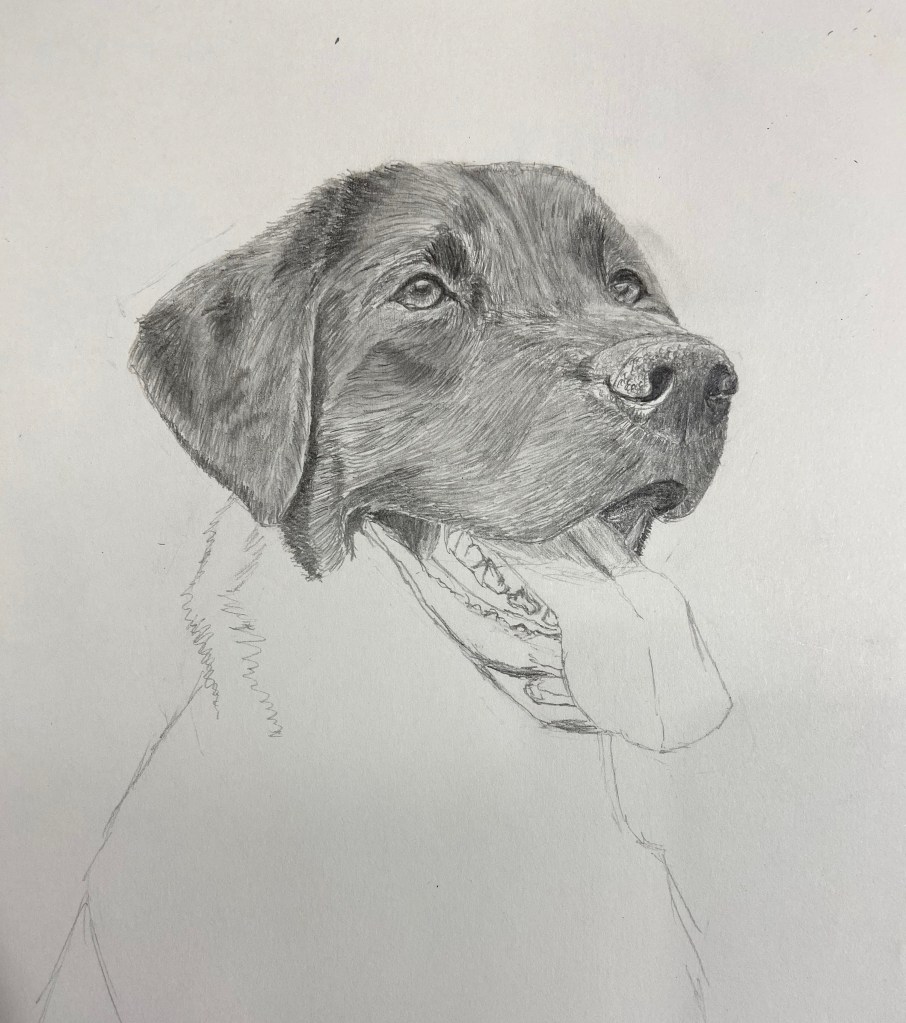
Say hello to Wolfgang (Wolfy), who was willing to take a short break from his squirrel hunting to pose for this quick portrait. This is a smaller piece that isn’t quite as refined and complete as the previous Happy Lab portrait from last month, but the intent was to practice a couple of smaller drawings before taking on a more comprehensive composition.

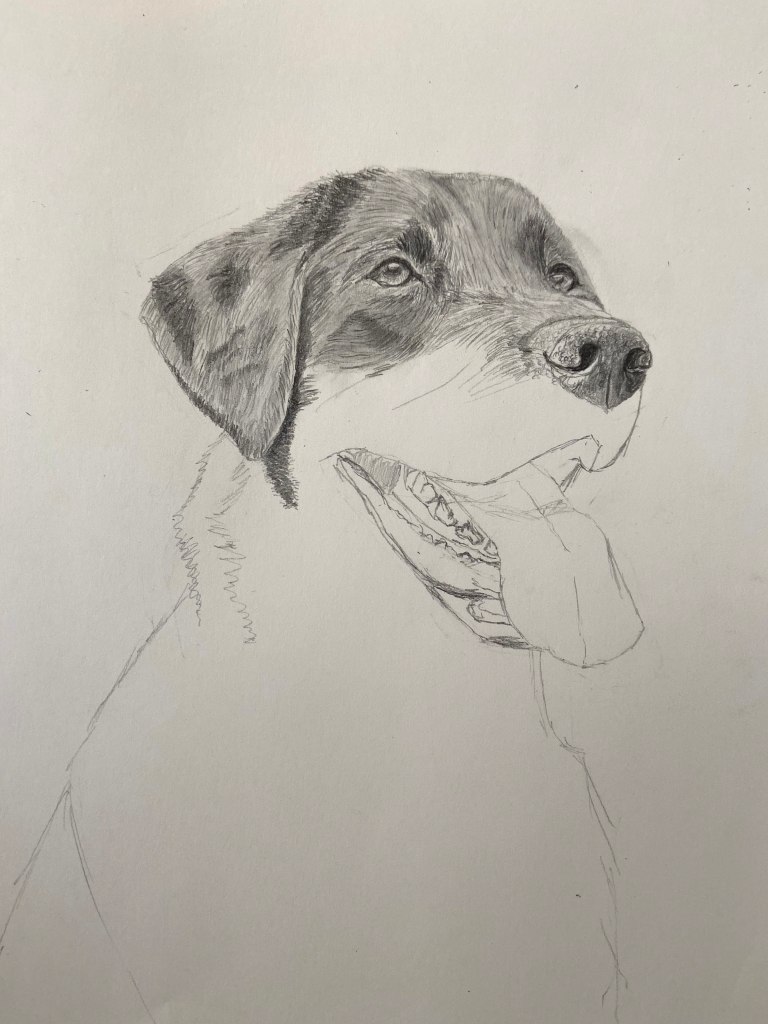
This is actually the second effort at this portrait, the first having gotten off track just enough to warrant starting over. Despite carefully checking and verifying the dimensions and proportions along the way, somewhere along the process I inadvertently extended his snout, which threw everything off. It took me a little while to figure out what was going on, as the error was ultimately very small, but that seems to be the challenge with portraits – the slightest proportional error is magnified, but it sneaks up on you in a very insidious way. 

I also wasn’t very happy with the focal point of his left eye in the original effort, which I had redrawn at least twice prior to discovering the proportional issue with his snout, so I decided to restart the entire composition. Rather than flipping to another page in my drawing book, I used the opposite page so I could contrast and compare along the way. The immediacy of the failed effort staring me in the face proved very helpful as a reminder of where the key problem areas were initially.

Final on Left | Initial Fail on Right

In the end Wolfy’s draft portrait came to life pretty nicely – see progression gallery below. It’s very hard for me to incorporate the variations of his brown, gold, and black coat, but focusing on the key patterns instead of every detail captured the essence of his inquisitive look and cute face. 

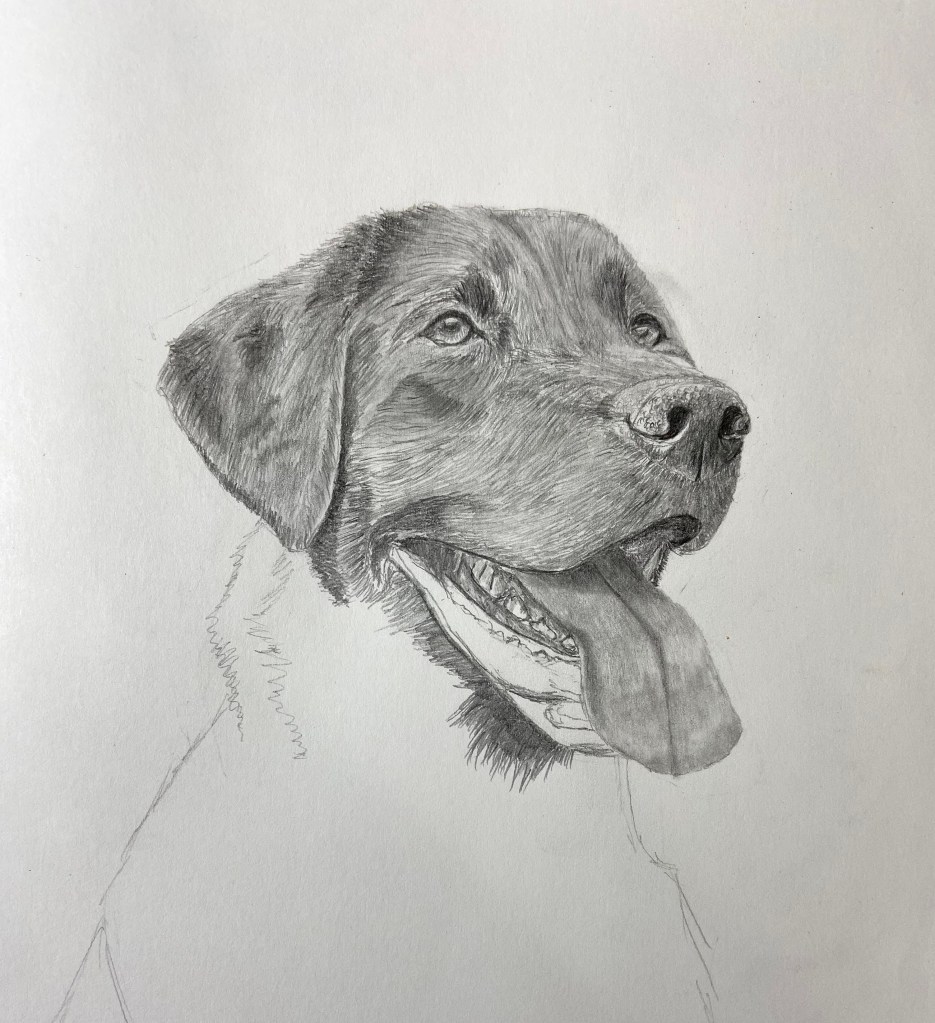
Happy Lab Portrait

Graphite on Paper | 6” x 8” 

dog-labrador-art-drawing-Abplanalp
Happy Lab Portrait | Graphite on Paper

This Labrador’s smile and overall happy, expressive face quickly caught my attention. I have no idea who this dog is, but I know s/he’s never met a stranger. 

I thoroughly enjoyed the slow, methodical pace of working through this drawing. One of my focal areas this year is something I call “dogs in motion”, basically dog’s doing stuff (see Frisbee Dog), which remains my primary interest when it comes to dog related art. However, the challenge of doing a realistic dog portrait has always nagged at me, in large part because I could never figure it out. This composition is either a fluke, which is entirely possible, or something clicked in my art brain – my big, smushy, oft confused art brain. 

The technical keys to this drawing, at least for me, were as follows:

  • Proportions: Free-hand drawing, no tracing is mandatory for me… otherwise I won’t learn a damn thing. There’s something elusive about getting the snout of a dog just so. Eye spacing and size of the nose, which is a lot bigger than you think, were also key.
  • Eyes: Oh those precious stares! The expressive nature of a dog oftentimes exudes from their eyes, but I realized so much of that expression is from the hair around the eyes, too. 
  • Hair Strokes: The darker areas of the coat are a combination of different types of pencil hardness, but also more variations of stroke density, i.e. darker areas have more strokes, which is obvious now that I say it aloud. 

Hopefully the progression shots above are helpful to see the compositional approach. There’s a lot of bouncing around, but ultimately it’s about getting the eyes and nose nailed and then building out from those anchors. 

Thanks for reading!

Frisbee Dog!

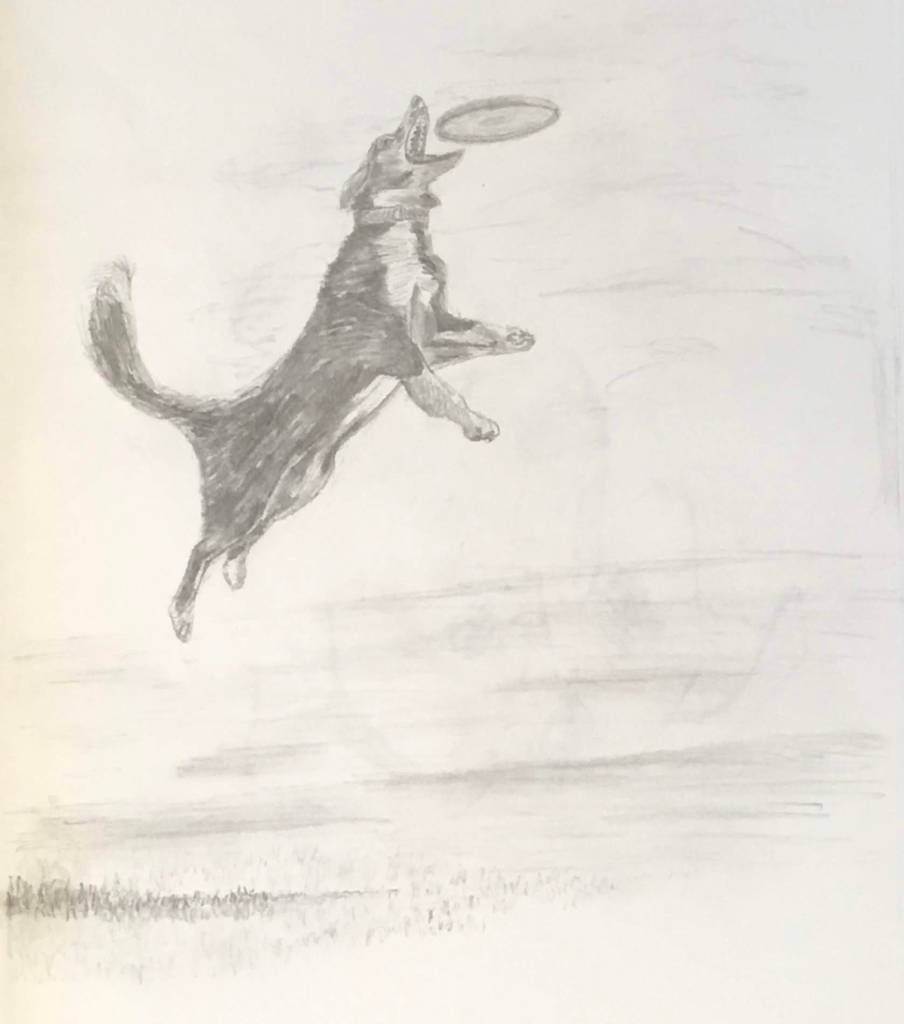
Frisbee Dog | Graphite on Paper

One of my dogs, Zip, is obsessed with 2 things in life: food and anything thrown. I used to think her love was exclusive to tennis balls, but over the years I’ve learned that not unlike her willingness to eat anything thrown into her food bowl, she will retrieve anything thrown across her yard. The day she trained me to sling a frisbee was a fond day indeed… for both of us. It’s her insatiable drive (dare I say “lust”?) to retrieve that inspired this drawing of Frisbee Dog

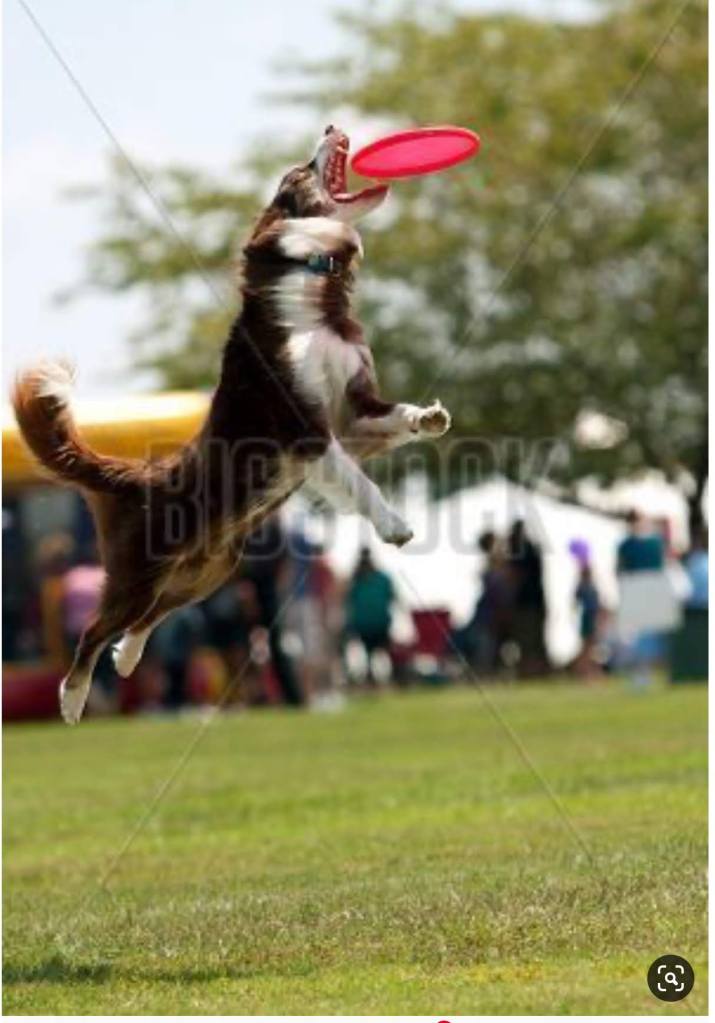
No, this is not Zip, but the reference photo captures all the key elements of a dog in motion doing her thing. The face is particularly tricky, in large part because it’s obscured and squinty, which mutes distinguishing features like eyes and ears. But you gotta love the open mouth and all those frisbee hungry teeth! 

The gallery includes a reference photo and two versions of the drawing. Granted, the drawing is a rough study and not intended to be a refined composition, I thought it was interesting to see how different photo settings can change the look and feel of a piece of art. Using the same source photo of the final drawing, one is set to sharper detail while the other uses a soft setting to remove some of the detail of the pencil strokes. Bear in mind this drawing is done in my sketch book on thin, see-through pages; there’s not a lot of teeth in the paper, thus the relatively rough nature of the drawing. Also, the entire piece was done with only 3 pencils – 2B, HB, and H. 
I think this type of subject would make for a good painting.

I’ll try a few more drawings of frisbee dogs and then make the jump to the canvass. 

Squirrel Watch

Pivoting from painting to drawing last week and finally made the time to finish this one. Squirrel Watch is pretty self explanatory – Wolfgang, my 3 year old rescue mutt, sitting in the yard watching the tree tops for the infiltrators! 

One of my artistic goals this year is to improve my dog related art skills. I’m not a big fan of dog portraits, however, I thoroughly enjoy what I like to call “dogs doing stuff”, creating intrigue through motion and activity. Over the coming months I’ll work on various dog related pieces that capture the essence of dogs being dogs as they do their thing. 

Squirrel Watch | graphite on paper

Squirrel Watch was done over the course of a few weeks – I have no idea how long it took, but I wouldn’t be surprised if I spent 6 hours on this relatively small piece. There were a lot of mistakes along the way, but nothing an eraser and some patience couldn’t remedy. 

This isn’t a piece I would frame and hang, but I’m pleased with it from a progress perspective. It’s also riddled with lessons learned, so if you zoom in to see the details you can spot various styles and techniques.

Here’s what I learned and need to remember for future drawings:

  • It’s not necessary to draw hair detail throughout the subject. In this piece, the emphasis should have been on shading and shape foremost, whereas hair detail should be secondary. 
  • Draw hair details with a clear understanding of actual direction of the hair on the dog.
  • Work hair dark to light. 
  • Most of the hair detail can be accomplished using 2B, HB, and H pencils.
  • Show wrinkles in the coat by changing the density of hairs, i.e. closer together or further apart.
  • Dog paws are hard to draw, dammit! 
  • Blades of grass can be done by either individual strokes or by lifting out shading with a thin eraser. 

A Stuffed Kong and Its Dog

I recently saw a question on Quora asking “when does drawing end and painting begin?”, which was a timely inquiry given a new approach I’ve been taking with some recent paintings. It’s always a bit tricky and, frankly, pretty intimidating to take on a new type of composition. For me, that tends to be something that involves shapes and/or subject matter that’s new or unfamiliar. In one of my current projects, A Stuffed Kong and Its Dog, I came to realize that while the subject of a dog toy was not a new compositional challenge, the complexity of a dog chewing and pawing something was really friggin’ hard!

My normal process, and what’s been reinforced at workshops by artists far more experienced and talented than myself, is to do a study of the subject to help get a feel for the composition (see Dances With Squirrels blog post for more on studies). I prefer sketching as opposed to small paintings, largely because I like to sketch, it’s more expedient than painting, and it’s more flexible, i.e. erasing graphite is infinitely easier than wiping out paint. Lately, however, I’ve been refining this process whereby I still do an initial sketch before starting the painting, but as I work through the project and run into challenges, I go back to the sketch and either do another or simply refine the one I was working on earlier.

In hindsight it’s frankly a brilliant idea, of which I don’t have many, because the pause from the painting a) makes me breathe as I gather my thoughts to overcome the problem, and b) let’s me return to an existing sketch and figure out how to navigate a solution based on a similar composition. What I’ve found thus far is that I often find the same problem in the original sketch, kicking myself for not having seen the problem in the first place, but I can quickly figure out how to make changes and move forward.

In A Stuffed Kong and Its Dog, you can see the original sketch being reworked (I forgot to take a picture of the original state of the sketch) when I ran into 2 problems. First, there was something fundamentally wrong with the Kong dog toy shape, which became clear when I returned to the sketch and saw that the bottom planes of the humps were misaligned. Secondly, I thought the size of the Black Lab’s right paw was too big once I painted it, but when I returned to the sketch and redrew it, I found that the size was actually fine and the issue was the related to the size of the black fur shadow gaps between the toes. Clear as mud, right?

The final painting will need a few minor refinements, but I want to let it dry before I make those updates. I’ll update this post when it’s really done. The intrigue with this piece is to make the viewer wonder what in the world is in that stuffed dog toy Kong! It was very hard to translate the focus and excitement of the dog as it diligently worked to get to the yummy treats out of this toy. While the focal point is the Kong, the supporting cast is the nose and that huge right paw, which in combination should convey the canine treat obsession.

Lastly, I’m not pleased with the sketch or the painting. The sketch is not supposed to be a finished work, and is muddled with various experiments to see what was going to work, so I’m. not flustered it. However, the finished painting, while not intended to be a refined piece of exceptional artwork, is ultimately a composition that doesn’t work well. The angle of the nose looks wrong relative to the muzzle, but it’s actually accurate as most dogs are able to bend that nose around in weird ways. That said, it doesn’t convey well in the painting. The large paw also creates visual confusion and seems out of place even though it’s proportionally accurate.

This exercise has taught me that all compositions aren’t destined for a “real painting”, but that’s why we do studies and small pieces to see how it plays out. I’ve also learned that my dog portrait skills need a lot of work, something I knew already, but this work has highlighted the gap and is proving to be quite motivating to start sketching my dogs’ faces!


1 Hour Challenge – Run Sandpiper, Run

Moving these updates to the blog to motivate myself to do them more frequently. The goal is to hone my drawing skills by doing sketches in 1 hour.

This session is from a reference photo taken by my brother. Very challenging given the need to incorporate movement of the bird and the advancing waves. Oh, and drawing ocean foam is hard as hell. I think the key is to not draw it. 

“Rescued”

IMG_3636

“Rescued” is done and hung on the wall downstairs in our powder room! This was my first “commissioned” piece, done for my wife who wanted something with a lot of saturated color and big! The design is entirely from her and the passion and love she has for rescuing dogs, of which we’ve had the pleasure of fostering 114… and counting. When my wife says “rescue”, she means literally rescued from the kill list at the Austin pound, not “rescue” from a pet store (don’t do it… just adds to the breeding problem), and these dogs are often in really bad shape – parasites, detached intestinal walls, starvation, neglect, flea infestations, ticks, kennel cough, Parvo and more.  But she nurses them back to health, even waking at all hours of the night to feed them meds every couple of hours, and finds each one of them loving homes. She is amazing!
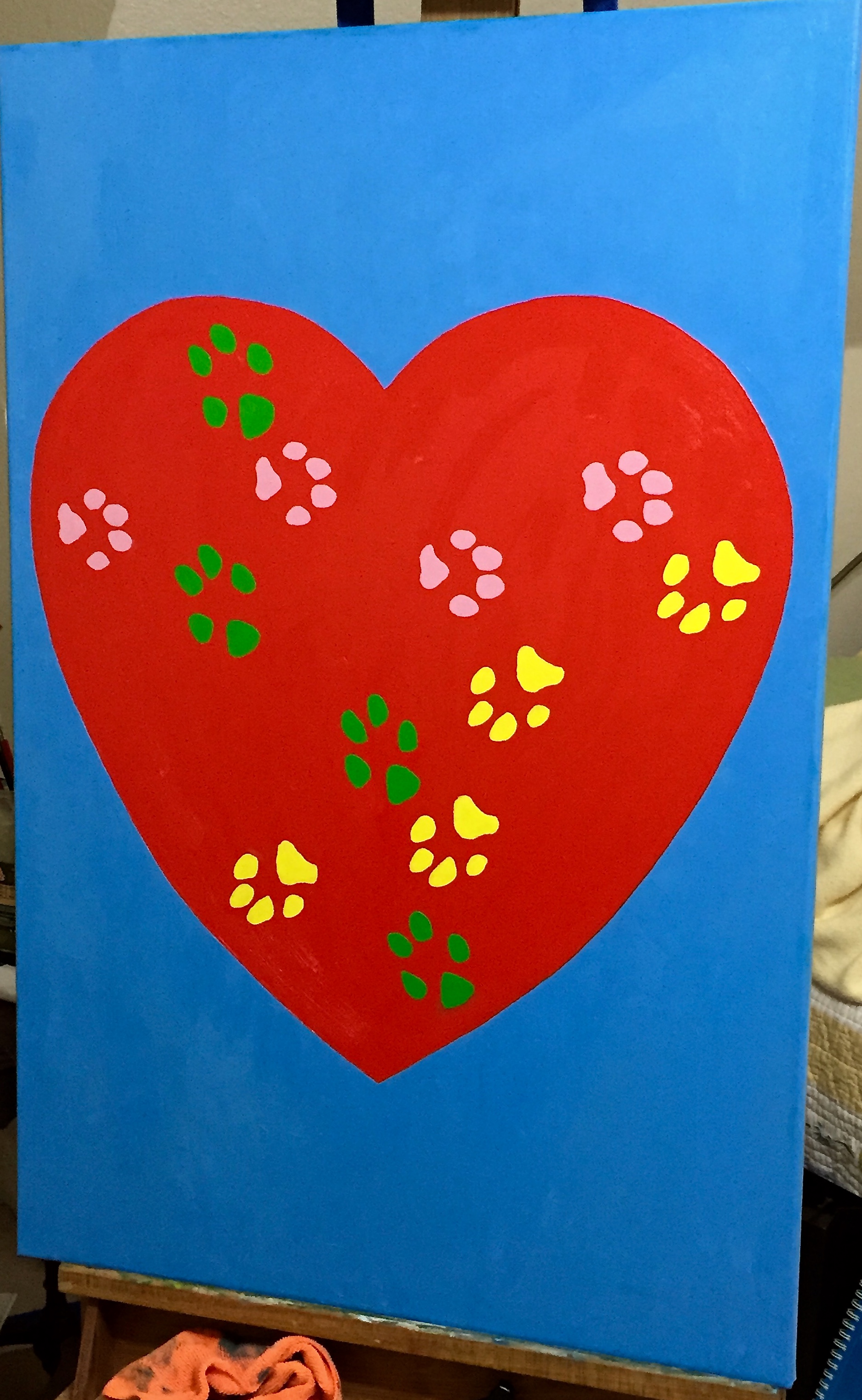
She also had the primary design in mind, of which you see in the picture – a large heart with the paw prints of our 3 dogs (yes, rescues all of them) on it. We had a lot of fun collaborating on the details, although she would say there was some stress involved in figuring out the right colors for each dog’s prints, which ended up as follows:

  • Pink – Crash, female, age 13
  • Green – Boom, male, age 12
  • Yellow – Zip, female, age 3

The process for getting the dog’s paw prints on the painting is worthy of a separate post, so I’ll pause here today and give an update on that entertaining adventure in my next update.

Tech details of the painting for those interested:

  • Canvass, 24″x36″
  • Colors were almost straight out of the tube, but had to make some small tweaks:
    • Blue background – Titanium White + a small amount of Pthalo Blue + tiny bit of Orange.
    • Red heart – Cad red medium
    • Green paws – Permanent Green Light + Titanium White
    • Yellow paws – Lemon Yellow + Titanium White
    • Pink paws – Titanium White + small amount of Alzarin Crimson
  • I added the Titanium White in heavier doses with the yellow and pink paws because it helps add opacity to those more transparent colors. Sitting atop the red heart it was helpful to cut back on the bleed through.

For the dog rescue lovers out there, the group we work with, Austin Pets Alive, is fantastic and is by far the most influential and impactful rescue group in Austin, perhaps all of central Texas. If you want to learn more, check them out.

French Countryside Loire Valley – Practice sessions continue on 2 fronts

More progress this weekend on the practice sessions for the Loire Valley countryside piece. Added the first pass at details to the sky on the oil on paper. I’ve done clouds in graphite before, but never detailed painting. Learned a lot about what not to do, most notably trying to be too precise and layered paint to thickly. Need to go with looser brush strokes and thinner paint, I think. Advice is welcome, so comment if you have some helpful guidance please.

The second pic below is a practice session on my iPad. Still getting the hang of the Paper 53 app tools, but it’s been very helpful in drafting possible compositional elements that I wouldn’t otherwise have taken the time to do with paint. It’s very limited when compared to real painting and drawing, but it’s an invaluable drafting tool for layout and testing ideas.
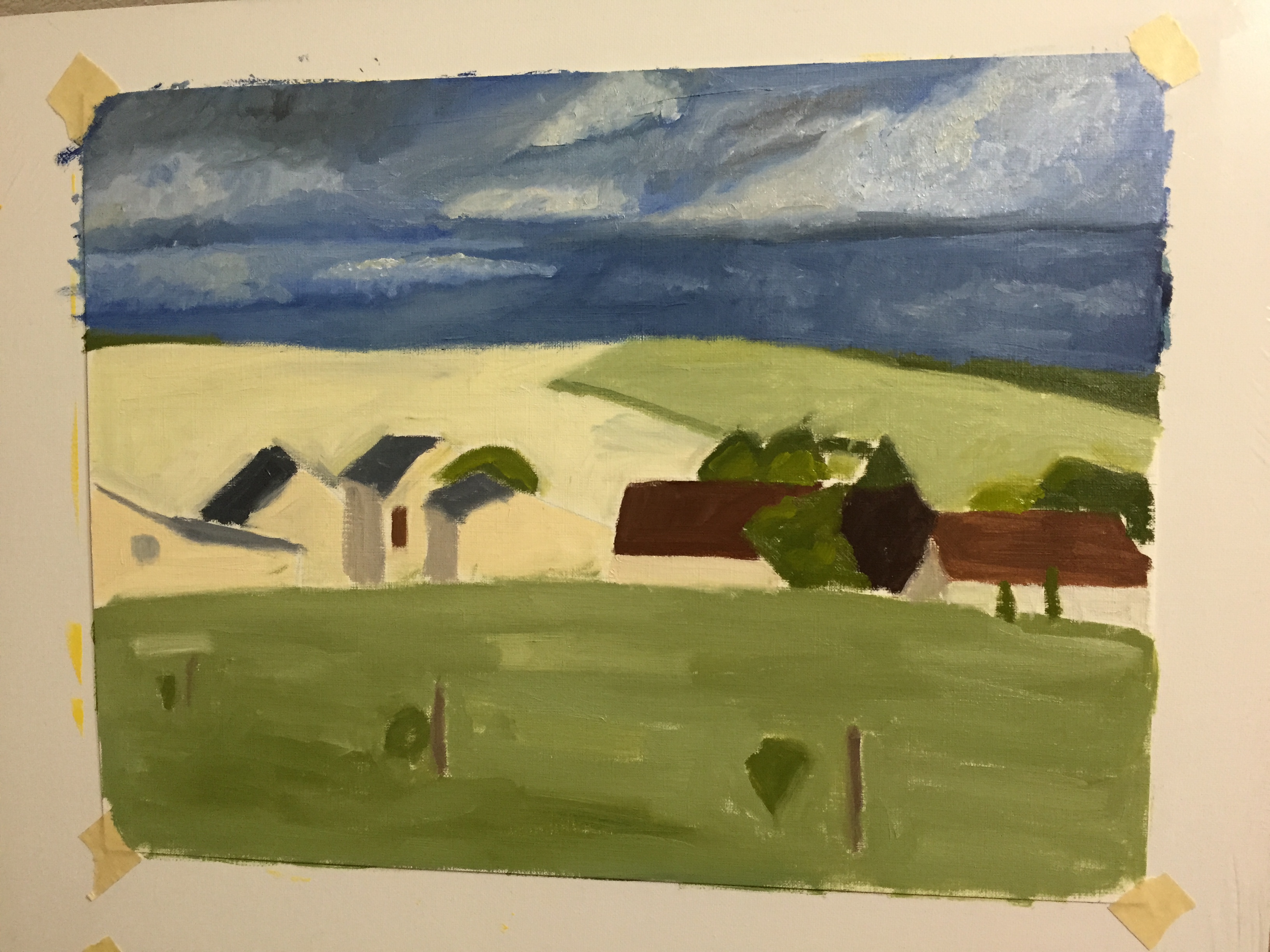
IMG_3617 IMG_0002

Loire Valley Landscape

Started a new project today. I’ve sketched this one a few times already, but intend to use this as a reference point for the actual painting whereby I’m going to try to emphasize the storm clouds in the background, add some color to the foreground with flowers, and insert some actual people doing stuff in the village area to draw the viewer into the scene. This first effort will be a quick draft painting on paper to get the values and compositional elements figured out. If that goes well, I’ll parlay this into a larger piece.

IMG_2423
Reference Photo – Loire Valley, France

IMG_3612
Sketch on paper

IMG_3613
Initial block-in. Focus on values and basic color scheme.

iPad sketch with “Paper by 53” app

Used a new art app on my iPad today and it was surprisingly easy to use, yet had a good range of options to create great sketches. 

Did this whale tail in about 30 minutes, including fumbling time with the app features. Might prove to be a great way to do quick art on the go while traveling without supplies, or in bed where graphite and eraser debris are unwelcome. It was a lot of fun!