Here’s another installment from my January “draw-a-day” self-imposed challenge. While I didn’t draw every single day, I came pretty close. Most of what I did was practice for new paintings, which, as I’ve mentioned previously, can be immensely helpful in determining not only how to approach a new composition, but even if you want to do it in the first place!
FRENCH CAFÉ is a sketch intended to inform a painting I just started. After having done an initial block-in on the canvas I realized this was going to need further consideration before moving forward. This sketch is that “further consideration”, allowing me to do a handful of things before returning to the canvas.
For the curious, following is how this sketch will help the painting:
People: arrangement, sizing/scale, and simplification. The last point, simplification, is a by-product of drawing whereby one has to convey the essence of the figures purely through shapes, whereas the painted version will also leverage colors.
Focal point: The sketch taught me that I’m lacking a focal point, so the painting will need to do a better job of focusing on a particular grouping of people at the tables. In this sketch, it’s not clear where the viewer should concentrate.
Details: Between the umbrellas, windows, people, and trees, there’s a lot going on. It will be important to exclude some elements in the painting to make it effective, and more enjoyable to paint. The vines growing up the walls will get 86-ed, as will some of the ground floor windows and doors.
Values: There will need to be very high contrast of values between the shaded people and those areas that are in direct sunlight. You can tell that this sketch, while effective in many ways, really looks flat with the exception of the overhanging trees at the top. This is where I made a point to do high contrast in light and darks, adding a 6B pencil to the mix.
Stay tuned for the actual painting, which will be a challenge, albeit a well informed one thanks to this sketching exercise.
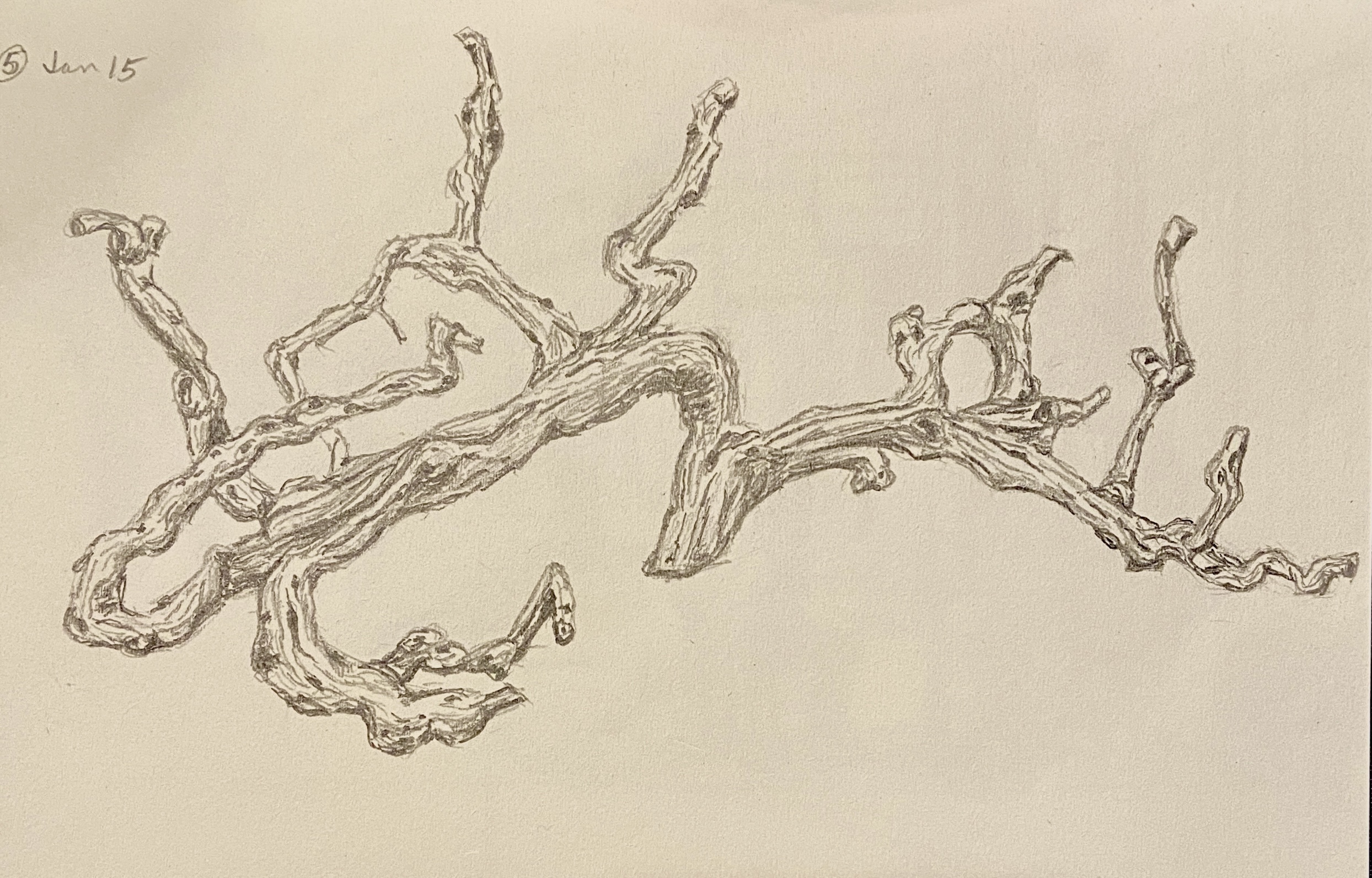
Today is for the wine lovers out there! This is one of the various drawings from this month’s draw-a-day self-imposed idiocy. I think even oenophiles would have trouble recognizing this drawing at first glance, but it hopefully becomes apparent that this is a grape vine. An old, grape-less, dead vine, but a grape vine nonetheless.
The reference photo is from my visit to The Piccolo Hotel (great place, btw) in Paso Robles, California. I didn’t realize what it was at first – I just thought it was a cool wood carving over the fireplace in the lobby. But when you get to looking at it in more detail, and taking into account the location (wine country!), the reality sets in that this is the epitome of upcycling! This grapevine, while alive, provided tasty wine… and in death is transformed into art! What’s not to love about that!
The Library at The Piccolo, Paso Robles
As an art subject, it was very tricky initially. I thought it was going to be a disaster, in large part due to the details involved, but perseverance won out and all the wavy lines and dark circles coalesced into a pretty decent drawing. More importantly, it was a lot of fun to draw and something I’ve added to the short-list of formal compositions. Drawing or painting, I’m not sure which… maybe both.
One final comment: Paso Robles wine is excellent! Makes sense, right? I mean, c’mon, the vines are beautiful, alive or dead!
The bats are coming! This is a skrawing, or is it a dretch… I dunno, whatever you call the in between gray area of an informal sketch and a structured drawing. Regardless, the plan is to do a larger piece, at least by my standards, of the iconic Austin bats departing their home under the Congress Street bridge.
The focal point will be the silhouettes of the people on the bridge, secondarily the bats. The anchor, not something that’s officially a painting term as far as I know, will be the brilliant sun in the lower right corner, which is very tricky in a drawing, so you’ll have to use your imagination. The value contrasts will be extreme, so balance is going to be key. Why I’m attempting this is beyond me…
3 BOATS ON CASCO (study) | 5×8” | graphite on paper
Figuring out why a composition is failing can be a real challenge at times. If the painting fundamentally sucks, I know it’s a lack of talent or experience on my part. Sometimes, however, it just doesn’t look right. It’s on this latter front that I often find myself with boats.
Granted, I don’t have extensive experience painting seascapes that highlight boats. They’re tricky and I believe lots of practice is the key to get the blizzard of weird angles, maddening levels of detail, and the reality that they move constantly, even when anchored, working in concert as a composition.
Last week I did a short plein air session of boats – it was a total failure, although the outing itself was great time spent on the coast. I decided to try drawing the same scene in the studio to see if I could figure out the issues. As it turns out, this small study solved a lot of problems, of which there were 2 big ones.
First, the viewing angle was too steep, meaning it works better with a more horizontal perspective. The painting I had done was simply too aerial, probably in part because I was standing on a pier and secondly it was low(ish) tide, so everything was below my line of sight.
Secondly, the composition included something very unusual, namely Fort Gorges, which is literally a Civil War era fort seemingly floating around in Casco Bay. It’s an iconic part of the Bay for those who know Portland, Maine, but for those “from away”, it’s basically a big ‘ol WTF part of the horizon. It’s made all the more confusing to the uninitiated because it has a tree filled square in it’s center, which makes Fort What-the-Fuck even more awkward with what looks like a Jolly Green Giant broccoli patch springing skyward. How does one work that convincingly into a composition. NOBODY!
Upon realization that Fort WTF needed to be ignored, aka artistic license, the final version of the drawing was complete. Note that in the pictures there is a before and after version to show the impact of using a drastic design decision to make the composition work. Whaddya think?
This was a commission piece for a friend, Jason, who had recently lost their beloved furry family member, Vedder. His wife, Alicia, reached out to me and wanted to have the piece done as a surprise. I knew the loss of Vedder was very difficult for both of them, having seen various remembrance posts from Jason on Facebook recently, it was clear this was a difficult time, so I wanted to make sure I got this right.
Alicia was extremely easy to work with, remaining very flexible in terms of what she wanted, essentially leaving most of the creative decisions up to me, saying she had confidence that whatever I created would be wonderful. At least that made one of us.
Then the pressure set in! This had to be perfection given the subject matter.
Ultimately I devised a number of possible compositions based on pictures and videos of Vedder, created sketches, and passed them along to Alicia for review. Thankfully her top 2 choices were the ones I wanted to paint the most.
I’m not a pet portrait expert, at least not at this point in my creative experience. That said, I have done a number of what I like to call “dogs in motion” pieces, so not having to tackle the task of Vedder’s face in detail was going to make this a lot easier.
There were a few compositional elements I wanted to bake into this piece. First and foremost, Vedder had to look like Vedder, even if his face was in profile, there’s still the challenge of getting his body just right. I wanted someone who knew Vedder to walk into the room where the painting was hanging and be able to tell at a distance “hey, that’s Vedder!” Secondly, the setting had to be his favorite excursion location, which was this unnamed rocky beach along the coast (they live in the Los Angeles area), and there had to be clear elements that made it recognizable as that beach. Lastly, I wanted to include “Easter Eggs” in the composition that would give the work more meaning and personalization for Jason and Alicia.
The initial block-in went well, despite the need to improvise the landscape a bit – the natural rocky jetty wasn’t in the same view as Vedder in photos, but it was an integral element of the beach, so it had to be included. The initial draft of Vedder’s silhouette was a lot more difficult, having gone through at least 10 variations before landing on the final version. I also made the decision to incorporate a calmer ocean than what was typically in the reference photos, which often featured a very active surf.
The most difficult technical challenges were the very black coat of Vedder, and the !*$king sand! First, the sand…
I’ll need to do a number of seascapes featuring beaches this year so I can capitalize on the lessons learned with sand. First, sand apparently comes in a wide range of colors, none of which you recognize until you try to paint said granules. I thought there was simply dry sand (light brown) and dark sand (dark brown). This is not the case. For the record, a beach full of sand has an infinite number of value and color gradations. Suffice to say it worked out, but I have a newfound appreciation for professional painters who incorporate footprints along the beach.
The biggest challenge, as expected, was Vedder. Getting the shape right, and I hope it is (you’d have to ask Jason and Alicia), wasn’t too bad, but trying to get the black hair to pop on the canvas and work the reflection of the sun on his coat, well that took some experimentation. Ultimately it came down to the magic of alternating warm and cool blues. I also incorporated a lot of knife work so there was some texture to his coat, as well as some fine brush work on the edges so he looked wet. When I asked Alicia what Vedder likes to do at the beach, thinking I could incorporate a ball, stick or frisbee into the artwork, she said “he just likes to run around”, or something to that effect. He was simply a happy, energetic, loving dog!
As to the Easter Eggs, namely hidden references in the artwork, I like to use these in commission pieces because it adds personalization and helps lend meaning to the work. The trick is to not do too many, keep them simple, and above all else, don’t compromise the quality of the art. In the case of VEDDER, I incorporated 3 Easter Eggs, two of which I’ll share here. First, Vedder’s paws create a rainbow reflection in the sheen of the water, representing the Rainbow Bridge. This element is designed to be subtle and not something you notice until you look very closely at the artwork. The other Easter Egg can be seen in the rocky peninsula. If you turn the painting upside down, reading left to right are the letters “VeddEr”. They’re not easy to see at first, but the intent is to make it hard to find initially, but then it’s impossible to look at the painting and not see them going forward.
Overall I’m very happy with how this piece turned out. More importantly, Jason and Alicia loved it, at least that’s what they told me. Haha! All kidding aside, the fact that I got a text from Jason with a picture of him holding the painting with a huge smile on his face was all the thanks I needed.
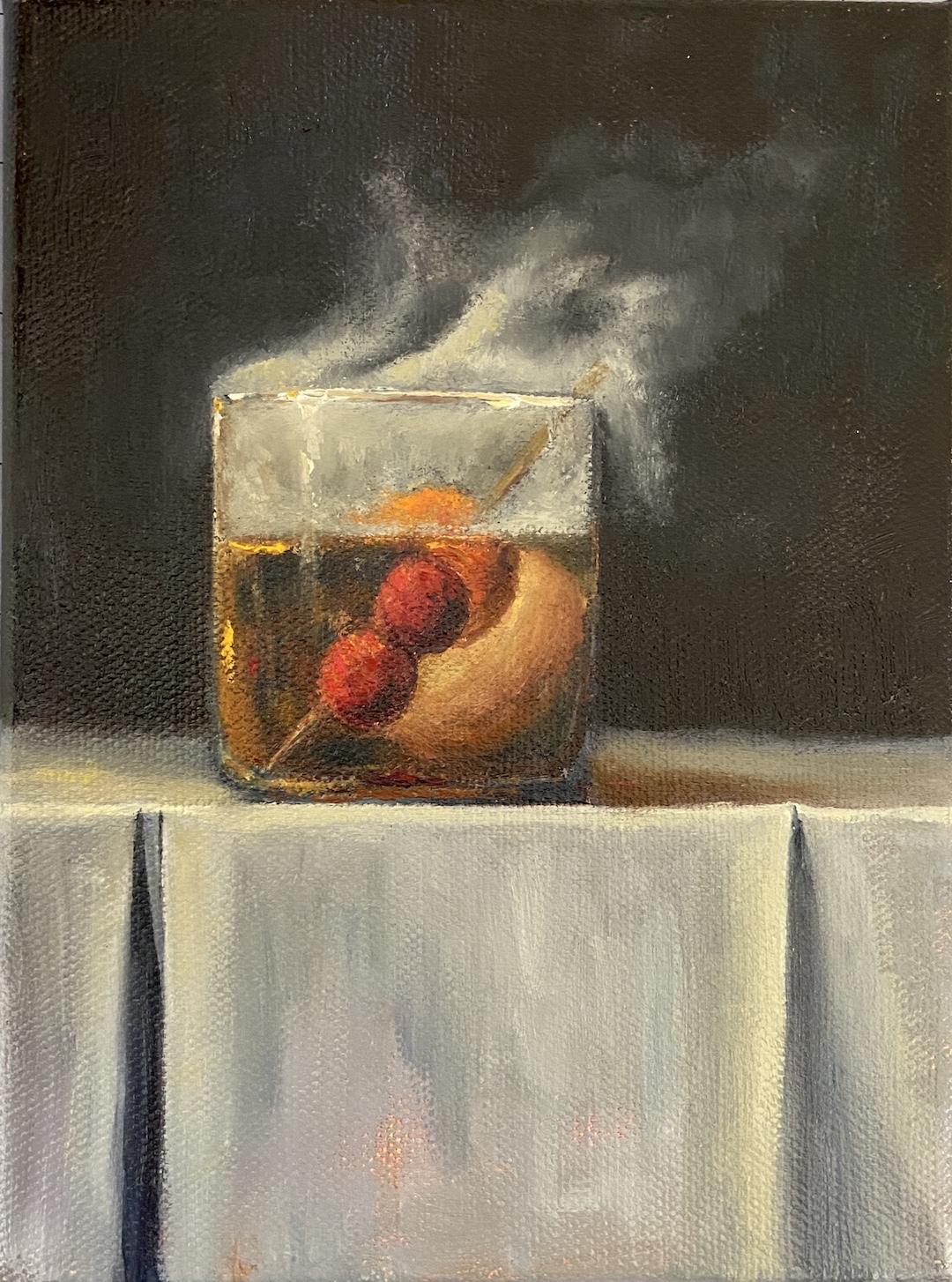
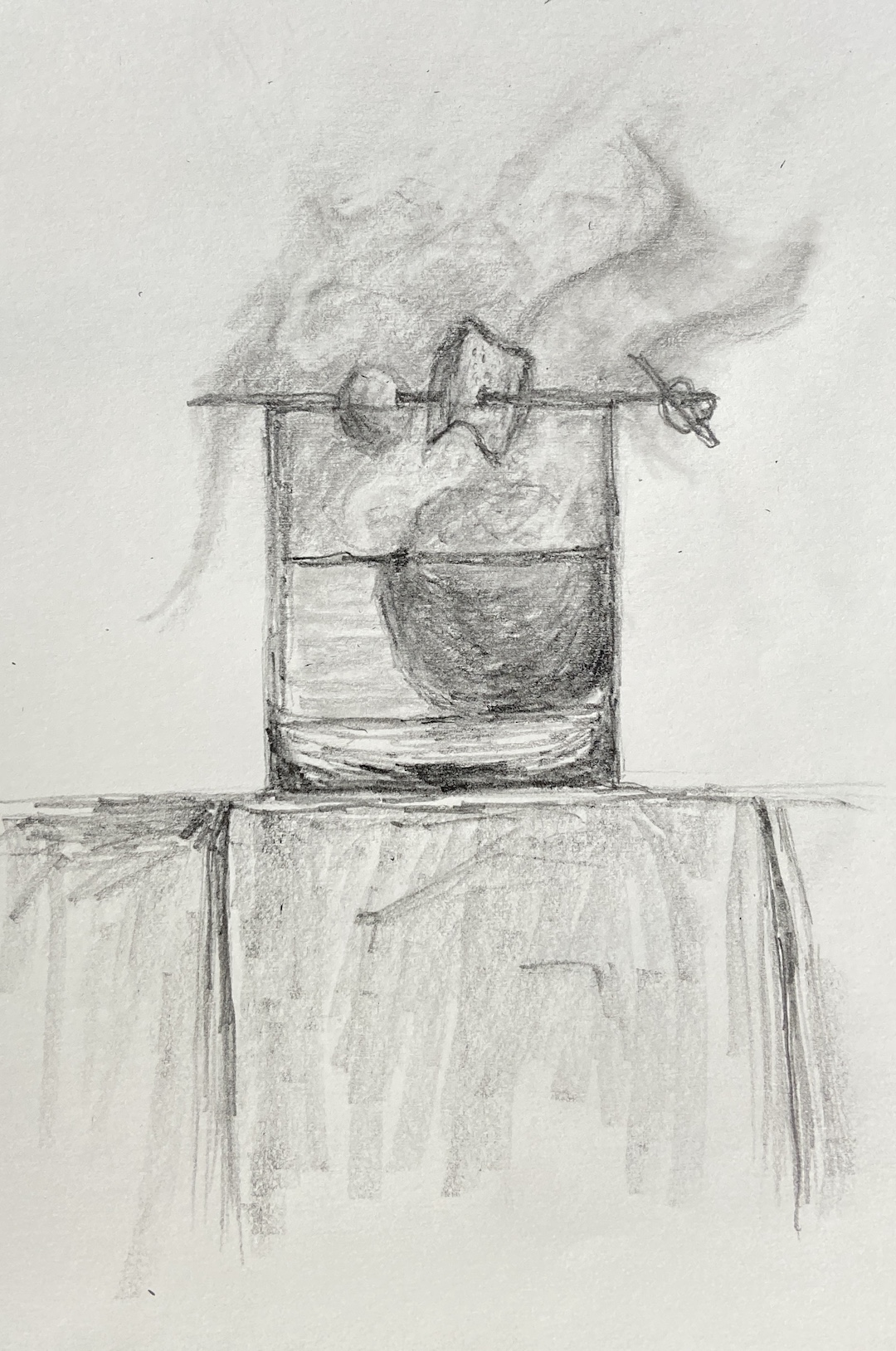
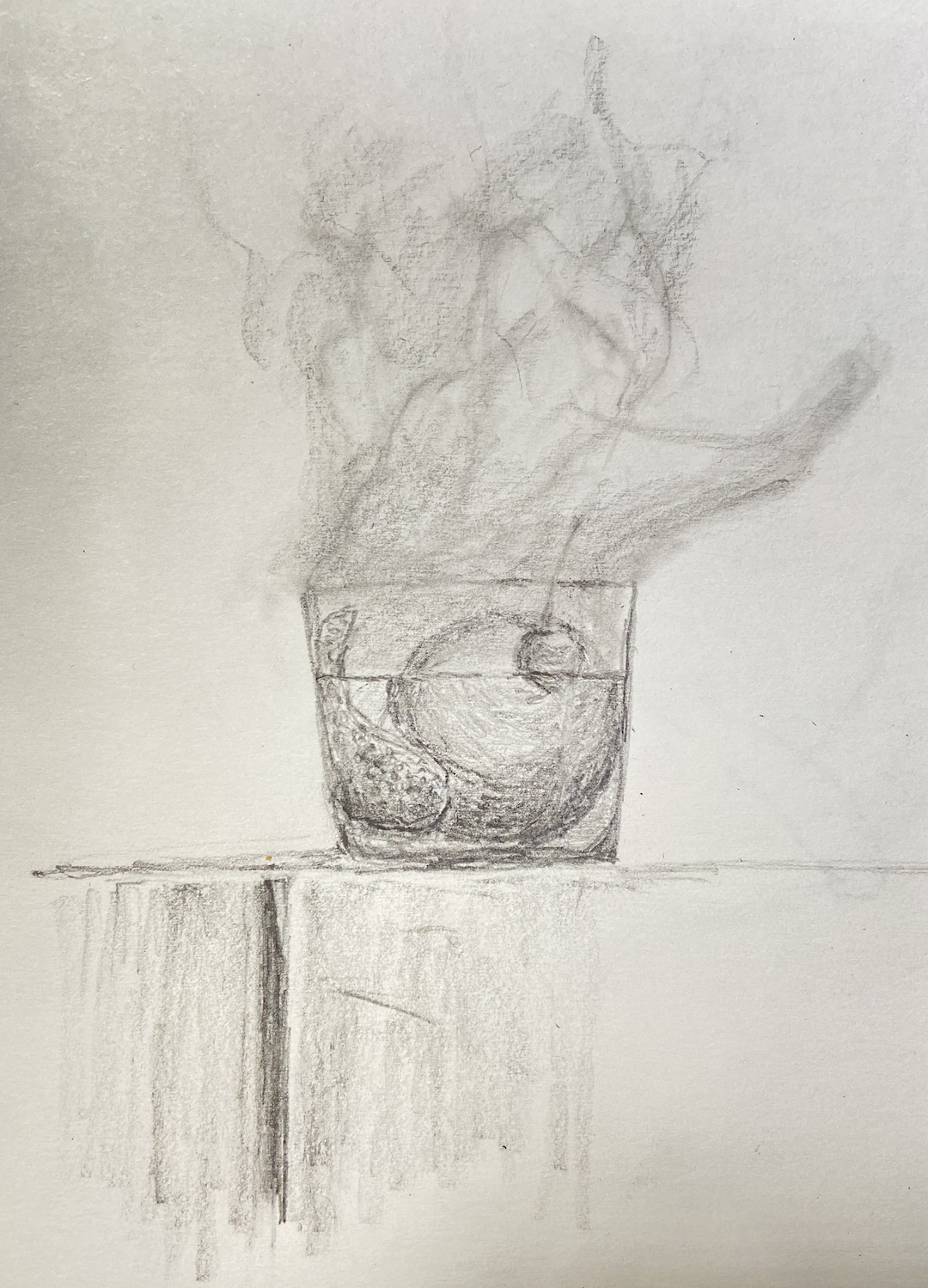
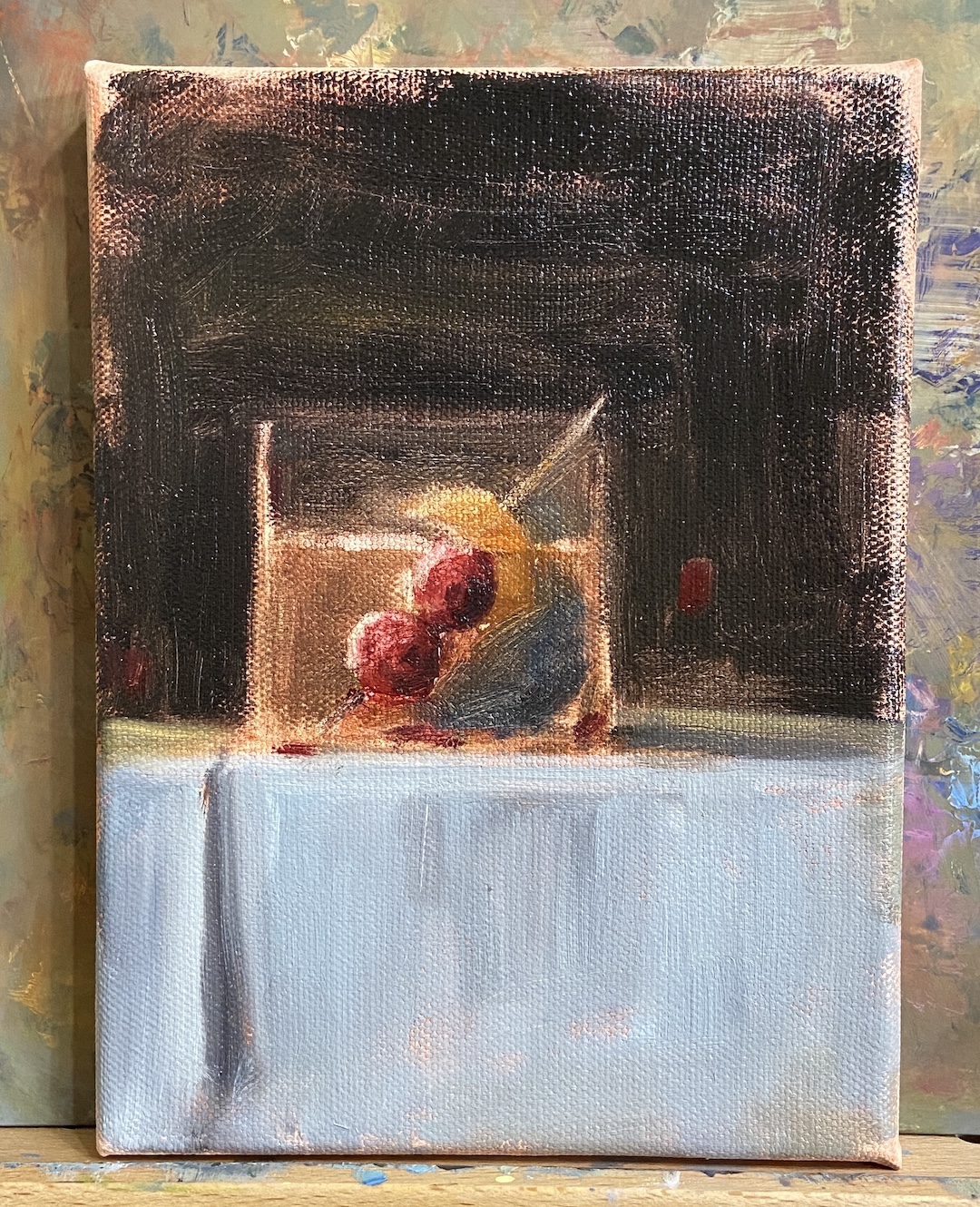
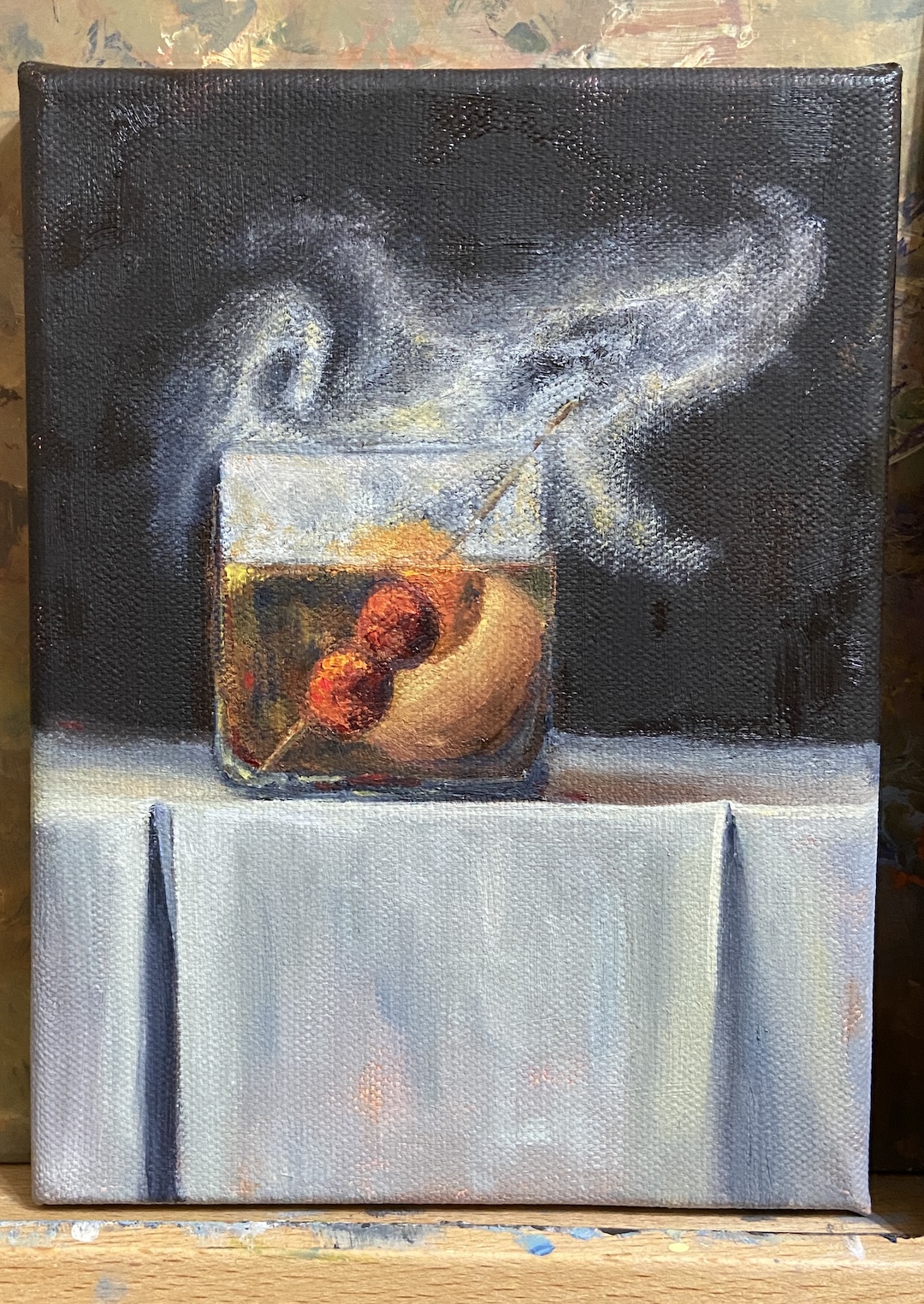
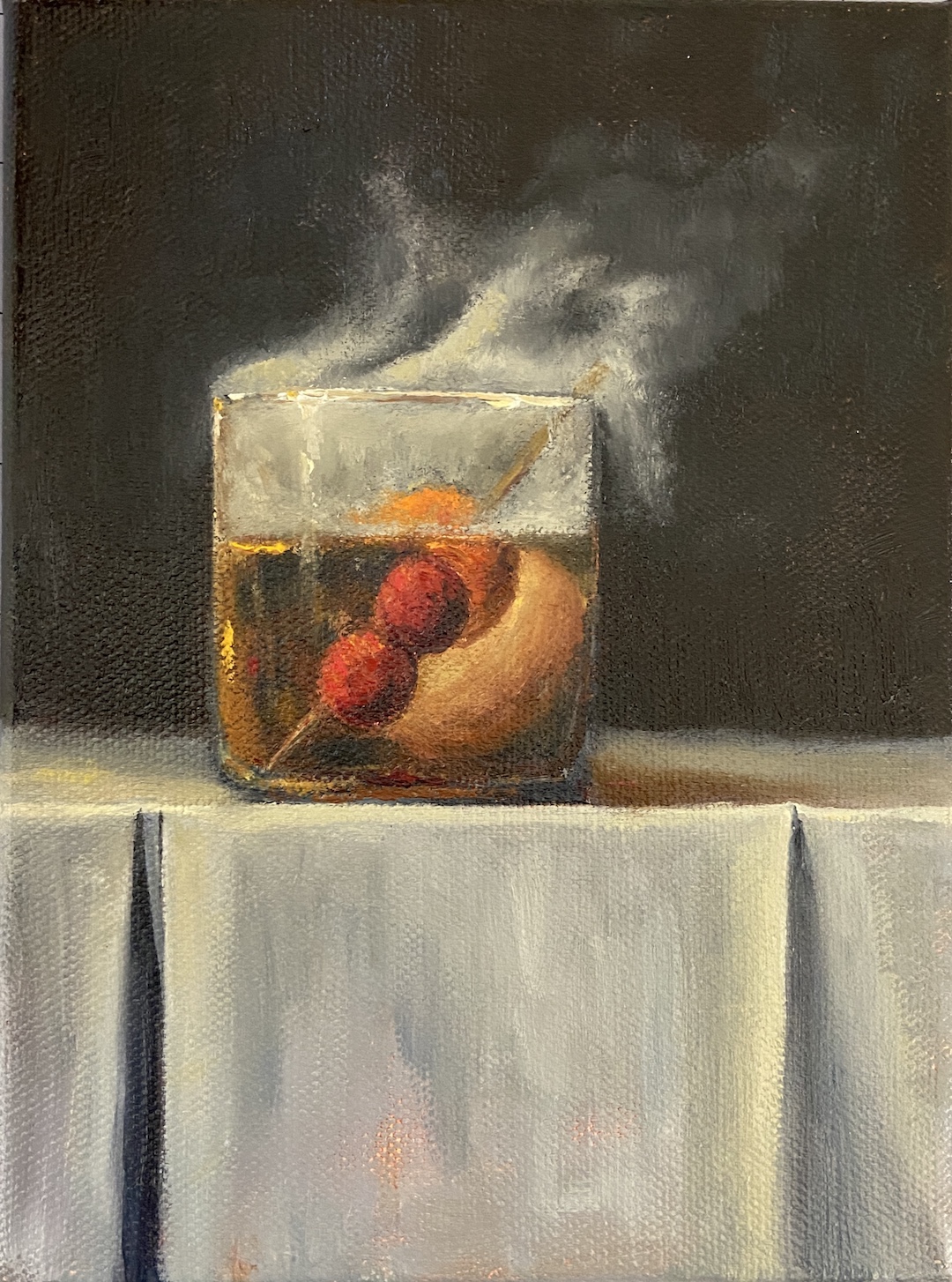
SMOKY OLD FASHIONED is a recent commission piece, something I love doing, especially when it’s for a gift or something sentimental. In this instance, the painting is for a gift for someone who apparently has everything. Painting to the rescue!
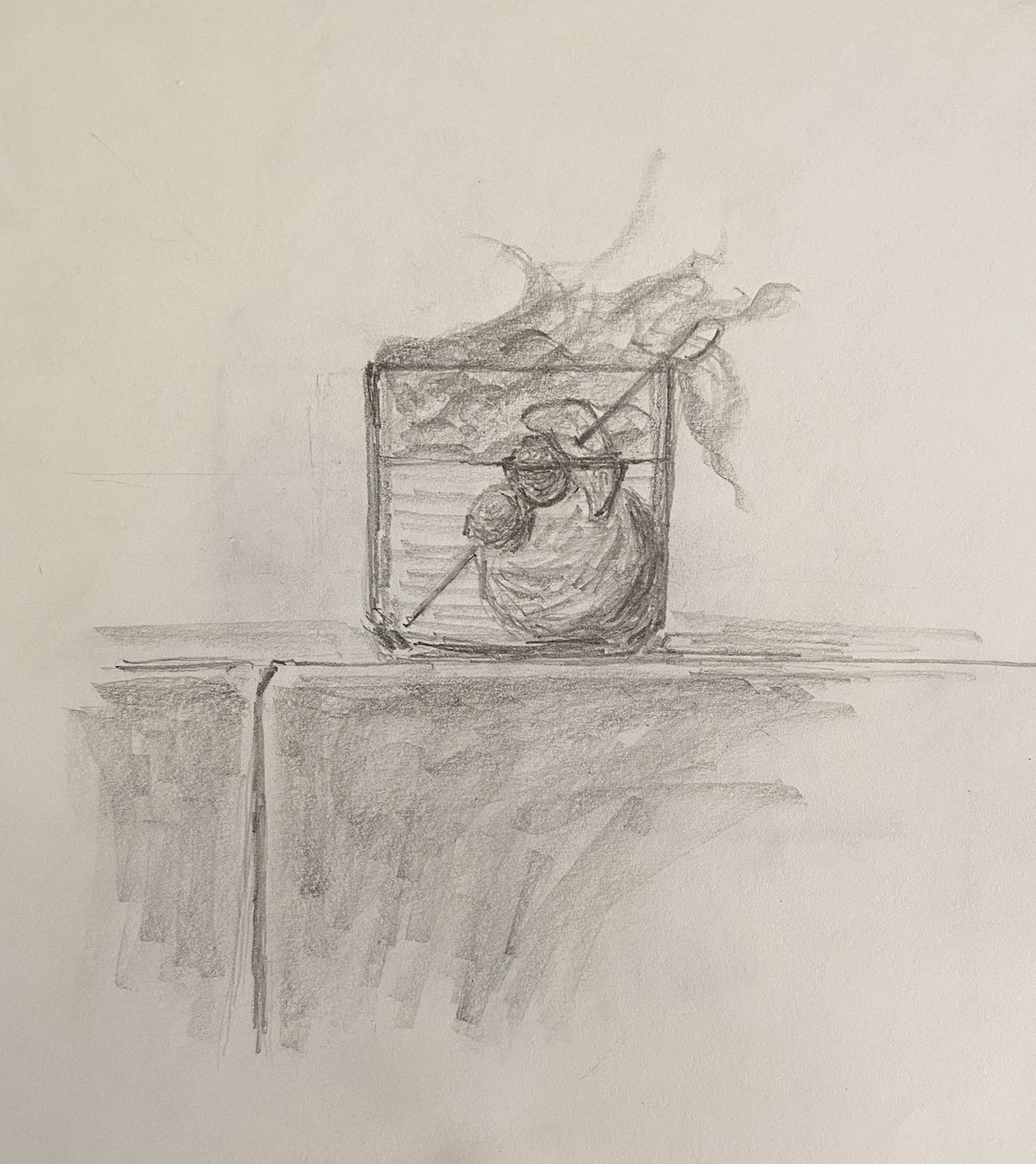
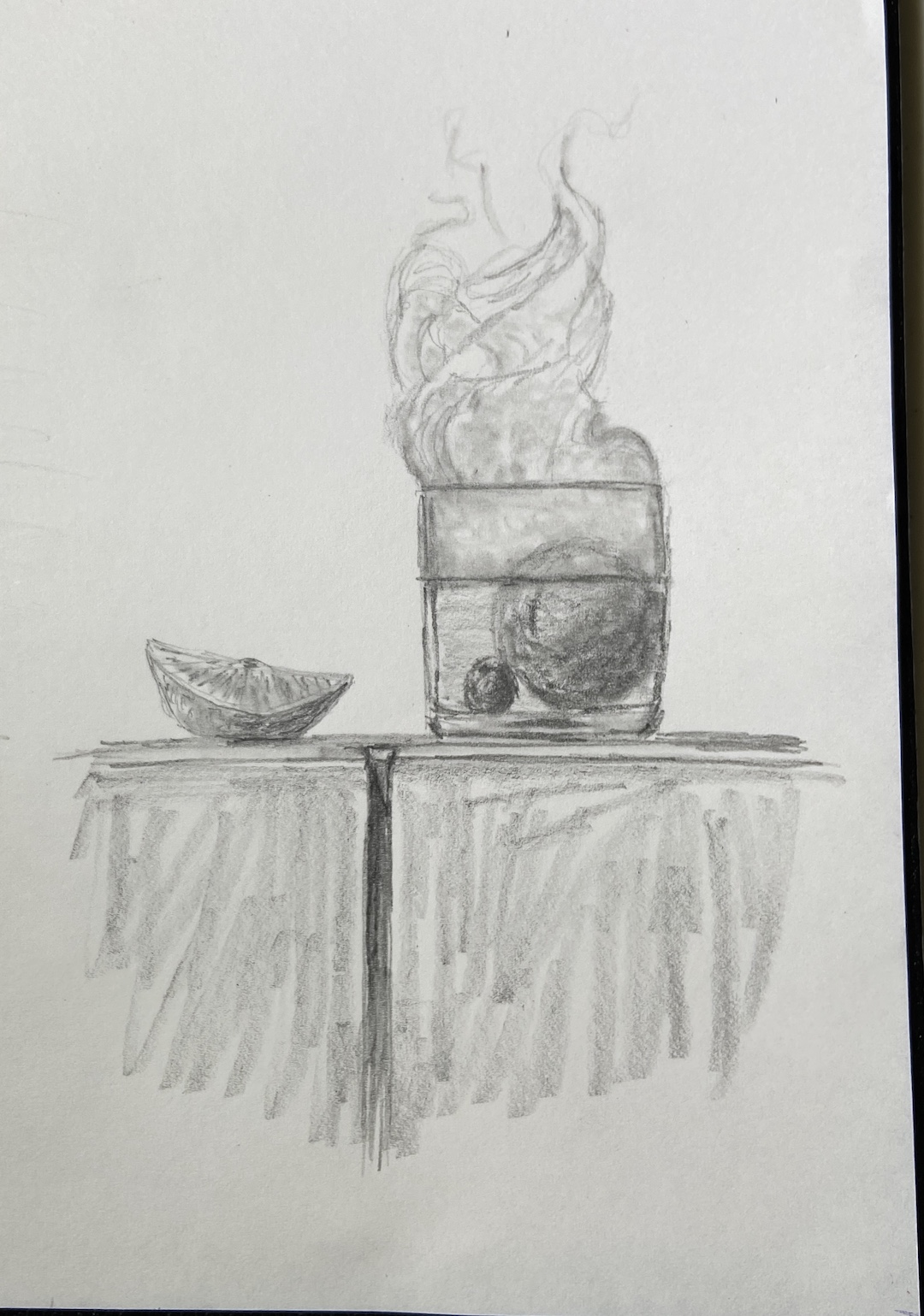
My process for custom work involves a number of preliminary discussions followed by sketches that give compositional options. Just like blocking in the value structure of the actual painting is key to a good outcome, with a custom piece, coming to an agreement on the core elements and structure of the composition is vital.
I’ve painted a number of libation-based still life compositions, but nothing with smoke. It required me to investigate if painting smoke was similar to creating fog, mist, or larger fire-based plumes.
The answer, it turns out, was an emphatic NO! It seems that once you pump smoke into a cocktail glass, weird shit happens and it becomes lifelike and animated. Looking at reference photos further complicates matters, introducing possibilities of upward windy smoky tendrils, or smoky bits that spill over the edge toward the table. Come to discover both of these considerations are smoked red herrings! Smoky tendrils are “fresh” burning anomalies, and the only smoke that sinks seems to be dry ice based smoke, which you can imagine is in a lot of cocktail glamour shots.
The trick with this piece was clearly… smoke! But before getting to that challenge, there was the issue of compositional tension. Technically, an Old Fashioned isn’t so much a cocktail as an origins story of composition. The Meehan’s Bartending Guide, my personal true North for all things cocktail, notes “the cocktail was first defined on May 6, 1806, in The Balance and Columbian Repository as ‘a stimulating liquor, composed of spirits of any kind, sugar, water and bitters’. By the time it showed up in a professional bar manual for the first time in Theodore Proulx’s 1888 The Bartender’s Manual, it was already “old-fashioned”.” My personal preference is rye whiskey, simple syrup, bitters, 1 cherry and an orange twist. Now back to the painting…
The request for this piece was to incorporate Luxardo cherries, orange peel, and a large round ice cube. Figuring out how best to structure this as a piece of art was trickier than I thought, even without the smoke. Once you put all that stuff into a lowball glass, it’s impossible to not notice the tension of so many things jammed into a small space. To tackle this problem we simply talked through various sketches that presented different solutions, and we ultimately landed on cherries on a toothpick, angled into the glass, orange peel also on the toothpick but above the whiskey line, and lastly a demotion of the round ice to the background. As a pleasant surprise, once the smoke was added, it significantly improved the compositional structure because it broadened the view and seems to have further reduced the tension, essentially granting the viewer a larger viewing room.
Lastly, the smoke technique. I still need to refine the approach, so stay tuned for more smoky cocktails, but the core approach seems sound. The smoke is not white, that’s the first thing. Turns out it’s about 20 variations of gray, leaning warm (cad yellow deep) above the glass, and a little cool (lemon yellow) below the rim. The brushwork boils down to a lot of push and pull between the light grays and the black background, using a lot of scumbling with an oversized round brush. As the smoke expands above the glass, it was important to make sure there was a very thin layer on the outside edges of the core smoke to lend it a sense of movement. The person who commissioned this piece has a cocktail smoker top, which sits on the top of the glass and is then pulled off in a flourish when the smoking is done, which pulls some of the smoke up and out of the glass. It’s all very entertaining, until you try to paint it!
I recently saw a question on Quora asking “when does drawing end and painting begin?”, which was a timely inquiry given a new approach I’ve been taking with some recent paintings. It’s always a bit tricky and, frankly, pretty intimidating to take on a new type of composition. For me, that tends to be something that involves shapes and/or subject matter that’s new or unfamiliar. In one of my current projects, A Stuffed Kong and Its Dog, I came to realize that while the subject of a dog toy was not a new compositional challenge, the complexity of a dog chewing and pawing something was really friggin’ hard!
My normal process, and what’s been reinforced at workshops by artists far more experienced and talented than myself, is to do a study of the subject to help get a feel for the composition (see Dances With Squirrels blog post for more on studies). I prefer sketching as opposed to small paintings, largely because I like to sketch, it’s more expedient than painting, and it’s more flexible, i.e. erasing graphite is infinitely easier than wiping out paint. Lately, however, I’ve been refining this process whereby I still do an initial sketch before starting the painting, but as I work through the project and run into challenges, I go back to the sketch and either do another or simply refine the one I was working on earlier.
In hindsight it’s frankly a brilliant idea, of which I don’t have many, because the pause from the painting a) makes me breathe as I gather my thoughts to overcome the problem, and b) let’s me return to an existing sketch and figure out how to navigate a solution based on a similar composition. What I’ve found thus far is that I often find the same problem in the original sketch, kicking myself for not having seen the problem in the first place, but I can quickly figure out how to make changes and move forward.
In A Stuffed Kong and Its Dog, you can see the original sketch being reworked (I forgot to take a picture of the original state of the sketch) when I ran into 2 problems. First, there was something fundamentally wrong with the Kong dog toy shape, which became clear when I returned to the sketch and saw that the bottom planes of the humps were misaligned. Secondly, I thought the size of the Black Lab’s right paw was too big once I painted it, but when I returned to the sketch and redrew it, I found that the size was actually fine and the issue was the related to the size of the black fur shadow gaps between the toes. Clear as mud, right?
The final painting will need a few minor refinements, but I want to let it dry before I make those updates. I’ll update this post when it’s really done. The intrigue with this piece is to make the viewer wonder what in the world is in that stuffed dog toy Kong! It was very hard to translate the focus and excitement of the dog as it diligently worked to get to the yummy treats out of this toy. While the focal point is the Kong, the supporting cast is the nose and that huge right paw, which in combination should convey the canine treat obsession.
Lastly, I’m not pleased with the sketch or the painting. The sketch is not supposed to be a finished work, and is muddled with various experiments to see what was going to work, so I’m. not flustered it. However, the finished painting, while not intended to be a refined piece of exceptional artwork, is ultimately a composition that doesn’t work well. The angle of the nose looks wrong relative to the muzzle, but it’s actually accurate as most dogs are able to bend that nose around in weird ways. That said, it doesn’t convey well in the painting. The large paw also creates visual confusion and seems out of place even though it’s proportionally accurate.
This exercise has taught me that all compositions aren’t destined for a “real painting”, but that’s why we do studies and small pieces to see how it plays out. I’ve also learned that my dog portrait skills need a lot of work, something I knew already, but this work has highlighted the gap and is proving to be quite motivating to start sketching my dogs’ faces!
Moving these updates to the blog to motivate myself to do them more frequently. The goal is to hone my drawing skills by doing sketches in 1 hour.
This session is from a reference photo taken by my brother. Very challenging given the need to incorporate movement of the bird and the advancing waves. Oh, and drawing ocean foam is hard as hell. I think the key is to not draw it.
Started a new project today. I’ve sketched this one a few times already, but intend to use this as a reference point for the actual painting whereby I’m going to try to emphasize the storm clouds in the background, add some color to the foreground with flowers, and insert some actual people doing stuff in the village area to draw the viewer into the scene. This first effort will be a quick draft painting on paper to get the values and compositional elements figured out. If that goes well, I’ll parlay this into a larger piece.
Reference Photo – Loire Valley, France
Sketch on paper
Initial block-in. Focus on values and basic color scheme.
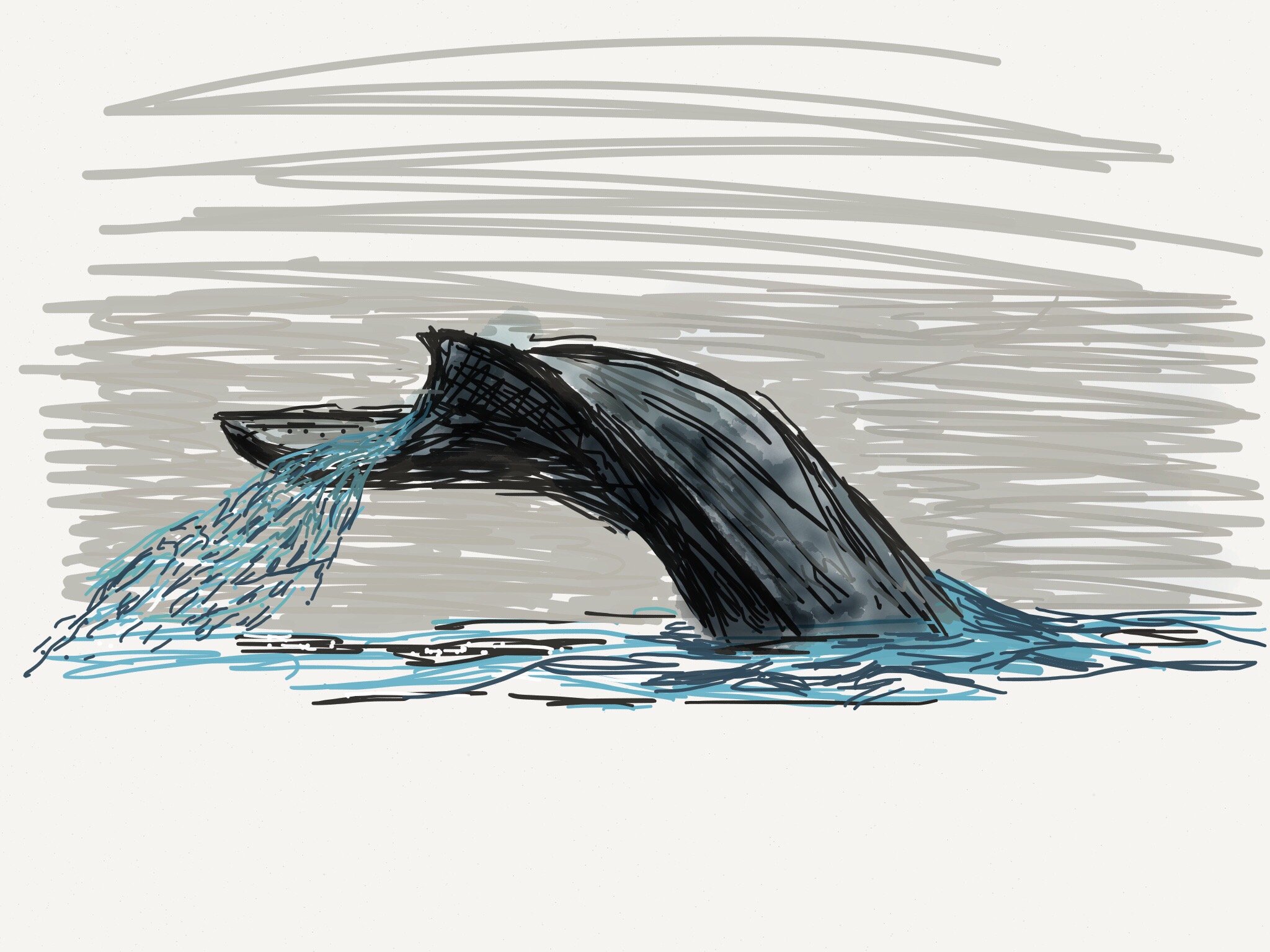
Used a new art app on my iPad today and it was surprisingly easy to use, yet had a good range of options to create great sketches.
Did this whale tail in about 30 minutes, including fumbling time with the app features. Might prove to be a great way to do quick art on the go while traveling without supplies, or in bed where graphite and eraser debris are unwelcome. It was a lot of fun!





 Art Bern