Squirrel Watch

Pivoting from painting to drawing last week and finally made the time to finish this one. Squirrel Watch is pretty self explanatory – Wolfgang, my 3 year old rescue mutt, sitting in the yard watching the tree tops for the infiltrators! 

One of my artistic goals this year is to improve my dog related art skills. I’m not a big fan of dog portraits, however, I thoroughly enjoy what I like to call “dogs doing stuff”, creating intrigue through motion and activity. Over the coming months I’ll work on various dog related pieces that capture the essence of dogs being dogs as they do their thing. 

Squirrel Watch | graphite on paper

Squirrel Watch was done over the course of a few weeks – I have no idea how long it took, but I wouldn’t be surprised if I spent 6 hours on this relatively small piece. There were a lot of mistakes along the way, but nothing an eraser and some patience couldn’t remedy. 

This isn’t a piece I would frame and hang, but I’m pleased with it from a progress perspective. It’s also riddled with lessons learned, so if you zoom in to see the details you can spot various styles and techniques.

Here’s what I learned and need to remember for future drawings:

  • It’s not necessary to draw hair detail throughout the subject. In this piece, the emphasis should have been on shading and shape foremost, whereas hair detail should be secondary. 
  • Draw hair details with a clear understanding of actual direction of the hair on the dog.
  • Work hair dark to light. 
  • Most of the hair detail can be accomplished using 2B, HB, and H pencils.
  • Show wrinkles in the coat by changing the density of hairs, i.e. closer together or further apart.
  • Dog paws are hard to draw, dammit! 
  • Blades of grass can be done by either individual strokes or by lifting out shading with a thin eraser. 

PB&K

Say hello to PB&K the latest addition to the Dog Toys series, although it might be more appropriate to start a new sub-category called “Cheeky Still Life”.

The Kong was done with a painting knife to give it the subtle texture of a well worn, go-to Fido favorite. As any dog lover would attest, especially the big chewers, a peanut butter stuffed Kong is a great source of entertainment… and protein. Even the most hearty chewers have trouble putting a dent in one of these rubber wonders, but they do lose their sheen and get a roughed up look over time. By contrast, the (creamy) peanut butter and the remainder of the composition is all impasto-free brushwork.

Ultimately, the intent of the composition is to make every dog parent look, nod, and laugh at the reality of what we’re all willing to do for our lovable canine companions.

  • Oil on canvas paper, 8″x10″
  • Palette knife and an array of brushes (rounds and flats)
  • Key colors
    • Peanut Butter – Yellow Ochre, Naples Yellow
    • Kong – Ivory Black + Ultramarine Blue, Burnt Sienna + Ultramarine Blue

Dances With Squirrels

Dances With Squirrels (study)
6″x8″, Oil on canvass paper
This simple study piece is done, although I invested more time in the composition than originally planned. I rarely do a study as a painting (if you’re not familiar with the term “study” in this context, here’s a short summary on Wikipedia here), opting for a drawing instead (which I had already done previously, as noted in the Meteors and Squirrels post last week), but my goal was to practice the brushwork needed to capture a dog in motion from a short distance. I also wasn’t sure how well this composition would translate to the canvass. I learned a lot in this exercise. 

First, I was surprised that the dog (Wolfgang) portion of the painting wasn’t very difficult, probably due in part to the various practice sketches done previously. The trick was to apply the darker parts of his coat last, which might technically be incorrect, but it was easier to manipulate the black shapes on his coat if it was the last step.
 
There are a number of compositional changes that will need to be made for the “real” piece:
  • The fence was both boring, distracting, and worst of all had many of the same values and hues of the trees and the dog, which made it hard to work into the layout effectively. I think the fence will be removed going forward. 
  • The trees were tricky from a color perspective. In real life, they’re a weird gray black, basically a color graveyard, so making them interesting took time. The other problem, which I haven’t yet solved, is ensuring their coloring isn’t too similar to the Wolfgang’s black and golden brown coat. 
  • ​The coloring of the grasses are fine, but the shadows will need more attention in a formal composition. They’re a real highlight of the work because they give a more comprehensive feel of the height and breadth of the tree tops, which are out of the frame.
  • Last but not least, that pesky squirrel. I was so focused on how to paint the dog that I hadn’t given any thought to the squirrel. Have you tried to paint a squirrel? The good news is that my lack of practice painting rodents might have worked to the benefit of the composition because the squirrel is very hard to see against the light blue sky background, so the viewer has to follow the gaze of the dog to find the squirrel. And there’s our compositional intrigue!
I’m going to wait a few weeks before firing up an actual painting based on this study, but I think it’ll be an eye catching, tall, narrow canvass layout that should be fun to create.
Thanks for visiting! ​

Meteors and Squirrels

It’s been a couple months since I worked multiple pieces simultaneously. I like having the ability to bounce between works in progress for a number of reasons, not the least of which is the fact that alternating allows me to shift gears and keep my focus fresh on the piece in front of me, rather than getting burnt out banging away on the same composition for multiple days. Thus far in 2020 I’ve been working on small pieces that don’t take a long time to finish, so I’ve not had the opportunity to work in parallel. Well, that changes this week​, means blog updates will have more progress updates along the way and not necessarily include the finished product in a singular post.  
 
Last week I started 2 new pieces. I’m still waiting for inspirational names, but for now we’ll call them Meteor Spray and Squirrel Dancing Meteor Spray is an actual Mars meteor impact crater, which will be a mix of realism and abstraction. Compositionally I’m already excited, in large part because the splatter inspired block-in stage turned out to be damn near good enough to stand on it’s own as a monochromatic painting. The colors in the reference photo are wild, but might be tricky to replicate. The plan will also incorporate knife work and impasto to build up the texture of the Mars surface. This is a larger piece, oil on canvass board, 24″x30″. 

 
Back on planet Earth, Squirrel Dancing is a study more than a formal composition, at least for now. I want to improve my skills in painting dogs in motion, so the study will focus heavily on the body language of the dog in an effort to capture an element of motion that gives the piece intrigue. In the case of Squirrel Dancing, the focus is the dog ready to spring into action when the squirrel makes a move. I’ve included a couple of sketches that helped me get a handle on the composition structure. Based on these sketches, I opted for the zoomed out approach that captures the height and separation between the taunter and the taunted. The painting study is 6″x8″ oil on paper. Before painting Wolfy into the study I did a small practice version before committing it to the composition – see the picture with these side by side. 

 
I’ll keep working on these 2 pieces over the coming week. Stay tuned! 

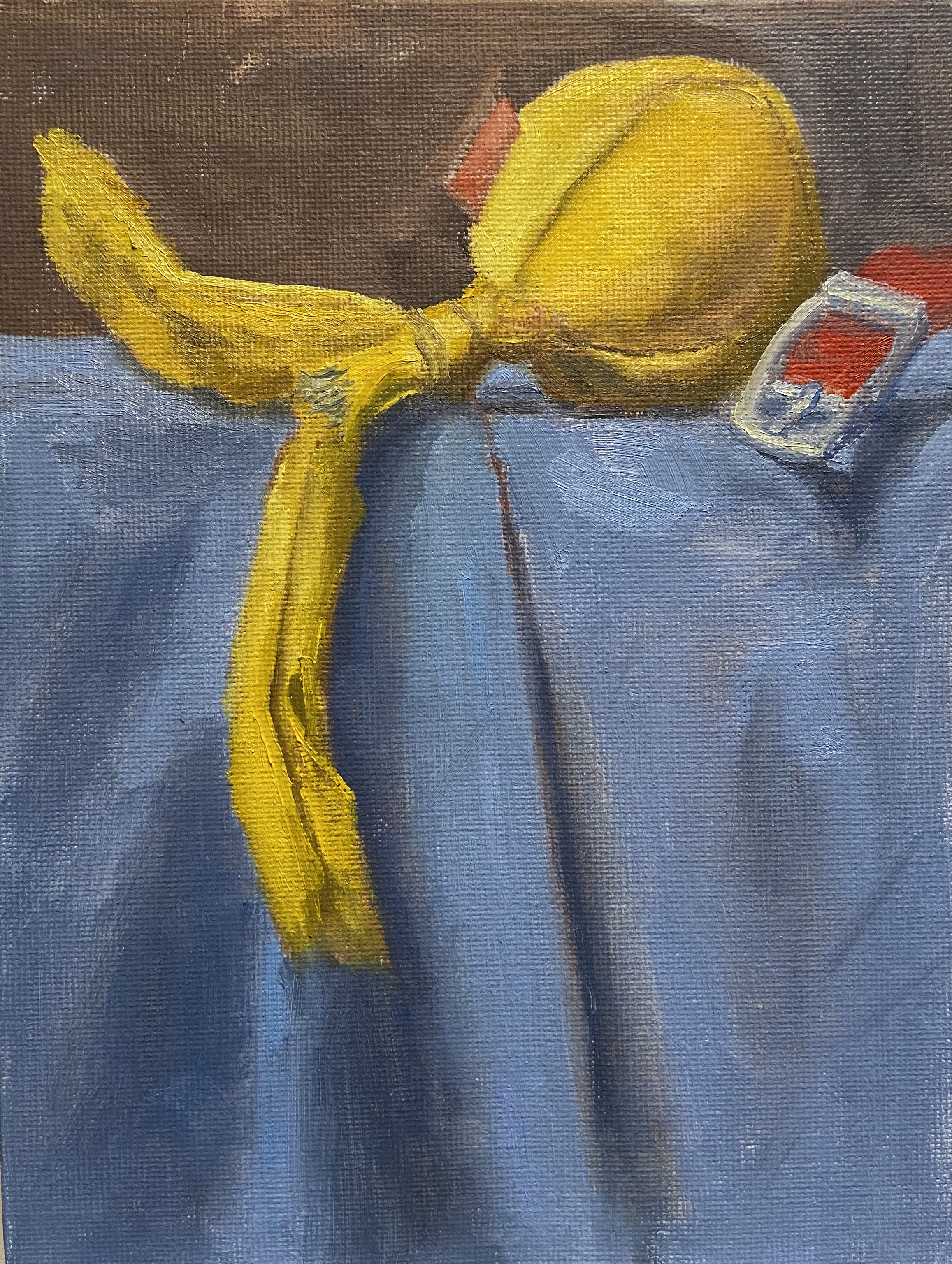
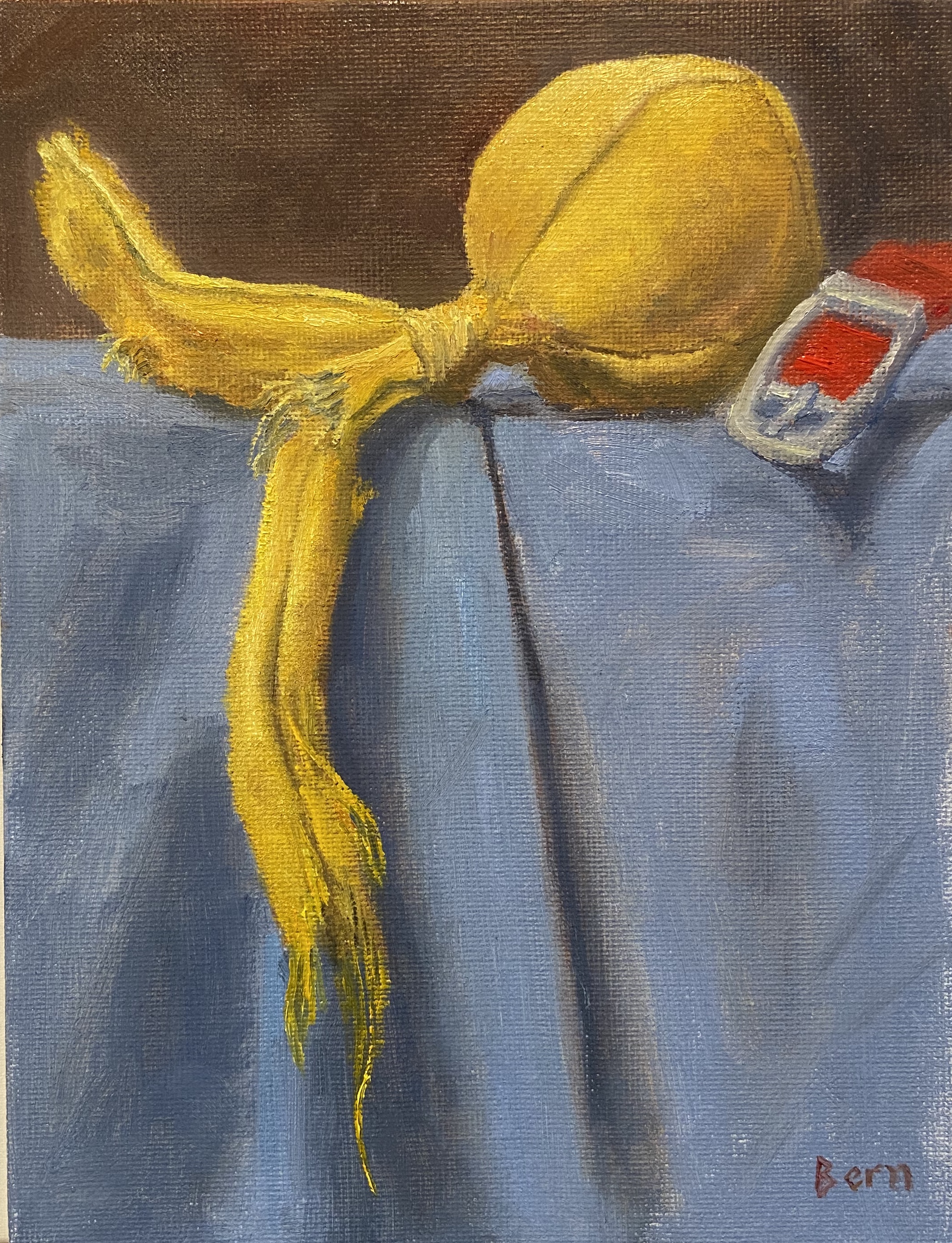
Yellow Ball with Tails

Yellow Ball with Tails
Oil on canvas board, 6″x8″
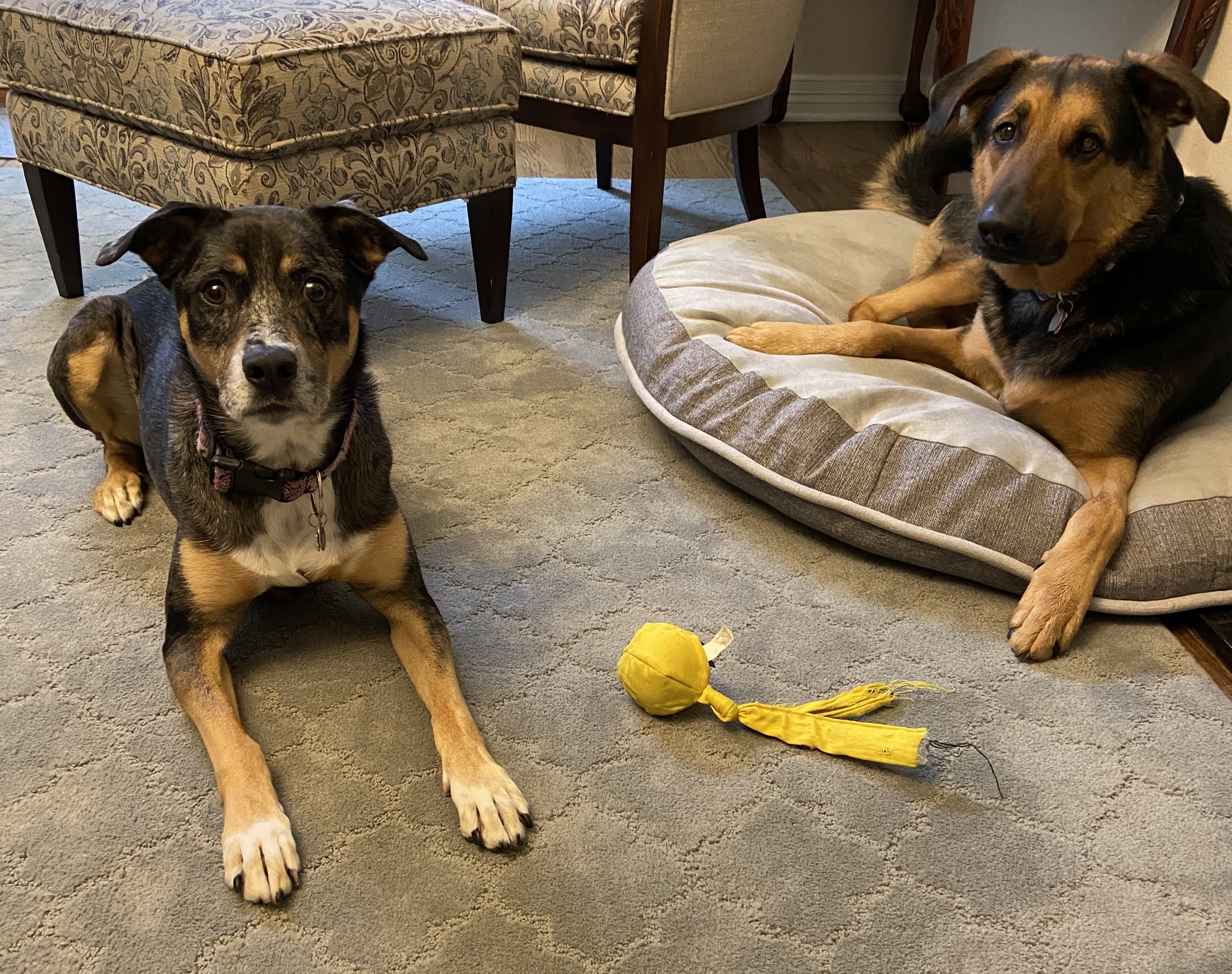
Sometimes you just know a composition is going to work, virtually able to paint itself. Yellow Ball with Tailswas exactly that kind of composition. Wolfgang and Zip loved this toy because the 2 tails made it tug-a-licious! As the designated thrower, I liked it because the ball made it easy to throw without getting dog slime all over my fingers.  Ultimately, this toy stayed inside and lasted about 20 play sessions before parts started to get ripped off and chewed up.
I’ve recently made some adjustments to my still life setup, changing the platform so it’s higher and is at sitting eye level. This gives a new angle that’s easier for me to translate to the canvas.
This piece moved quickly and was done in a couple of sessions this week. As I stated earlier, this composition looked great from the start and I knew it was going to be a fun project when I saw all that bright yellow shredding dangling against that blue background. Definitely going to spend more time on compositional arrangement with future dog toy paintings.
The canvas board was ideal for this type of toy because it has a lot of toothy texture, which easily lends itself to the toy’s material. The only thing I don’t like about a canvas board for this type of piece is the fine detail of the threads. The canvas texture makes it very hard to paint a thin line, so I often had to do some back and forth with the darker background color to get the thread lines just right, basically painting back into the yellow thread line to reduce the width.
There’s a lot of yellow in this piece, and I did some experimentation:
  • Deep Yellow + Titanium White as the base for the mid-range yellows. Added Ultramarine Blue and Cadmium Red Light in small doses for the shadows on the ball. 
  • Cadmium Lemon + Titanium White for the lighter areas. 
  • Indian Yellow, which I don’t typically use often, here and there to vary the lighting along some of the longer sections of the tails. 

The blue cloth was Ultramarine Blue and TW with variations of green made from Cad Yellow Deep and Cad Red Light. 

 
Originally, I had included the tag on the toy, but once the piece was 90% done the tag looked too distracting and didn’t add a lot of value, so I took it out. 
 
For those interested in the toy itself, it came from BarkBox, a monthly dog toy subscription service. Our dogs destroy toys, much to my artistic delight, so BarkBox has had to adjust what they send us to try and find toys that are good for tugging but also very durable.  Supervised play is the best solution for our fur balls because once they’re done tugging, it turns into keep away, which devolves into a game of “I’m going to eat this so you can’t have it”. Somewhere between keep away and vindictive chewing is when I like to step in and save the toy. If I was going to rate this toy, it would go something like this (1-10 scale):
  • Tugability 8 – withstood some strong tug sessions between my large dogs (Zip 50 lbs, Wolfy 85 lbs )
  • Durability 6 – hard for a canvas toy to rate higher than a 7, so this is pretty good
  • Versatility 8 – this could have easily been used inside or outside, both for fetch or tug. 
  • OVERALL 7

Yellow Ball with Tails - Dogs
Zip and Wolfgang – Dog Artists

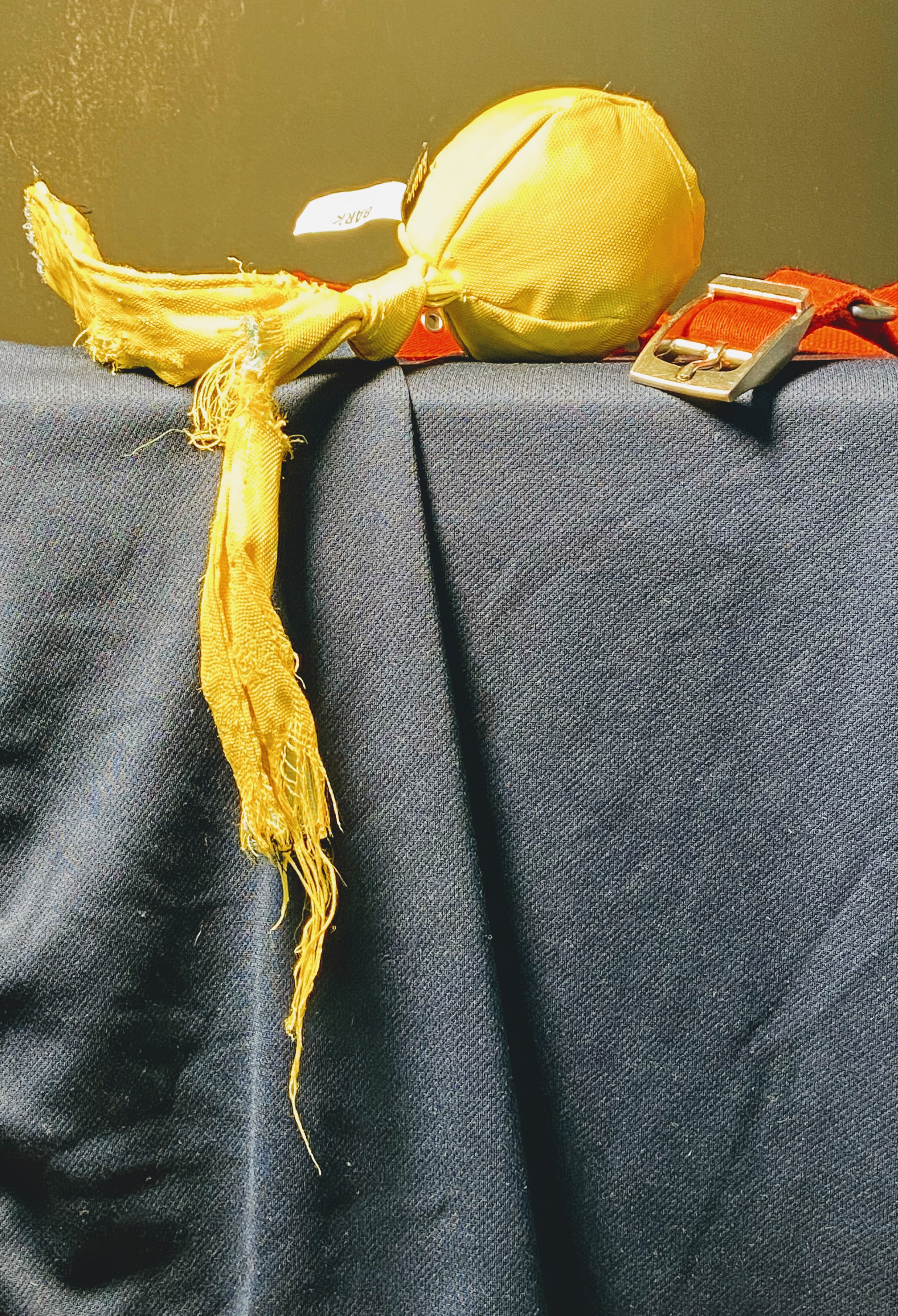
Yellow Tail Ball - ref photo
Reference photo – Yellow Ball with Tails

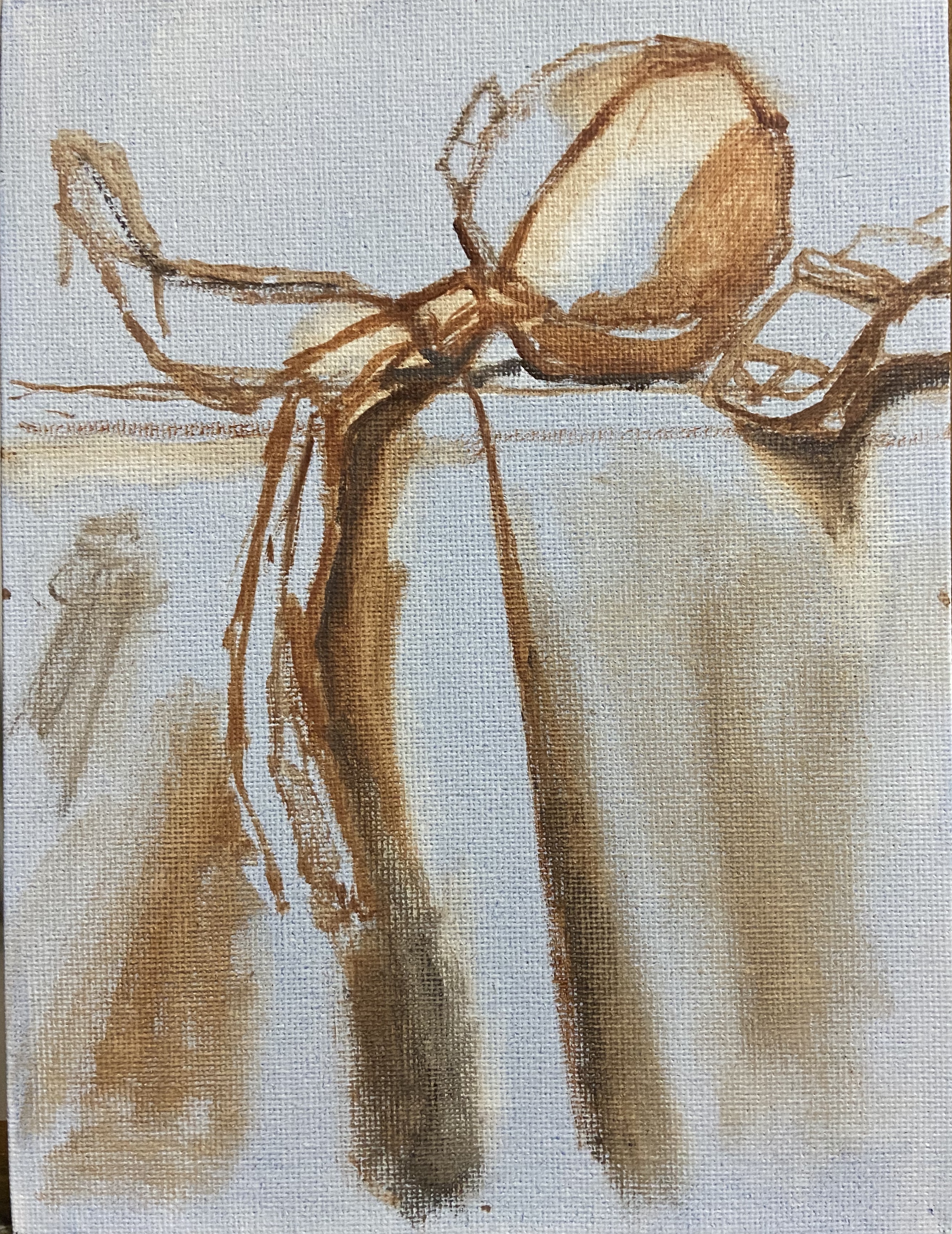
Yellow Tail Ball block in
Block in of dog toy

Yellow Tail Ball 1
Started with the yellows

Yellow Tail Ball 2
First paint draft done

Yellow Tail Ball 3
Working details

Yellow Tail Ball 4
Fine details of shredded threads

Yellow Tail Ball Final
Finished Yellow Ball with Tails dog toy

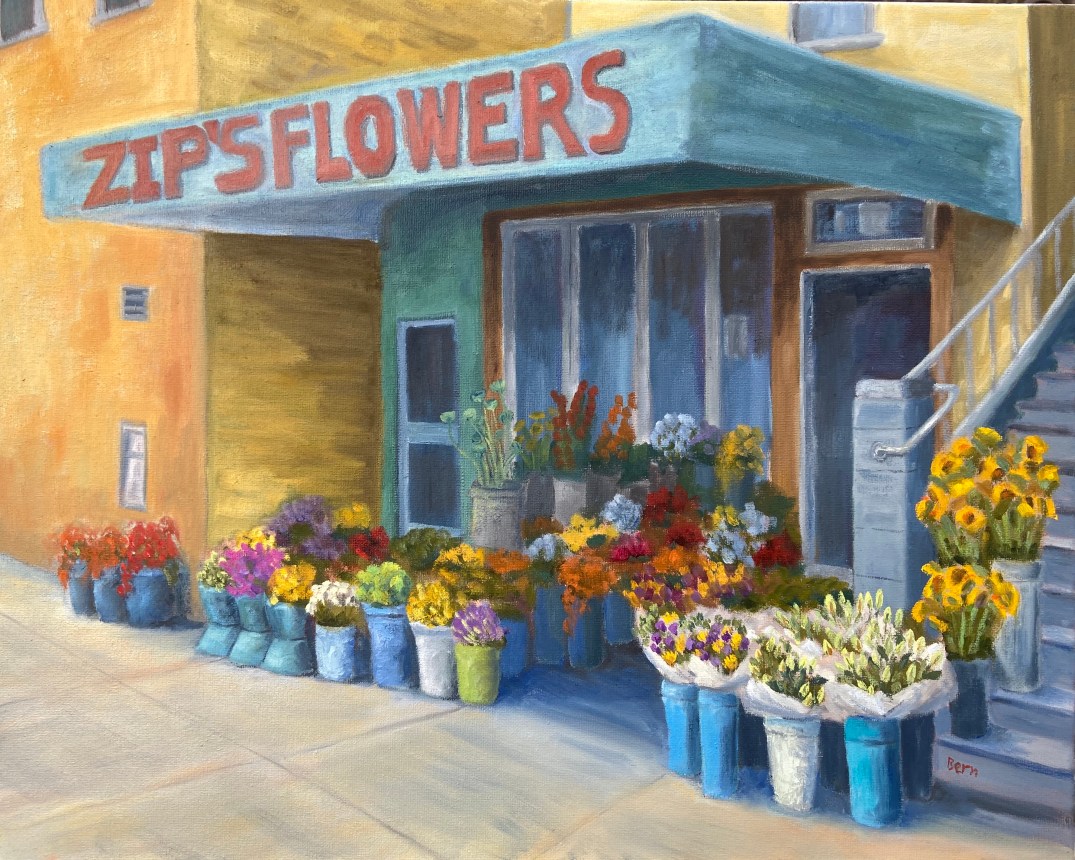
Zip’s Flowers

Zip’s Flowers: 20″x16″, oil on canvass

Sometimes art is very cathartic, but at times it can be maddening. However, I’ve learned over the years to rethink the frustration and consider those pull-my-hair-out-of-my-head moments as learning experiences, and more often than not it works. When I just can’t get a piece to work, either compositionally or from a technical skills perspective, if I focus on what I need to learn to fix it rather than become irritated at my shortcomings, I tend to get back that Zen painting zone.

Zip’s Flowers has been a long learning experience! Wars have taken less time to finish. That said, it’s chock full of newly acquired knowledge, of which I’m very excited about. There’s also some personal interest in terms of the background of this photo. This flower shop is a few blocks down the street from where I lived one summer in San Francisco. We lived in a great neighborhood along the border of the Mission and Castro districts, on 18th between Hartford and Noe. This flower shop, now called Urban Flowers, was along the way to the dog park. My wife would take the dogs at least once a day to the dog park. One day, the 1 year old puppy, Zip, decided smelling the flowers was no longer satisfying, so she opted to taste them. As the story goes, she reached out and grabbed a dangling flower from one of the pots and proceeded to knock the whole thing over! I wasn’t there, but my wife said the people at the shop were very friendly and weren’t concerned about Zip’s flower chomping. Of course I had to see this for myself, and a few days later I was walking Zip past this flower shop and sure enough, she tried to gobble down a basket of roses as we walked by.

The composition itself was probably the hardest hurdle to overcome, which I took license to adjust reality to make things work. The reference photo shows a wide variation of building colors and construction materials, so some adjustments had to be made on various fronts to make it look less contrived – ironically, the reality in the photo was too hard to believe in a painting. The values also had to be exaggerated to give depth and a sense of place, whereas the photo was very flat. Finally, the amount of tissue papered flowers was overwhelming and a bit distracting, so that was scaled back significantly.

My favorite part of this painting is the right foreground. First, the flowers in white paper came out much better than I had anticipated and they really frame that side of the painting. I also like the realism they add to the scene. Secondly, I’m very happy with the tall yellow sunflowers going up the stairs. These two elements combine to draw the viewer into the painting (hopefully) and consider wandering through the rest of the composition.

The sheer multitude of color is initially distracting for me, but once I stepped away from it for a day and returned to the completed piece, the colors were more welcoming and a source of excitement.

Do you like this piece? I’m guessing people either love it or hate it, given the colors and somewhat busy nature of the scene. Suggestions and observations are welcome.

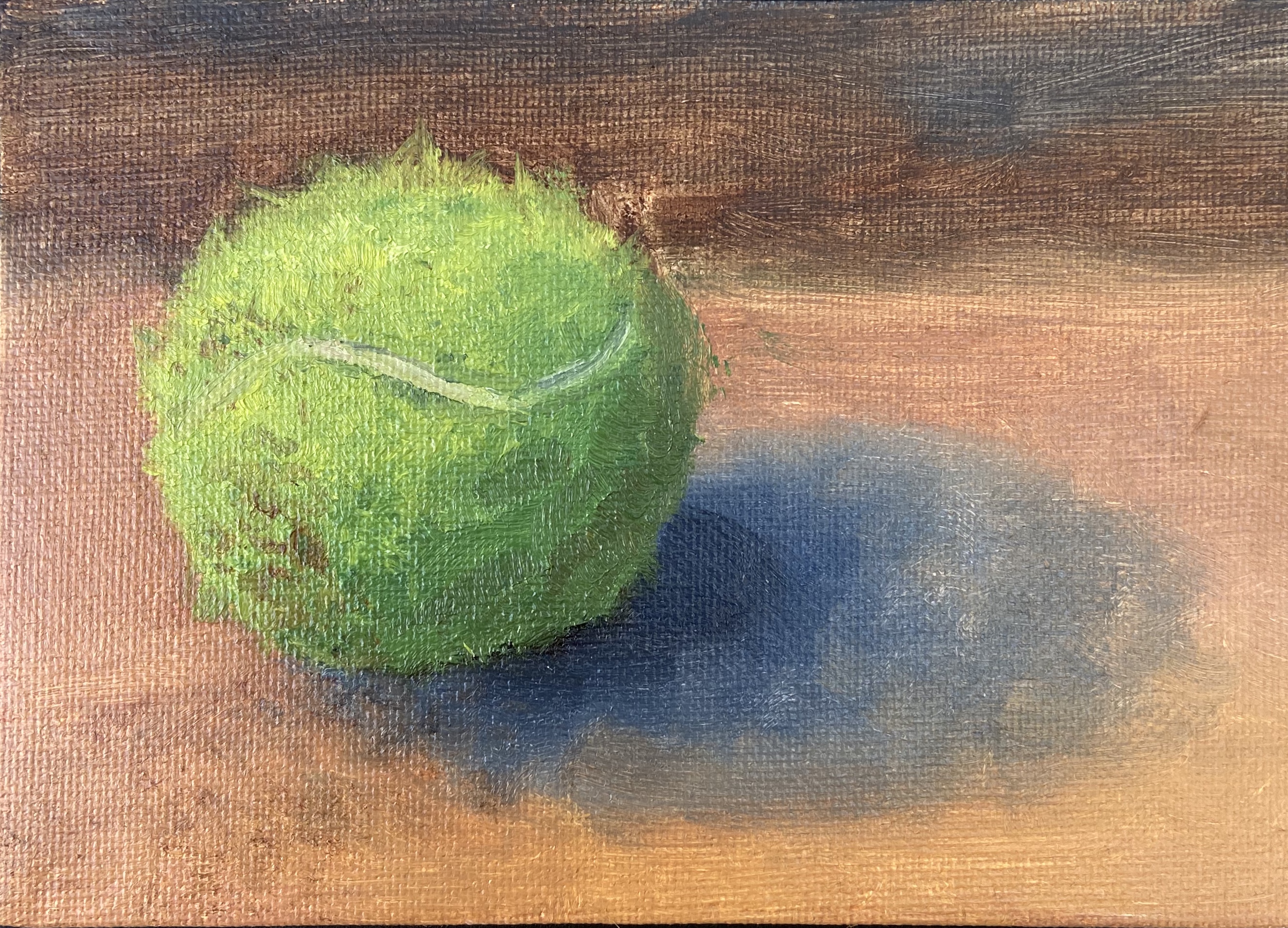
Ball! Ball! Ball!

Oil on canvass panel, 6″x4″
My dogs are a big part of my life, which means I live to serve their needs, in large part because I love them and, well, they don’t have thumbs. My oldest dog, Zip, is a 7 year old Aussie Catahoula rescue mutt from Austin Pets Alive!. Her world revolves around two things – food and “ball”. To that end, I serve as her chef and throwing machine.
The lifespan of a Zip tennis ball is a couple weeks. She chews on them while bringing the ball back for another throw, as if they’ve offended her and need to be destroyed. It’s the epitome of a love hate relationship.
This piece is a tennis ball after 1 throwing session. The fuzz and color have been adequately altered, making what had been a boring, new green smooth tennis ball into something with depth and intrigue. Thank you Zip!
I like to do these small dog toy pieces on a canvass board to help with texture. In this piece, it was very helpful with the need to pull out strands of tennis ball fuzz because the rough surface helped scatter the stringy look in a random pattern, thus making it look more natural. The hardest part was getting the dirt just right, which took some experimentation with Burnt Sienna, Raw Umber, and various puddles of orange.
Finally, I was pleasantly surprised how effective the white line of the tennis ball added realism. It was also important to put a small hint of shadow along the edge of the white line to give just enough depth on the surface of all that green fuzz.
Tennis Ball - Oil Panel 2

“Rescued” – molds and molds and molds

IMG_3641

As mentioned in the previous post, the process for creating the dog paw prints wasn’t straightforward. The challenge was finding a way to get the real prints of all 3 dogs on the canvass without having it look like a distorted mess. Sure, there are plenty of reasons to do a piece with the messy prints splayed across the canvass, and I’ll readily admit that is a good idea, too. However, that was not the direction for this project.

The other challenge was ensuring the actual prints of Crash, Boom, and Zip were used. I didn’t want to do a photo-based, realism approach, i.e. take a picture of the paws and free paint the shapes. I really wanted to have the touch and active presence of CBZ on the canvass. This became very important to me as the work progressed because it would be a forever connection to our beloved pups; a way to always reach out and touch their “real” paws.

So if you haven’t barfed from the sentimentality, you appreciate the concept… hopefully. The original thought was to slather some non-toxic kid paint on the dog’s paws and let them run on the canvass. That’s such a bad idea for so many reasons. Just think about it for a minute if you don’t know what I mean. The next idea was to paint the dog’s paws and then press their paws on the canvass myself, in a more or less controlled fashion. Aside from the obvious battle of wills that would ensue, of which I would surely be on the losing side, this doesn’t work well because the prints are muddled with hair marks, making the prints largely indiscernible. I know this because I did a trial with Boom, the mellow dog, by shaving his paws and following the technique noted above on a practice canvass. It looked like poo.

The final answer was molds in molds. The photo included has the molds I used plus one set I didn’t. The 3 molds on the top left and the set of 3 on the bottom left. Process went like this:

  • Pressed the dog’s paw into a round of molding clay.
  • Baked the molds for 30 minutes. These are the top 3 molds in the photo.
  • Using non-drying clay, pressed into the dried molds and pulled them out. These are the bottom 3 colored ones.
  • These non-drying clay molds held their shape, but could be manipulated, so I pressed each one gently down onto a flat surface to flatted out the paw prints so it would transfer the shape better.
  • Applied thin layer of paint to the clay molds and pressed carefully onto the canvass. This provided the general shape and worked surprisingly well.
  • Applied free-hand touch ups and additional layers of paint on paw prints on canvass.

The other 3 molds (on right side of photo) are a failed attempt to create oven dried impression molds as described with the non-drying clay above. They are great 3D molds of the dog’s prints, but turns out the paint doesn’t transfer well to the canvass because the paw pads are too well done, i.e. they are rounded and can’t be pressed flat to make a good stamp. One of those things you try and then feel like a moron for having overlooked such a simple mistake.

All the molds are reusable, so I can recreate this project again if I wanted to. The best part is that my wife gets the painting she asked for, plus a mold of each dog’s front left paw.

Going Big… Mixed media

The next step in the big heart project. Can you figure out where this is going?