Diving Whale Tail

Stuck with the whale theme for this next project. This is a diving whale based loosely on a reference photo I found on-line. Also bought some Payne’s Gray to work on a more balanced value gradation on this piece that is dominated by the tail.

I think this is pretty close to done, but I don’t like the matte finish, so I’m going to do a final glaze layer in hopes of giving the entire piece a wet look.

This is a diptych, each panel measures 9″ x 12″. I was pretty specific with the panel choice so as to get good proportions for the tail. In fact, I think the painting looks better than it really is b/c of the diptych layout. Curious what others think, too.

Technical Details:

  • 2 gesso panel boards, 9″x12″ each
  • Brushes – 2 flats (sizes 2 and 4), 1 round (size 4)
  • Tail palette – Payne’s Gray, Titanium White, and variations of Black and Ultramarine Blue
  • Ocean – Ultramarine Blue + variations of Pthalo Blue, Pthalo Green, and Titanium White.
  • Water dripping off tail – Titanium White + Naples Yellow + Paynes Gray + Ultramarine Blue
Quick practice sketch.
Rough in with diptych composition.
Ocean with initial tail shadow.
Tail almost done
Tail almost done
Water running off tail and updates to ocean near tail with ripples.

“Rescued”

IMG_3636

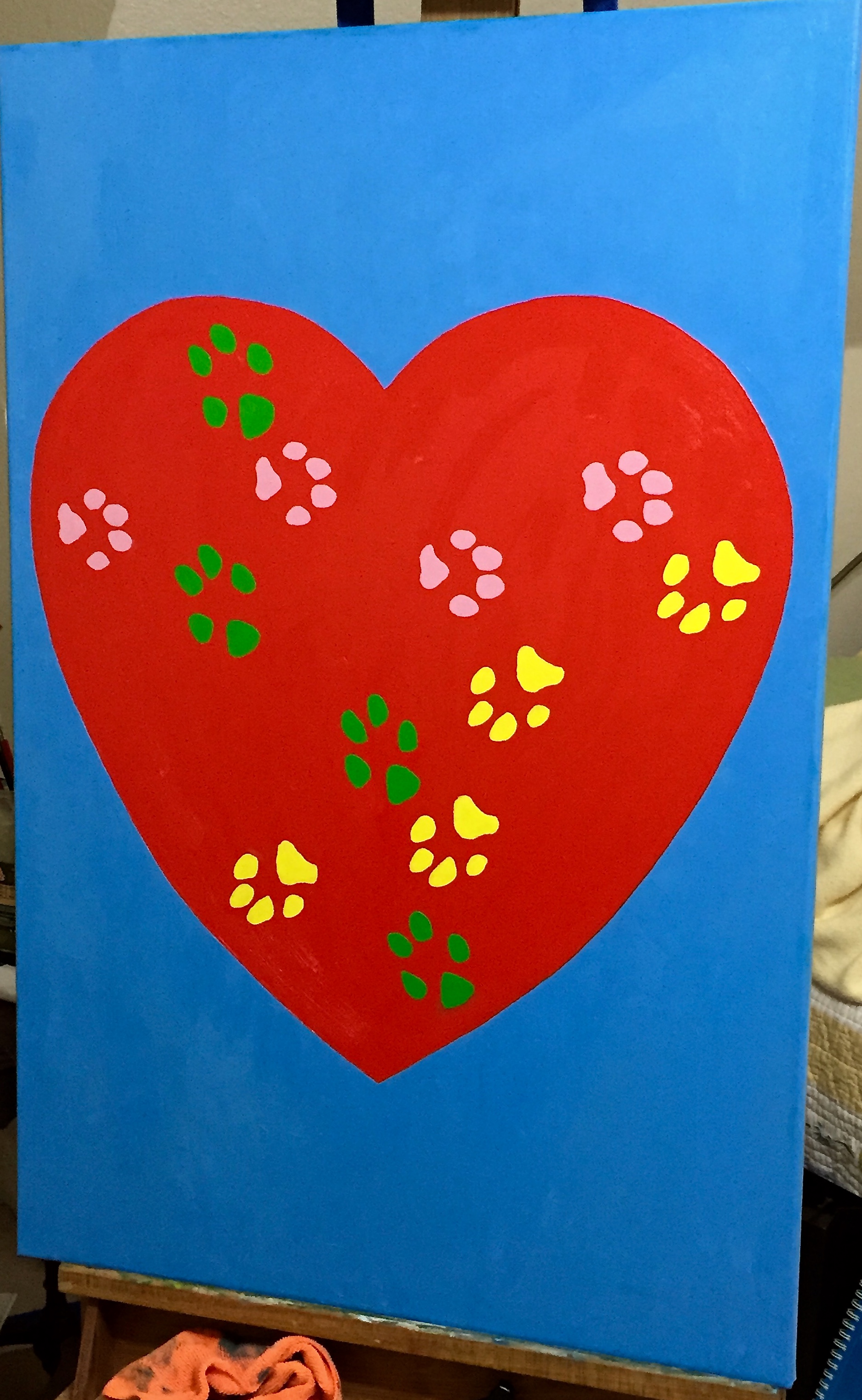
“Rescued” is done and hung on the wall downstairs in our powder room! This was my first “commissioned” piece, done for my wife who wanted something with a lot of saturated color and big! The design is entirely from her and the passion and love she has for rescuing dogs, of which we’ve had the pleasure of fostering 114… and counting. When my wife says “rescue”, she means literally rescued from the kill list at the Austin pound, not “rescue” from a pet store (don’t do it… just adds to the breeding problem), and these dogs are often in really bad shape – parasites, detached intestinal walls, starvation, neglect, flea infestations, ticks, kennel cough, Parvo and more.  But she nurses them back to health, even waking at all hours of the night to feed them meds every couple of hours, and finds each one of them loving homes. She is amazing!

She also had the primary design in mind, of which you see in the picture – a large heart with the paw prints of our 3 dogs (yes, rescues all of them) on it. We had a lot of fun collaborating on the details, although she would say there was some stress involved in figuring out the right colors for each dog’s prints, which ended up as follows:

  • Pink – Crash, female, age 13
  • Green – Boom, male, age 12
  • Yellow – Zip, female, age 3

The process for getting the dog’s paw prints on the painting is worthy of a separate post, so I’ll pause here today and give an update on that entertaining adventure in my next update.

Tech details of the painting for those interested:

  • Canvass, 24″x36″
  • Colors were almost straight out of the tube, but had to make some small tweaks:
    • Blue background – Titanium White + a small amount of Pthalo Blue + tiny bit of Orange.
    • Red heart – Cad red medium
    • Green paws – Permanent Green Light + Titanium White
    • Yellow paws – Lemon Yellow + Titanium White
    • Pink paws – Titanium White + small amount of Alzarin Crimson
  • I added the Titanium White in heavier doses with the yellow and pink paws because it helps add opacity to those more transparent colors. Sitting atop the red heart it was helpful to cut back on the bleed through.

For the dog rescue lovers out there, the group we work with, Austin Pets Alive, is fantastic and is by far the most influential and impactful rescue group in Austin, perhaps all of central Texas. If you want to learn more, check them out.

French Countryside Loire Valley – Practice sessions continue on 2 fronts

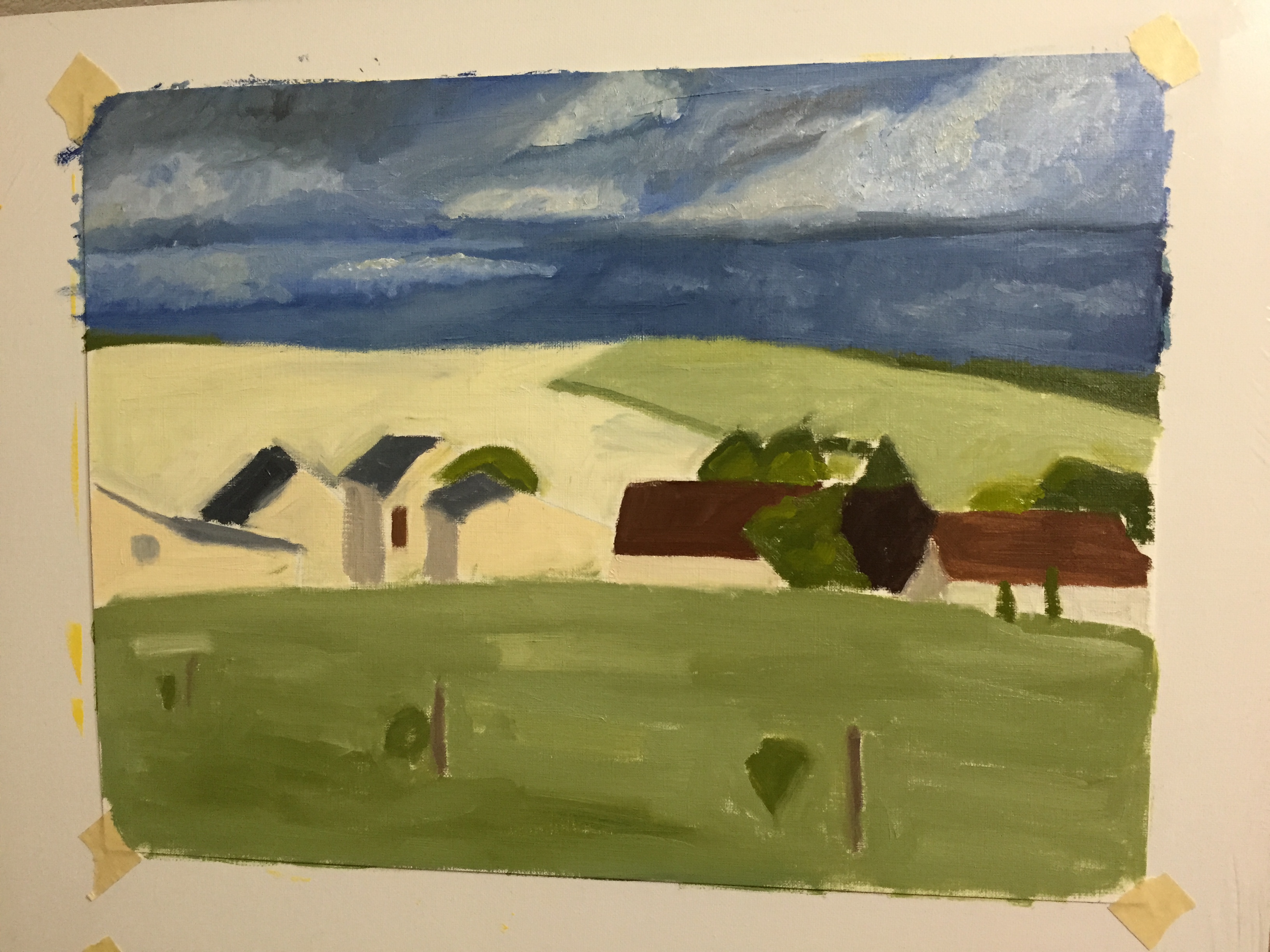
More progress this weekend on the practice sessions for the Loire Valley countryside piece. Added the first pass at details to the sky on the oil on paper. I’ve done clouds in graphite before, but never detailed painting. Learned a lot about what not to do, most notably trying to be too precise and layered paint to thickly. Need to go with looser brush strokes and thinner paint, I think. Advice is welcome, so comment if you have some helpful guidance please.

The second pic below is a practice session on my iPad. Still getting the hang of the Paper 53 app tools, but it’s been very helpful in drafting possible compositional elements that I wouldn’t otherwise have taken the time to do with paint. It’s very limited when compared to real painting and drawing, but it’s an invaluable drafting tool for layout and testing ideas.

IMG_3617 IMG_0002

Going Big!

Started a new project this past week. I won’t reveal the final design details, but suffice to say its going to be very different from anything I’ve done so far in many ways:

  • No reference photo: Instead it’s inspired by my wife, who is the source of this great idea, and it’s something very personal for both of us. While I don’t have the convenience of a picture to look at whenever I need guidance, I get to collaborate with her and evolve the idea together as it comes out of her imagination.
  • This is BIG! At least for me. This is going to be twice the size of any work I’ve done in the past – 24″ x 36″.
  • The technical challenges are very different, too. At first I thought it would be much easier because I’m using mostly just 2 colors, but neither are straight from the tube, which means the need to mix enough volume to cover the entire area is something of a challenge, which I didn’t realize until I was already running out of the first batch. You really have to mix a large volume up front so the area is covered in a contiguous hue, or else it will look uneven, i.e. the top half will look darker, lighter, duller, etc than the bottom half. In a landscape painting, even a large piece, you can get away without worrying about slight variations because you use it around the entire piece to create depth and texture to the objects, but this is a modern piece that needs continuity (at least for part of it.. hint hint of what’s to come) throughout.
  • The other technical challenge is doing the large heart shape freehand. I didn’t use a stencil, and actually took some time to create a demo piece on a much smaller scale to get the proportions and shape aligned with what my wife wanted. Then it was a matter of dusting off some high school math on ratios to translate to the larger format, i.e. the 10″ x 11″ heart is what dimension on the 24″x36″ canvas? Patience on the drawing front paid off.

The photos below show the staging and completion of stage 1. I promise you, stage 2 and the challenges involved will be very exciting, so stay tuned for updates in the coming week.

IMG_3528 Reference drawing/painting. This was used to get the palette choices figured out and the proportions and shape of the heart established. The original idea was red on yellow, but all we could see was McDonalds, which led to a lot of laughter as we tested out new background options. The baby blue was final decision. The heart is cadmium red + a little white + a little permanent green light. The blue is Titanium White + a little Pthalo Blue. Looks greenish on this test piece b/c the yellow was bleeding through.

IMG_3530

This is what 24×36 looks like on my easel. It dwarfs the pieces stacked up on the floor – still dealing with renovation messes, so all the art isn’t back up on our walls yet.

IMG_3531

Transferred to the canvass, the red heart is looking great!

Finished with Phase 1 after getting the blue background slathered on. Getting the line crisp along such a large object made my shoulder ache, but it was great practice for painting adjacent wet paints. No easy feat, especially with the curvatures of the heart. I had to rotate it around the easel many times to get the right painting angle.

The color combination in real life is a little less saturated, but it works really well together. Hats off to my wife for making the palette call on this one. I wouldn’t have thought to go with such bright hues, but it works really well. Finally, the picture doesn’t show the texture contrasts – I used a palate knife for the blue area and brush for the heart. More on that later.

IMG_3533

Red Vase in Cellophane: DONE

IMG_3083

Did a pivot back to the “canvas” today, so Daily Sketch continues tomorrow.

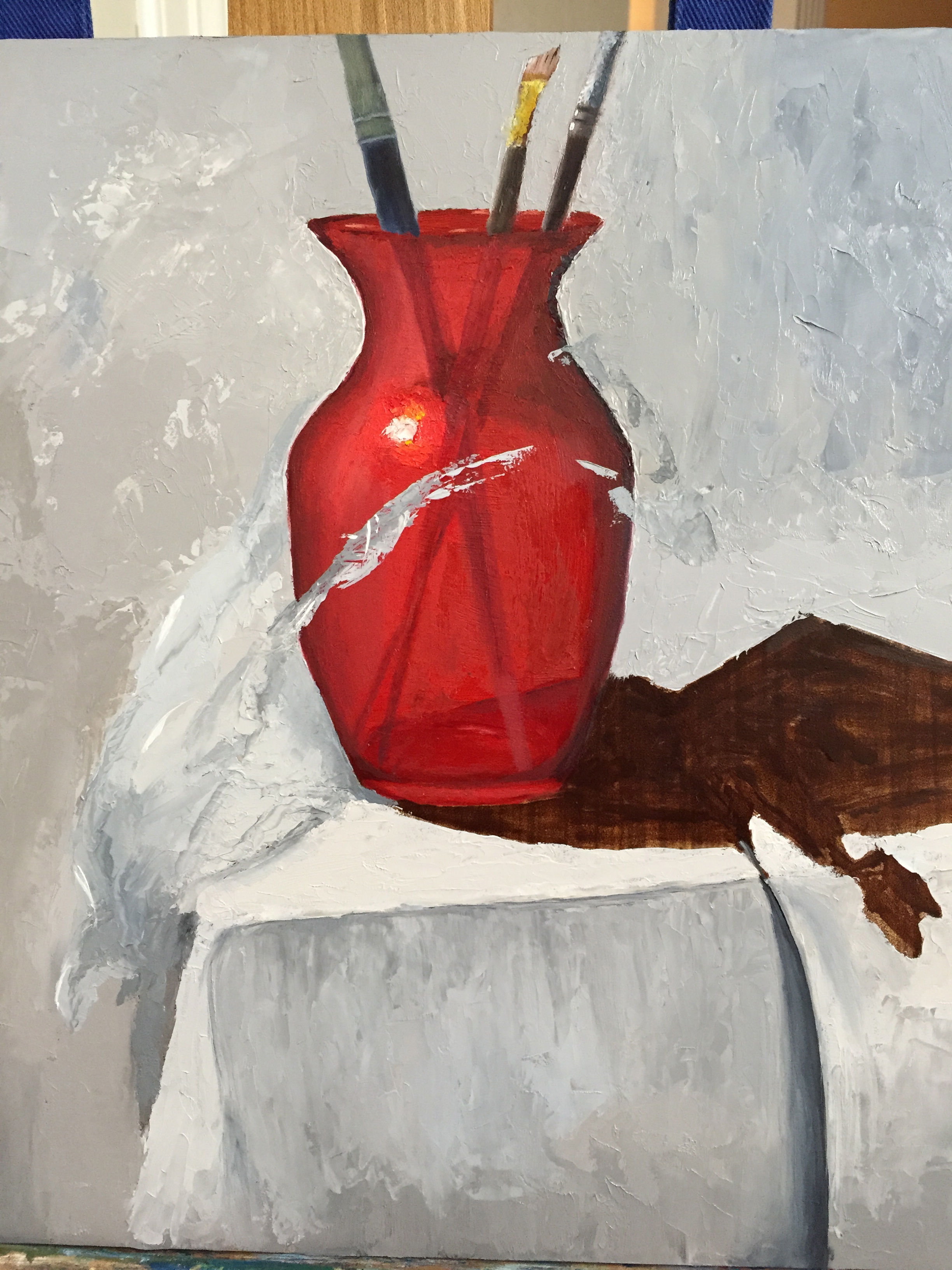
I returned to the challenge of the cellophane wrapped vase, having run into numerous problems that I just couldn’t figure out. But after some time to think through why the cellophane just didn’t look right, I came up with 3 primary issues to fix:

  1. Too many highlights. The painting looked like it had run into a bird poop tornado! Luckily I had learned how to remove these with a painting knife from the Cheifetz workshop last month; added some pics of the removal of one of the offending highlights.
  2. The highlights were to rounded. The cellophane highlights should be at hard angles which helps give the sense of stiff shapes, as opposed to softer material like fabrics.
  3. The values were wrong. Needed warmer grays on the light source side (left) and a wider range of lights.

In the end, I’m pleased with the results given it was a first effort with this somewhat complicated medium. Next time I will make sure the wrapping of the still life object is done with more purpose and in tighter bunches. This composition was poorly designed on my part. The cellophane was a loose gathering on the left side and lacked enough tight fitting accents, which would have made it easier to interpret.

Light pressure on knife…
IMG_3081
… and the highlight slides right off!

Red Vase and Cellophane – Update

I’m probably just dodging the real challenge of wrapping my pretty vase in saran wrap, which essentially may ruin the piece, but at least I had the pleasure of completing my first white linen table cloth top and folds. Painting the palette knife (with a palette knife) was a little difficult with the gold/brass colors where the wood handle meets the metal neck, but it’s close enough given it’s not the focal point of the work. I also kept it a little soft so as to not draw too much of the composition’s attention. Also got some of the red of the vase in the cast shadow by simply working wet alizarin into the cast shadow darks – pure, dumb luck. Did all of this work with a palette knife, which is becoming an addictive tool.

Next session will tackle the cellophane challenge head-on. But for now I’m happy with the supporting cast.

IMG_3067

Red Vase and Cellophane – Update

With a few deep breaths, and some tasty wine for liquid courage, I dove into the cellophane stage of this composition. I carved out a little more than an hour tonight to get the ball rolling. I was pleasantly surprised with the progress, but I will admit that my inner artist was struggling with laying gray tones on top of the pretty red vase in the name of cellophane.

It was rough going initially b/c there weren’t enough value contrasts between the white table cloth and the wide range of cellophane grays and cast shadows. Then I remembered the advice from David Cheifetz during his workshop a couple weeks ago – “Value is king! A painting with the right values but wrong colors will still look pretty good.” I’m not about to put that on a tshirt or a bumper sticker, but its great guidance. I stepped away from what seemed like the right dark and light grays and made both ends of the spectrum more extreme, darker grays and lighter grays. It seems to have worked so far.

The real power of the cellophane image won’t really come together until the grays are laid in properly and then the bright, white highlights are added on top. That’s what gives the cellophane it’s shape and texture. I’m still not entirely convinced this will look like the real thing when I’m done, but stepping back from this first stab at it, I was able to see the shape of the cellophane starting to come together. The key is going to be establishing that clingy sensation with the highlights. Fingers crossed…

[The grays of the cellophane are primarily 2 setups: Ultramarine blue + burnt umber + white OR white + ivory black. I’ll probably add a 3rd option for the cooler side of the cellophane (right side, away from the light source) of UB+raw umber+white. ]

IMG_3064

Workshop Day 2 – knives aren’t just for cooking, slicing, and stabbing!

Another great day at the workshop. We did a lot more painting today, but things started off with an hour of David doing a demo. He picked up where he had left his painting off from yesterday. Very interesting as he demonstrated more technique and color strategies for the support cast of objects. I learned another volume of painting secrets, well secret to me at least, and was able to apply many things immediately to my painting later in the day. Watching David create one of his signature compositions before my very eyes was worth the price of the workshop alone.

David doing a demo  to start off day 2.

We spent more time working on our paintings today than the first day. I spent a lot of time working slowly and carefully with the painting knife, never picked up a brush today. After 5 hours of painting I started to get much more comfortable with the painting knife, getting a feel for how to manipulate the paint on the surface of the board, as well as gaining more comfort in knowing where the paint was on the knife and where it needed to be on the knife for tricky angles.

David continued to work the room constantly during our workshop today. I spent numerous sessions of 1on1 time with him as we worked through some of the challenges in my painting, of which there are many. He told me that I was tackling a very difficult subject on many fronts – the water pitcher is hard to do b/c it’s reflective, has a wide range of values, the shape is tricky, and the coloring is far from straightforward. No better time to dance out of my comfort range and skill level. Needless to say, David was willing to demonstrate solutions to me directly on my painting.

David Helping

The lighting in the studio is great for our painting work, but it’s awful for taking pictures of the work. I’ve posted my progress below, but will try to get a better shot tomorrow with some decent lighting. It has a long way to go, but I’ve already learned so much that it’s hard to believe it’s only been 2 days.

Progress and Layout Progress 1

Day 3 we shift gears to a new composition, so I’ll have to finish my first knife painting back home later this month.

Giverny Update

Spent a few more hours on the sea of green. Since the last post, I’ve worked on the back of the landscape, working in more dark tones to get things pushed backwards. But the bulk of time was spent on the large grouping of ferns on the left bank, and the bright pink flowers that are the focal point. Also added some life to the darkest part of the stream and the long grass hanging over it.

Prior to these past two sessions, I spent a little time experimenting with color mixing to get a wide array of greens. Greens are tricky, in my opinion, because there are so many subtle differences, even in the most innocuous of landscapes. It’s also takes some time to control the saturation values properly so the tone of the entire composition is consistent, which seems harder to do with a natural landscape full of green plants.

Next up is the stream, which is really out of whack in the current state, but I don’t think it will take a lot to get it firmed up.

IMG_2863