Yellow Ball with Tails

Yellow Ball with Tails
Oil on canvas board, 6″x8″
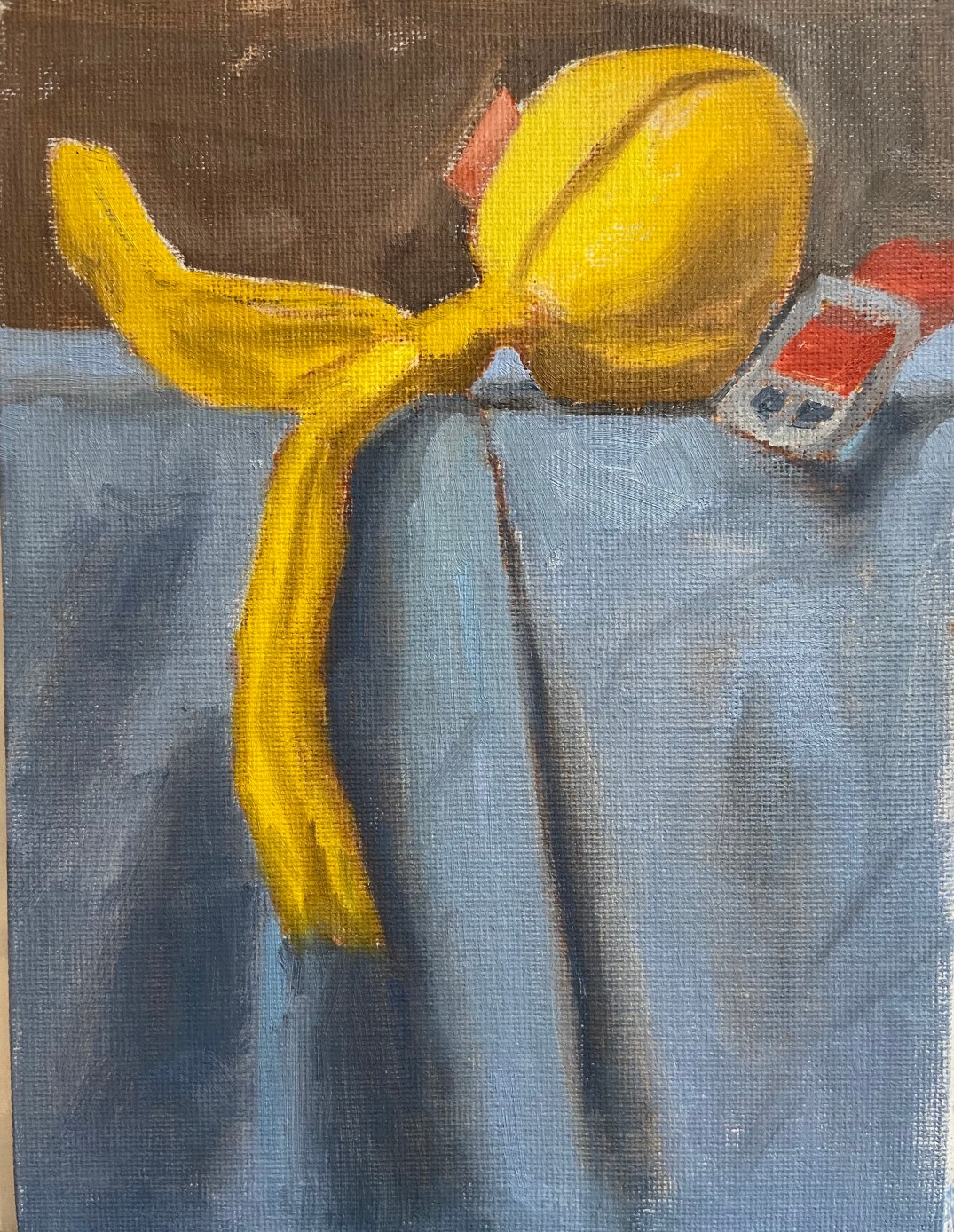
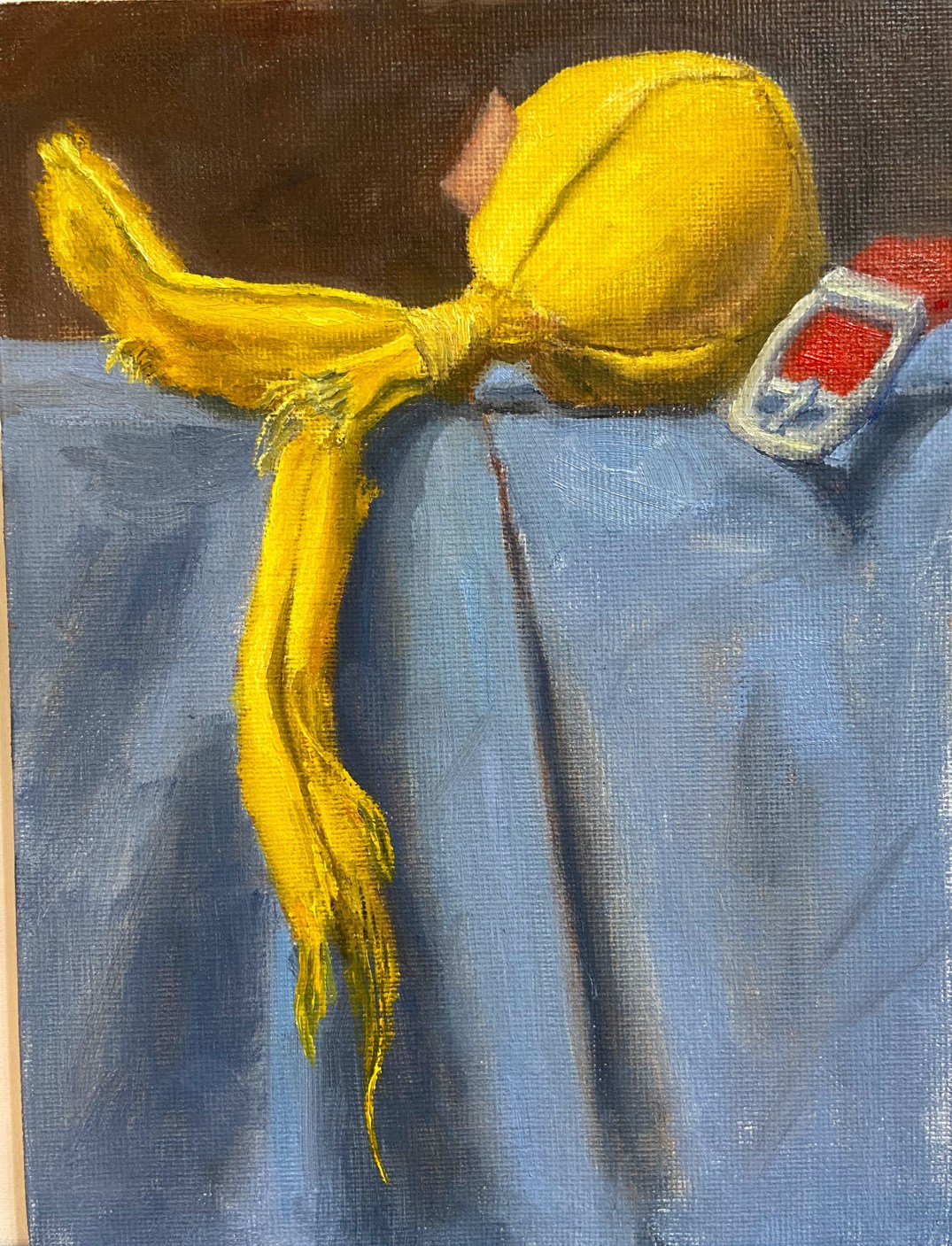
Sometimes you just know a composition is going to work, virtually able to paint itself. Yellow Ball with Tailswas exactly that kind of composition. Wolfgang and Zip loved this toy because the 2 tails made it tug-a-licious! As the designated thrower, I liked it because the ball made it easy to throw without getting dog slime all over my fingers.  Ultimately, this toy stayed inside and lasted about 20 play sessions before parts started to get ripped off and chewed up.
I’ve recently made some adjustments to my still life setup, changing the platform so it’s higher and is at sitting eye level. This gives a new angle that’s easier for me to translate to the canvas.
This piece moved quickly and was done in a couple of sessions this week. As I stated earlier, this composition looked great from the start and I knew it was going to be a fun project when I saw all that bright yellow shredding dangling against that blue background. Definitely going to spend more time on compositional arrangement with future dog toy paintings.
The canvas board was ideal for this type of toy because it has a lot of toothy texture, which easily lends itself to the toy’s material. The only thing I don’t like about a canvas board for this type of piece is the fine detail of the threads. The canvas texture makes it very hard to paint a thin line, so I often had to do some back and forth with the darker background color to get the thread lines just right, basically painting back into the yellow thread line to reduce the width.
There’s a lot of yellow in this piece, and I did some experimentation:
  • Deep Yellow + Titanium White as the base for the mid-range yellows. Added Ultramarine Blue and Cadmium Red Light in small doses for the shadows on the ball. 
  • Cadmium Lemon + Titanium White for the lighter areas. 
  • Indian Yellow, which I don’t typically use often, here and there to vary the lighting along some of the longer sections of the tails. 

The blue cloth was Ultramarine Blue and TW with variations of green made from Cad Yellow Deep and Cad Red Light. 

 
Originally, I had included the tag on the toy, but once the piece was 90% done the tag looked too distracting and didn’t add a lot of value, so I took it out. 
 
For those interested in the toy itself, it came from BarkBox, a monthly dog toy subscription service. Our dogs destroy toys, much to my artistic delight, so BarkBox has had to adjust what they send us to try and find toys that are good for tugging but also very durable.  Supervised play is the best solution for our fur balls because once they’re done tugging, it turns into keep away, which devolves into a game of “I’m going to eat this so you can’t have it”. Somewhere between keep away and vindictive chewing is when I like to step in and save the toy. If I was going to rate this toy, it would go something like this (1-10 scale):
  • Tugability 8 – withstood some strong tug sessions between my large dogs (Zip 50 lbs, Wolfy 85 lbs )
  • Durability 6 – hard for a canvas toy to rate higher than a 7, so this is pretty good
  • Versatility 8 – this could have easily been used inside or outside, both for fetch or tug. 
  • OVERALL 7
Yellow Ball with Tails - Dogs
Zip and Wolfgang – Dog Artists
Yellow Tail Ball - ref photo
Reference photo – Yellow Ball with Tails
Yellow Tail Ball block in
Block in of dog toy
Yellow Tail Ball 1
Started with the yellows
Yellow Tail Ball 2
First paint draft done
Yellow Tail Ball 3
Working details
Yellow Tail Ball 4
Fine details of shredded threads
Yellow Tail Ball Final
Finished Yellow Ball with Tails dog toy

Zip’s Flowers

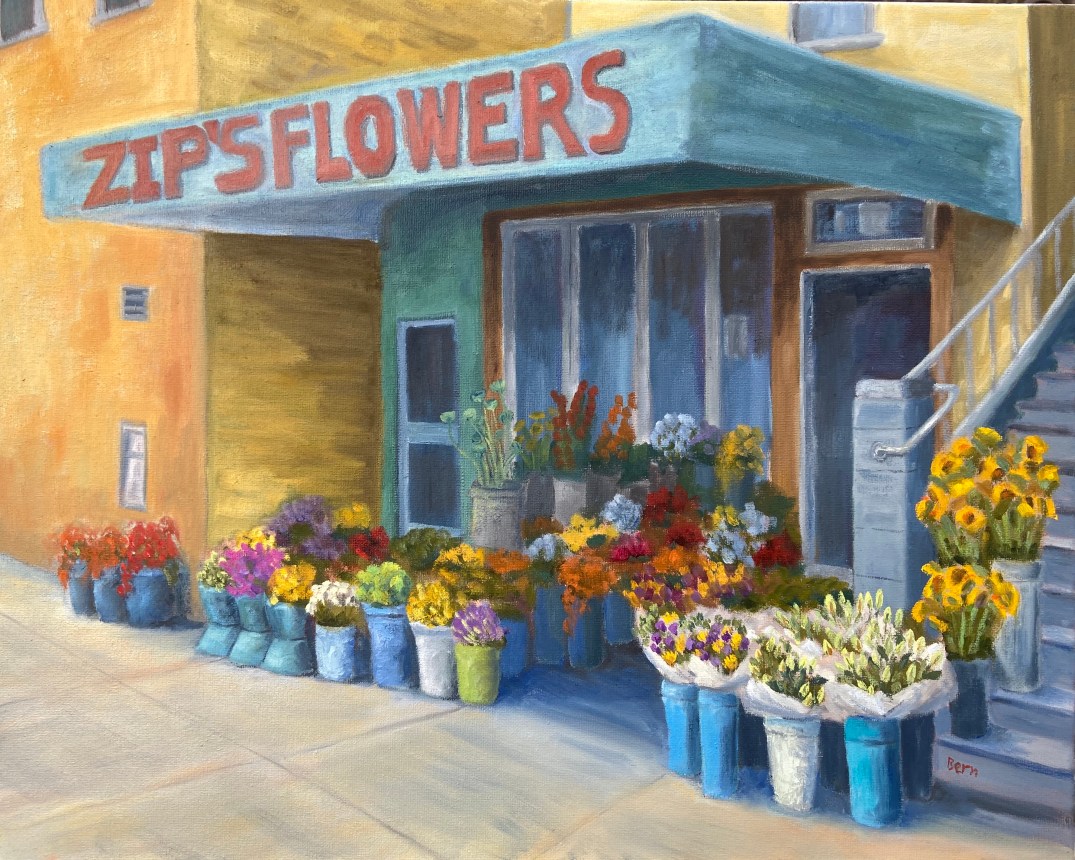
Zip’s Flowers: 20″x16″, oil on canvass

Sometimes art is very cathartic, but at times it can be maddening. However, I’ve learned over the years to rethink the frustration and consider those pull-my-hair-out-of-my-head moments as learning experiences, and more often than not it works. When I just can’t get a piece to work, either compositionally or from a technical skills perspective, if I focus on what I need to learn to fix it rather than become irritated at my shortcomings, I tend to get back that Zen painting zone.

Zip’s Flowers has been a long learning experience! Wars have taken less time to finish. That said, it’s chock full of newly acquired knowledge, of which I’m very excited about. There’s also some personal interest in terms of the background of this photo. This flower shop is a few blocks down the street from where I lived one summer in San Francisco. We lived in a great neighborhood along the border of the Mission and Castro districts, on 18th between Hartford and Noe. This flower shop, now called Urban Flowers, was along the way to the dog park. My wife would take the dogs at least once a day to the dog park. One day, the 1 year old puppy, Zip, decided smelling the flowers was no longer satisfying, so she opted to taste them. As the story goes, she reached out and grabbed a dangling flower from one of the pots and proceeded to knock the whole thing over! I wasn’t there, but my wife said the people at the shop were very friendly and weren’t concerned about Zip’s flower chomping. Of course I had to see this for myself, and a few days later I was walking Zip past this flower shop and sure enough, she tried to gobble down a basket of roses as we walked by.

The composition itself was probably the hardest hurdle to overcome, which I took license to adjust reality to make things work. The reference photo shows a wide variation of building colors and construction materials, so some adjustments had to be made on various fronts to make it look less contrived – ironically, the reality in the photo was too hard to believe in a painting. The values also had to be exaggerated to give depth and a sense of place, whereas the photo was very flat. Finally, the amount of tissue papered flowers was overwhelming and a bit distracting, so that was scaled back significantly.

My favorite part of this painting is the right foreground. First, the flowers in white paper came out much better than I had anticipated and they really frame that side of the painting. I also like the realism they add to the scene. Secondly, I’m very happy with the tall yellow sunflowers going up the stairs. These two elements combine to draw the viewer into the painting (hopefully) and consider wandering through the rest of the composition.

The sheer multitude of color is initially distracting for me, but once I stepped away from it for a day and returned to the completed piece, the colors were more welcoming and a source of excitement.

Do you like this piece? I’m guessing people either love it or hate it, given the colors and somewhat busy nature of the scene. Suggestions and observations are welcome.

Ball! Ball! Ball!

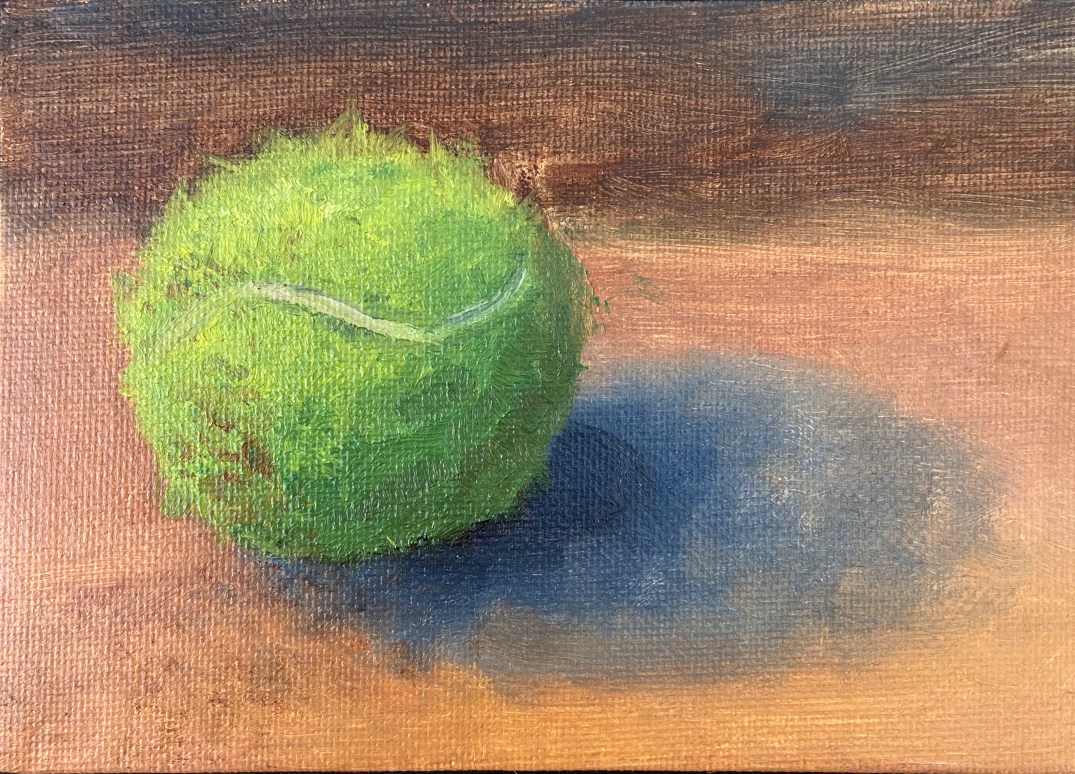
Oil on canvass panel, 6″x4″
My dogs are a big part of my life, which means I live to serve their needs, in large part because I love them and, well, they don’t have thumbs. My oldest dog, Zip, is a 7 year old Aussie Catahoula rescue mutt from Austin Pets Alive!. Her world revolves around two things – food and “ball”. To that end, I serve as her chef and throwing machine.
The lifespan of a Zip tennis ball is a couple weeks. She chews on them while bringing the ball back for another throw, as if they’ve offended her and need to be destroyed. It’s the epitome of a love hate relationship.
This piece is a tennis ball after 1 throwing session. The fuzz and color have been adequately altered, making what had been a boring, new green smooth tennis ball into something with depth and intrigue. Thank you Zip!
I like to do these small dog toy pieces on a canvass board to help with texture. In this piece, it was very helpful with the need to pull out strands of tennis ball fuzz because the rough surface helped scatter the stringy look in a random pattern, thus making it look more natural. The hardest part was getting the dirt just right, which took some experimentation with Burnt Sienna, Raw Umber, and various puddles of orange.
Finally, I was pleasantly surprised how effective the white line of the tennis ball added realism. It was also important to put a small hint of shadow along the edge of the white line to give just enough depth on the surface of all that green fuzz.
Tennis Ball - Oil Panel 2

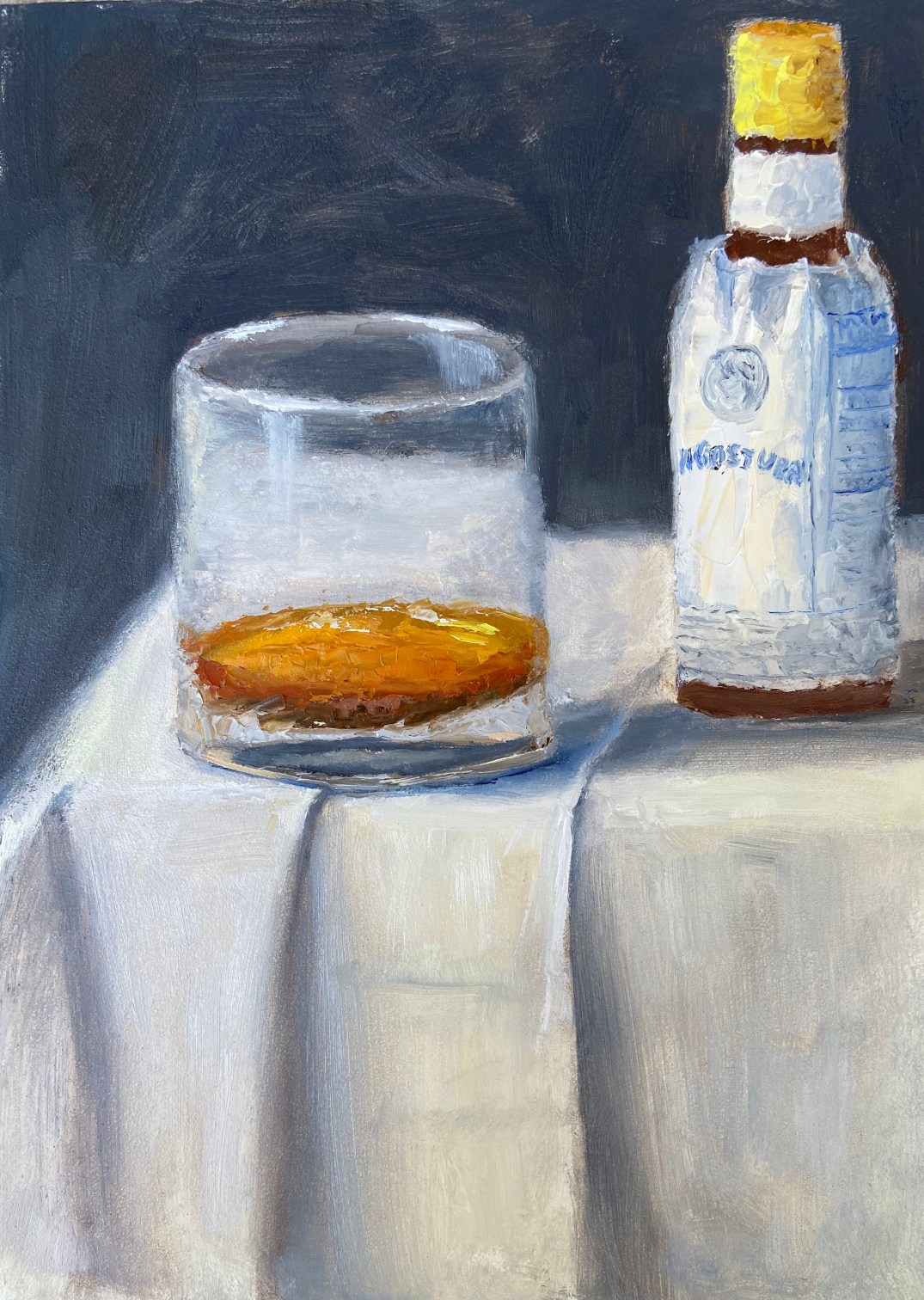
Happy Hour – Angostura

As the saying goes, “It’s happy hour somewhere in the world”, but seeing as it’s 10am here in Austin, a post about cocktails is about all I can muster.

HH Agostura 20200108
“Happy Hour – Angostura”

This is a small piece, oil on board, 5″x7″. This is the first in a series I’m going to do over the course of this year called “Happy Hour”. I’m always trying to think of ways to make art creative and engaging, which can be done in a number of ways. Instructors and workshops will often stress composition and technical prowess, which is very important, but I consider that table stakes. What’s often missing is intrigue, of which I’m plenty guilty of excluding in my works. To get the interest piqued with the Happy Hour series, I’m not going to reveal the specific cocktail in the name of the piece or initial blog post. The intrigue is for the viewer to figure it out based on bartender savvy hints.

Take this initial piece, “Angostura”, which is very simple in terms of composition. What do you consider valid and helpful hints in the painting? When putting this together, I wanted to provide 3 hints that a savvy bartender – professional or simply someone like me with a well stocked bar at home – would be able to use to identify the drink. In this case, those hints are some, but not all of the ingredients, color of the cocktail, and glassware. Can you figure it out?

If you want some help, PUNCH is a fantastic libation focused publication that is a notch above pretty much everything else out there, at least as far as I’ve been able to find. Once you crack the mystery of “Angostura” (hint: think simplicity… I’m not being clever with this one), dive into PUNCH and see what I mean about great cocktail insights.

Maybe 2020 should be the year of artistic intrigue?

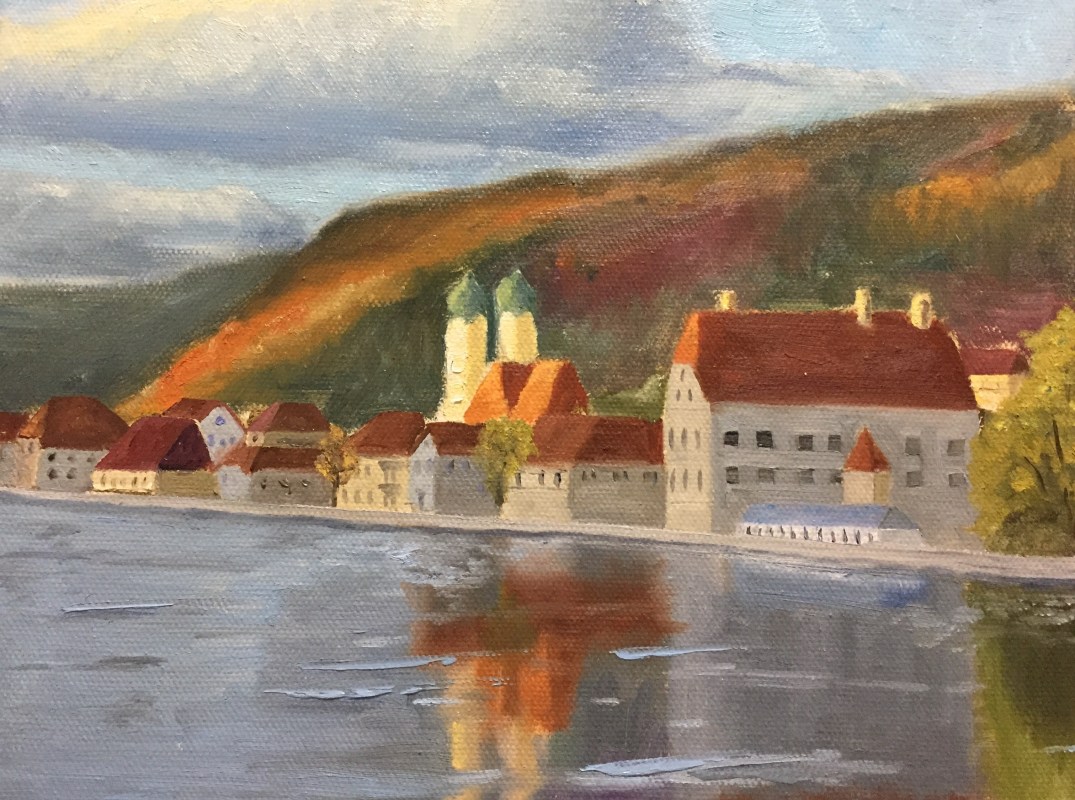
Danube River Village

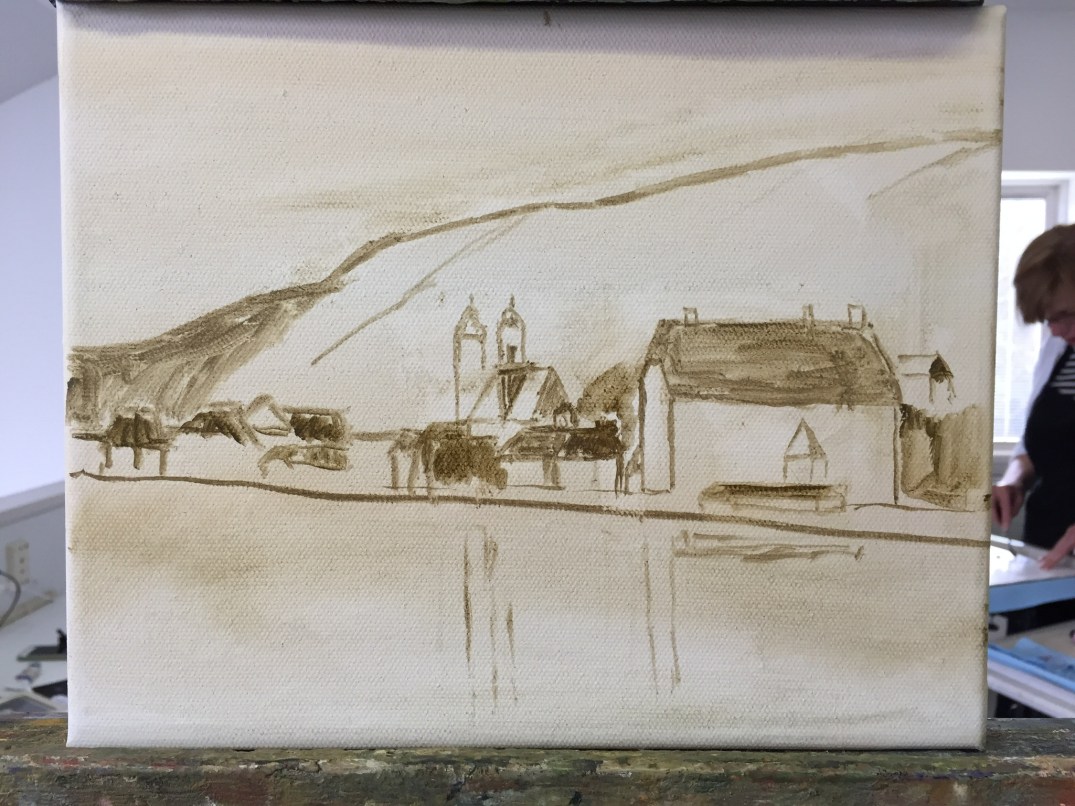
New project today from a photo along the Danube. My wife and I were visiting the Christmas Markets this past year, mostly in Austria and Germany. They were fantastic! Along the river these idyllic scenes were commonplace. We had ridden bikes along the river the day before and visited this church.

img_0192img_0044img_0043

Smaller canvas this time around. Working on loose and colorful, with very strong contrast in values where the late day light is hitting the tops of the buildings. This post is about 3 hrs of work. Moved a little slow at the start to get the sketch right. Usually I draw the subject before trying to paint it, but opted to jump right in this time.

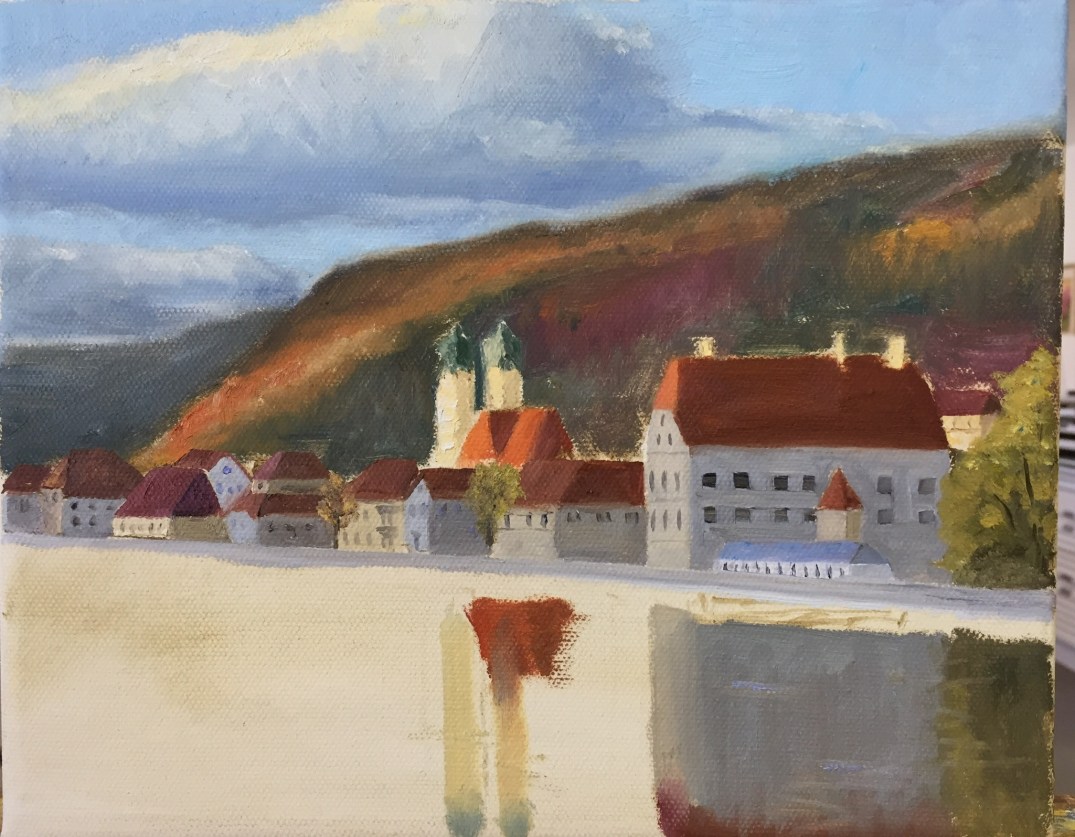
Updated progress: Couple of hours working on the detailed village. Getting the proportions and values in the shaded areas took patience, but very rewarding. One more session focused on the water reflections should get us most of the way there.

img_0046

Forgot to add the finished painting from a few months ago. I like how this turned out but need to practice with more river landscapes.

IMG_5766

Yosemite – El Capitan

Started a new project this week, El Capitan in Yosemite National Park. This is a massive wall of rock that is a marvel to see in person. I haven’t been able to find them on the photo, but there are a number of climbers on the wall. If I hadn’t taken the picture myself I wouldn’t believe it either.

This composition is actually a study to get some key aspects of the hues and values figured out prior to doing a much larger piece. This particular effort is being done on a 12×18 canvass board, all oils, using palette knife only.

Figuring out the variations of grays, both sunlit and shaded, is proving to be an enjoyable challenge. This is a great way to really learn the subtleties of warm and cool grays.

Another session or two and this preliminary piece should be done. Still need to get the right half of the shadow area done, but it’s moving along at a faster clip now that the value scale has finally been figured out. There’s more paint on this piece than I’d like to admit.


Heceta Head Lighthouse

This was a fun one! This is Heceta Head Lighthouse on the Oregon Coast. Breathtaking coastline and this area is particularly rugged and beautiful. One day I’ll replicate this painting en plein air, but for this iteration I had to use a reference photo. At least the photo was taken by myself, so I had a sense for the place; hoping some of that personal experience made it into the final work.

This piece is on 12″x18″ gesso panel and took about 8 hours to complete. While I still have a couple of minor highlights to add, this is close enough to the final product to call it done. I have never painted ocean, so the waves were a challenge, but I’ve started taking some lessons with a new instructor for a few hours every other week, and she was a tremendous guide when I ran into problems. If you like landscapes, check out her work at Mary Watkins Fine Art.

The palette is what I’m most excited about with this piece. While there’s a lot of (for me) technical skills that come into play with the water/waves/rocks, it’s the hues that I’m most excited about. Mary was very instrumental in teaching me about landscape warming and cooling using hues I hadn’t considered. Previously I had thought in terms of strict color wheel compliments to adjust saturation, but I learned how to think through the balance of what makes up colors that trend towards one end of the spectrum or another. For example, the use of Lemon Yellow, Cad Yellow Medium, or Yellow Ochre was actually a critical decision for this entire piece. Can you guess the winner and why?

Reference photo and progression timeline below. Enjoy!


Lamar Bridge into Austin

Getting close to finishing this Austin urban landscape piece. The view is from the south across the river towards downtown. The city has grown a lot since this photo was taken, so those familiar with the area might wonder why I excluded some buildings; not the case, they just weren’t there a few years ago.

Oil on gesso board, mostly brush work, done in studio with photo reference (included below). The bridge was tricky, despite having done a couple of practice drawings. It’s been an exercise in patience, having to redo various parts, but it’s been a great “learner” piece, specifically with the sky and water. I’ve started taking some formal art lessons every other week, and my teacher gave some great guidance with the sky and the water reflections. Confidence with these elements is 10x what it was a month ago. Not sure if it comes through in the photos, but the colors are rich, probably a tad too saturated, but the values and reflections are solid enough to carry the composition.

The bridge needs some tweaks to the facade so it’s not so flat, the addition of cars on the road, and a few street lights. At that point I’ll call it done. One more short session should do the trick. I’ll post the final product this coming weekend.


Diving Whale Tail

Stuck with the whale theme for this next project. This is a diving whale based loosely on a reference photo I found on-line. Also bought some Payne’s Gray to work on a more balanced value gradation on this piece that is dominated by the tail.

I think this is pretty close to done, but I don’t like the matte finish, so I’m going to do a final glaze layer in hopes of giving the entire piece a wet look.

This is a diptych, each panel measures 9″ x 12″. I was pretty specific with the panel choice so as to get good proportions for the tail. In fact, I think the painting looks better than it really is b/c of the diptych layout. Curious what others think, too.

Technical Details:

  • 2 gesso panel boards, 9″x12″ each
  • Brushes – 2 flats (sizes 2 and 4), 1 round (size 4)
  • Tail palette – Payne’s Gray, Titanium White, and variations of Black and Ultramarine Blue
  • Ocean – Ultramarine Blue + variations of Pthalo Blue, Pthalo Green, and Titanium White.
  • Water dripping off tail – Titanium White + Naples Yellow + Paynes Gray + Ultramarine Blue
Quick practice sketch.
Rough in with diptych composition.
Ocean with initial tail shadow.
Tail almost done
Tail almost done
Water running off tail and updates to ocean near tail with ripples.

French Countryside – Practice Study Done

Got back to the first painting study of the French Countryside (Loire Valley) landscape. Been awhile since I had worked on this one, but past post for reference here.

I liked how this came out, and ended up investing more time than originally planned. I definitely learned a lot about how I will change the composition when I do the “real” thing on a larger canvass (as opposed to this paper session), but enjoyed working in a  lose style and worked very hard on not sweating the details.

IMG_3669

I was pleased with a number of things:

  • Good balance of greens. The photo doesn’t show it very well, but the range of values also gives texture that I didn’t intend initially, but you can bet I won’t forget how it came together.
  • Dark rain clouds in the far distance have the right effect of coming storm.
  • Rose bushes, a complete improvisation, came out really well, especially given the speed at which they were done, ~ 15 minutes. I also find the red on green background works well to make them pop a little, giving them a good foreground effect to draw the viewer into the painting.
  • The fence line, meant to be wire strung along old wooden posts, can be painted better in a future composition, but I’m happy with how the variation in direction of the fence gives the sense of an undulating field. Also meant to direct the eye along the fence, across the field, and into the village and beyond. Not sure if that’s actually happening for viewers, but happy to be told I’m way off base here.
  • Trees have good depth and capture the direction of the sunlight well.
  • Clothes line, another improvisation, serves it’s primary purpose of giving a sense of wind from the approaching storm, as well as a nice focal point in the center of the composition.

What to do differently next time:

  • The village buildings are not well done. I wanted them to be muted, but I lost focus on them too much and the value variations between them are junk. For me, there are buildings further back in reality that appear to be too far forward. I also don’t like the roofs, which need to have a wider range of colors.
  • The green field in the distance is too saturated and a little too light. Need to push that back a little next time.
  • The clothes line is good, but can be improved. Wanted to add a person pulling down the clothes, but quickly learned that I don’t have that skill yet.
  • The clouds are awful. Need to practice in some other sessions, but globbed on paint too thickly and focused too much on the cloud shapes.